
Every software development team faces a familiar tension. On one side, there is the demand for new features, user stories, and visible product improvements. On the other, the invisible accumulation of technical debt that threatens long-term stability. Navigating this balance is not about choosing one over the other; it is about understanding the ecosystem of delivery. When teams ignore technical debt, velocity slows down. When they ignore features, the product loses market relevance. Finding the equilibrium requires intentional planning, clear communication, and a structured approach to capacity allocation.
This guide explores how to integrate technical debt reduction directly into your planning processes without sacrificing the delivery of business value. We will look at practical strategies, prioritization frameworks, and communication techniques that help teams maintain a healthy codebase while keeping stakeholders satisfied.
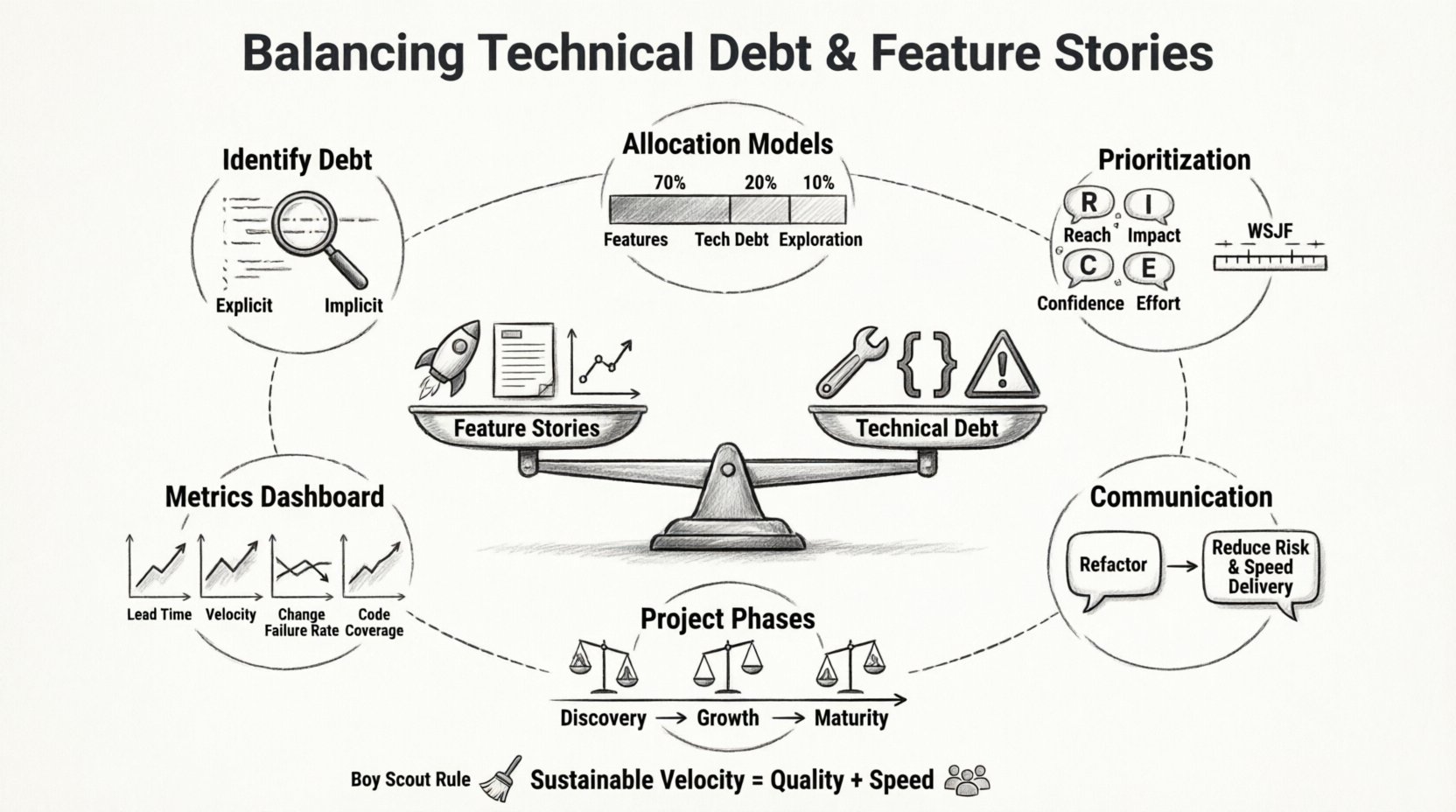
🧐 Understanding the Core Conflict
Technical debt is often misunderstood. It is not merely “bad code” or a sign of incompetence. It is a strategic choice made to deliver value faster in the short term, with the intention of paying it back later. However, that repayment often gets delayed indefinitely. When planning sprints or release cycles, the opportunity cost of paying down debt is high. Every story taken for debt reduction is a story not taken for a new feature.
Feature stories drive revenue, user engagement, and competitive advantage. They are the tangible outputs that justify the team’s existence. Technical debt, conversely, is preventative maintenance. It is like servicing a car engine to prevent breakdowns. You do not buy a car to service it, but you cannot drive it indefinitely without maintenance.
The conflict arises because feature stories are often prioritized by Product Owners or stakeholders who see immediate ROI. Technical debt reduction is an investment with a delayed and often abstract ROI. Without a structured approach, the feature stories will always win, and the debt will compound.
📋 Identifying Debt Within User Stories
The first step in balancing these competing interests is visibility. Technical debt often hides within user stories or emerges during the refinement process. To manage it effectively, teams must distinguish between explicit debt and implicit debt.
Explicit Debt: Known issues that have been documented. Examples include legacy code sections that need refactoring, outdated libraries that require updates, or known bugs that impact user experience.
Implicit Debt: Issues that are not yet known but are anticipated. This might include architectural decisions made during the initial sprint that limit future scalability, or the lack of automated tests in a new module.
During backlog refinement, the team should ask specific questions to uncover hidden debt:
Does this story require changes to the core architecture?
Will this implementation make future features harder to build?
Are we relying on workarounds that need to be replaced?
Is the test coverage sufficient for the proposed functionality?
By surfacing these concerns early, the team can decide whether to address the debt within the story itself or create a separate ticket for it. This prevents the “surprise” debt that appears mid-sprint and derails velocity.
📊 Allocation Models for Planning
Once debt is identified, the next challenge is capacity. How much of the team’s time should be dedicated to maintenance versus new development? There is no single magic number, but several models exist to guide this decision.
The 70-20-10 Rule
A common heuristic is to allocate capacity across three buckets:
70% Feature Development: The core work that drives the product forward.
20% Improvement & Optimization: Refactoring, performance tuning, and improving existing features.
10% Innovation & Debt Reduction: Tackling high-priority technical debt and exploring new technologies.
This model ensures that features remain the priority while guaranteeing a minimum allocation for health checks. It is flexible enough to adjust based on the current state of the codebase.
The Debt Interest Rate
Another approach treats technical debt like financial debt. Every unit of debt carries an “interest rate” in the form of reduced velocity or increased bug rates. If the interest rate is high, the team must allocate more capacity to pay it down. If the rate is low, they can focus more on features.
Teams can estimate this by tracking metrics such as:
Time spent fixing bugs related to specific modules.
Time taken to implement features in legacy sections of the code.
Frequency of deployment failures.
⚖️ Prioritization Frameworks
When deciding which technical debt items to address first, teams should apply the same prioritization frameworks used for features. This ensures that debt reduction is treated as a business value, not just a technical preference.
RICE Scoring
RICE stands for Reach, Impact, Confidence, and Effort. This framework helps quantify the value of a refactoring task.
Reach: How many users or developers will be affected by this change?
Impact: How much will this improve stability or velocity?
Confidence: How certain are we about these estimates?
Effort: How much time will this take?
By calculating a score, teams can compare a refactoring task against a feature story objectively.
WSJF (Weighted Shortest Job First)
Often used in larger agile environments, WSJF prioritizes tasks based on cost of delay. Technical debt often has a high cost of delay because it slows down every subsequent feature. If a specific architecture limits the ability to launch a critical feature quickly, that debt item becomes high priority under WSJF.
🗣️ Stakeholder Communication
One of the biggest hurdles in balancing debt and features is communication. Product Owners and business stakeholders may not understand why time is being spent on “invisible” work. To bridge this gap, the team must translate technical debt into business risk.
Translate to Business Terms
Instead of saying “we need to refactor the database schema,” try saying “we need to update the data structure to support the upcoming feature launch without downtime.”
Key communication points include:
Velocity Impact: Show data on how debt is slowing down feature delivery over time.
Risk Mitigation: Explain the risk of system outages or security vulnerabilities if debt is ignored.
Time-to-Market: Demonstrate how current debt extends the timeline for new features.
Visualizing the Trade-off
Use charts and graphs to show the trajectory. A simple line graph showing velocity declining over time as debt increases can be a powerful tool. It visualizes the compounding interest of technical debt. When stakeholders see that ignoring debt leads to slower releases, they are more likely to support allocation for maintenance.
🛠️ Integration into the Sprint Cycle
Planning for technical debt should not be a separate event. It must be integrated into the regular sprint cycle to ensure consistency.
Refinement Phase
During backlog refinement, the team should tag items as “Feature” or “Maintenance.” This allows for a clear view of the upcoming sprint composition. If the maintenance tag count is too high, the team can negotiate with the Product Owner to reduce the feature load.
Sprint Planning
When committing to work, reserve a specific portion of capacity. Do not fill 100% of the sprint with feature stories. Leave a buffer for unforeseen technical issues or debt items that surface during development. This buffer acts as insurance for the sprint’s success.
Definition of Done
Update the Definition of Done (DoD) to include debt reduction criteria. For example, new code should not introduce new debt. This might mean requiring unit tests, documentation updates, or code reviews that specifically look for potential debt. By baking this into the DoD, debt is prevented rather than just managed.
📉 Metrics and Measurement
You cannot manage what you do not measure. To ensure the balance is working, teams need to track specific metrics that reflect both feature delivery and code health.
Metric | What It Measures | Target Goal |
|---|---|---|
Lead Time | Time from commit to production | Stable or decreasing |
Change Failure Rate | Percentage of deployments causing failure | Below 5% |
Technical Debt Ratio | Cost to fix debt vs. cost to build | Below 10% |
Velocity Trend | Story points completed per sprint | Stable or increasing |
Code Coverage | Percentage of code covered by tests | Above 80% |
Review these metrics regularly in retrospectives. If the Change Failure Rate spikes, it is a signal that debt is accumulating faster than it is being paid down. If Velocity trends downward, it indicates that the team is spending too much time on maintenance.
🧩 Team Culture and Ownership
Technical debt is not solely a developer problem. It is a product problem. If the product team demands features faster than the team can build them sustainably, debt will accumulate. A healthy culture requires shared ownership.
Shared Responsibility
Product Owners should be accountable for the backlog health. Developers should be accountable for the code quality. When both sides understand that speed without quality leads to failure, they work together to find the right pace.
Continuous Learning
Encourage the team to share knowledge about debt. When a developer refactors a complex module, they should document the process and the benefits. This creates a culture where debt reduction is seen as a valuable contribution, not a distraction.
🔄 Adapting to Project Phases
The balance between debt and features is not static. It changes depending on the phase of the project.
Discovery Phase: Focus is on features. Debt is often higher, but speed is critical to validate ideas. Acceptance of debt is higher here.
Growth Phase: Velocity is key. Debt must be managed to prevent slowdowns, but features remain the priority.
Maturity Phase: Stability is paramount. A larger portion of capacity should be dedicated to debt reduction, optimization, and security.
Teams should review their strategy at the beginning of each phase. A strategy that worked in the discovery phase may be disastrous in the maturity phase.
💡 Practical Tips for Daily Execution
Beyond high-level planning, there are tactical steps teams can take to manage debt daily.
Boy Scout Rule: Leave the codebase cleaner than you found it. If you touch a file, fix a small issue or add a comment.
Automated Alerts: Set up tools to notify the team when debt metrics exceed thresholds. This removes the need for manual tracking.
Dedicated Sprints: Occasionally run a “Refactoring Sprint” where no new features are accepted. This allows the team to focus entirely on debt reduction.
Pair Programming: Use pair programming to spread knowledge and catch potential debt early. Two sets of eyes reduce the likelihood of introducing hidden issues.
🚀 Moving Forward
Successfully balancing technical debt and feature stories is an ongoing process. It requires discipline, transparency, and a willingness to make difficult trade-offs. By treating debt as a first-class citizen in the planning process, teams can avoid the trap of slowing down to a halt.
Remember that the goal is sustainable velocity. If you are building too fast, you will break. If you are building too slowly, you will lose. The sweet spot lies in the middle, where quality and speed coexist. With the right frameworks, communication, and metrics, this balance is achievable.
Start by auditing your current backlog. Identify the top three debt items that are causing the most friction. Schedule time to address them in the next sprint. Communicate the value to stakeholders. Monitor the impact. Repeat.
Over time, the compounding effect of paying down debt will become visible. Features will ship faster. Bugs will decrease. The team will feel less pressure. This is the true reward of balancing the scales between what you build and how you build it.