Requirement ambiguity is one of the most expensive errors in software development. When a stakeholder says, “Make it work,” the team often interprets “work” differently than intended. This gap leads to rework, missed deadlines, and frustrated stakeholders. To bridge this divide, teams rely on structured frameworks. The INVEST model offers a proven method to refine user stories into actionable, clear directives.
This guide explores how to apply the INVEST criteria to transform vague ideas into precise specifications. We will examine each principle, provide examples of vague versus refined requirements, and outline a practical workflow for implementation.
🧩 The Problem with Vague Requirements
Before diving into the solution, it is essential to understand the cost of ambiguity. A vague requirement often looks like this:
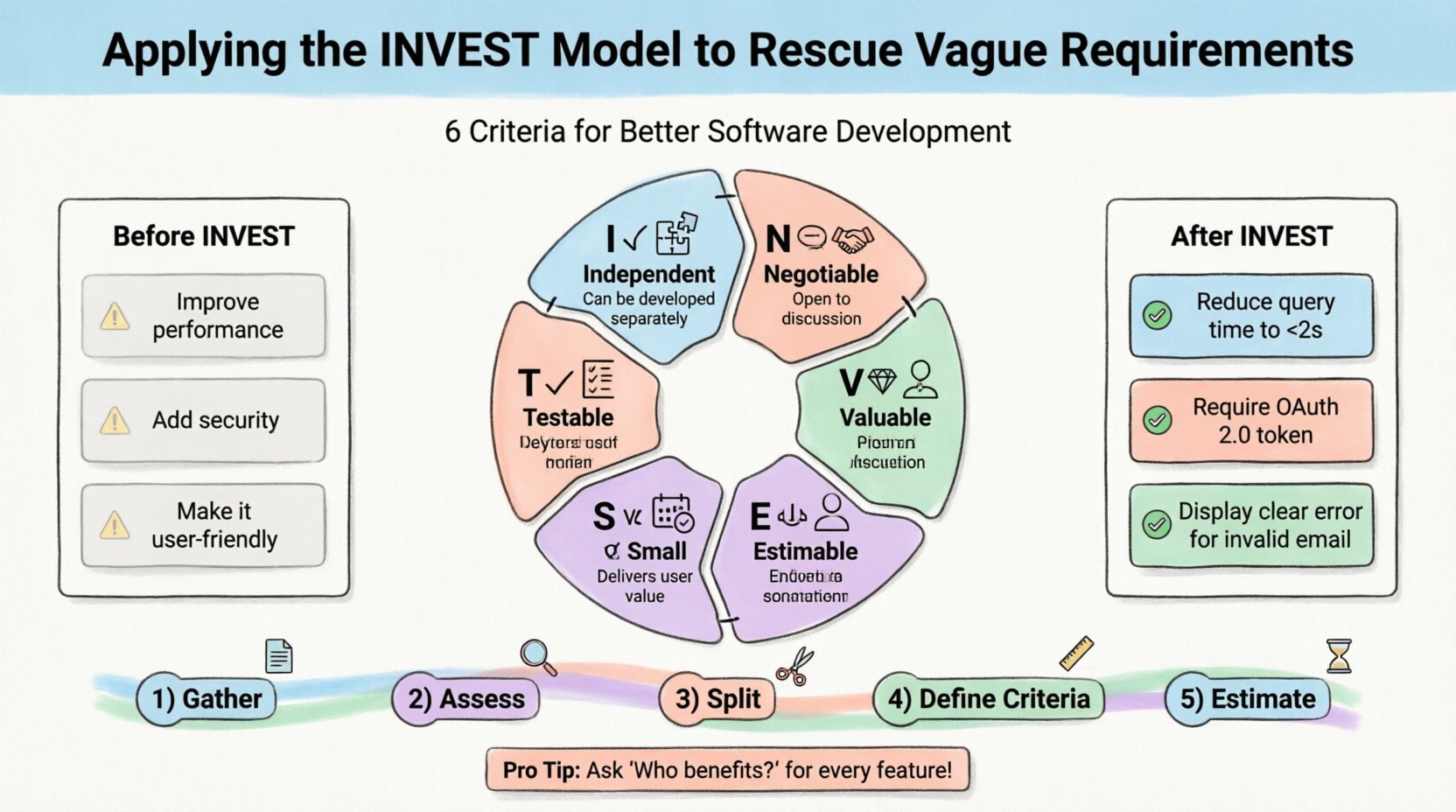
- “Improve performance.” – How much? On what device?
- “Add security.” – Which data? What standards?
- “Make it user-friendly.” – Subjective and unmeasurable.
Without clarity, estimation is impossible. Without estimation, planning fails. Without planning, delivery becomes unpredictable. The INVEST model acts as a filter to catch these issues before they enter the development pipeline.
📐 What is the INVEST Model?
INVEST is an acronym representing six criteria for high-quality user stories. It was introduced by Bill Wake to ensure that stories in Agile environments are manageable and valuable. Each letter stands for a specific quality attribute:
- I – Independent
- N – Negotiable
- V – Valuable
- E – Estimable
- S – Small
- T – Testable
When a story meets these criteria, it is ready for the backlog. If it fails, it requires refinement. Below, we break down each criterion with specific focus on how it resolves vagueness.
🔍 Deep Dive: The INVEST Criteria
1. Independent (I) 🔗
A story should stand alone. If story A cannot be built without story B, they are coupled. This coupling creates dependency hell. Vague requirements often hide dependencies. For example, “Build the checkout process” might implicitly depend on “Build the payment gateway”.
How to fix vague dependencies:
- Identify external systems or data flows.
- Split the story into distinct functional slices.
- Ensure the story can be delivered without blocking other work.
Example:
- Vague: “Enable users to log in and view their dashboard.”
- Refined: “Enable users to log in.” (Story 1) + “Enable users to view dashboard after login.” (Story 2)
2. Negotiable (N) 🤝
Details should not be fully defined upfront. The story is a placeholder for a conversation. If a requirement is written as a rigid specification, it kills negotiation. Vague requirements often mask this by being too broad, leaving no room for discussion on scope.
How to fix vague scope:
- Use the story as a prompt for dialogue.
- Avoid writing acceptance criteria that dictate exact technical implementation.
- Allow the team and product owner to decide the best approach.
Example:
- Vague: “The system must use API v2 to fetch data.” (Too prescriptive)
- Refined: “The system must fetch user data.” (Leaves implementation open)
3. Valuable (V) 💎
The story must deliver value to the user or the business. If a story is just a technical task without user impact, it is not a user story. Vague requirements often describe features without explaining why they matter.
How to fix missing value:
- Ask “Who benefits?” for every feature.
- Connect the feature to a business goal.
- Ensure the user can see the benefit immediately.
Example:
- Vague: “Add a search bar.”
- Refined: “As a shopper, I can search for products by name so that I can find items quickly without browsing categories.”
4. Estimable (E) ⚖️
The team must be able to estimate the effort required. If requirements are vague, estimation is a guess. This leads to missed deadlines. Vague stories often lack context, making it impossible to gauge complexity.
How to fix estimation blockers:
- Provide enough context for the team to understand the scope.
- Define clear acceptance criteria.
- Identify known risks or unknowns that need research.
Example:
- Vague: “Optimize the database.”
- Refined: “Reduce query time for the user report page to under 2 seconds.”
5. Small (S) 📏
A story should be small enough to be completed in a single iteration. Large stories (Epics) are often vague because they encompass too many moving parts. Breaking them down reduces risk and increases visibility.
How to fix scope creep:
- Set a time-box limit (e.g., 3 days of work).
- Split by data, UI, or functionality.
- Focus on a single slice of value.
Example:
- Vague: “Build the mobile application.”
- Refined: “Build the login screen for the mobile app.”
6. Testable (T) ✅
You must be able to verify that the story is complete. Vague requirements often lack measurable outcomes. Without testability, you cannot know if the work is done.
How to fix unmeasurable outcomes:
- Write acceptance criteria in Given/When/Then format.
- Ensure every condition can be verified with a pass/fail result.
- Include edge cases in testing plans.
Example:
- Vague: “The error message should be helpful.”
- Refined: “When the user enters an invalid email, the system displays a red error message stating ‘Invalid email format’ and prevents form submission.”
📊 Comparison: Vague vs. INVEST-Aligned
Visualizing the difference helps clarify the transformation process. Use this table as a reference during refinement sessions.
| Feature | Vague Requirement | INVEST-Aligned Story | Why It Works |
|---|---|---|---|
| Login | “Fix login issues.” | “Allow users to reset password via email.” | Specific action, clear value, testable. |
| Reporting | “Make reports better.” | “Export monthly sales data to CSV format.” | Defined format, actionable, estimable. |
| UI Changes | “Redesign the homepage.” | “Move the ‘Subscribe’ button to the header.” | Small slice, independent change, valuable. |
| Security | “Secure the API.” | “Require OAuth 2.0 token for all API requests.” | Testable, specific, estimable. |
🛠️ The Refinement Process
Applying the model is not a one-time event. It is a continuous process. Here is a step-by-step workflow to integrate INVEST into your requirement gathering.
Step 1: Initial Gathering
- Collect raw ideas from stakeholders.
- Record them exactly as spoken, without filtering.
- Label them as “Backlog Items” rather than “Stories”.
Step 2: INVEST Assessment
- Run each item through the INVEST checklist.
- Mark items that fail on any criterion.
- Flag items that are too large or dependent.
Step 3: Decomposition
- Split large items into smaller, independent stories.
- Ensure each new story has a clear “Who” and “Why”.
- Check if the split story is still valuable on its own.
Step 4: Acceptance Criteria Definition
- Draft specific conditions for success.
- Review criteria for testability.
- Ensure criteria cover positive and negative paths.
Step 5: Estimation and Planning
- Have the development team review the refined stories.
- Assign effort estimates based on the clarified scope.
- Prioritize based on value and feasibility.
⚠️ Common Pitfalls in Analysis
Even with the model, teams often stumble. Be aware of these common traps.
- Over-Negotiating: Spending too much time defining details that should be discovered during development.
- Under-Testing: Writing stories that are technically feasible but hard to verify.
- Ignoring Value: Focusing on technical tasks (e.g., “Refactor code”) instead of user value.
- Too Many Dependencies: Failing to break down stories that rely on other systems or teams.
- Static Stories: Treating stories as contracts rather than agreements. They must remain flexible.
🔄 Integrating with Acceptance Criteria
Acceptance criteria are the bridge between the INVEST model and actual delivery. They operationalize the “Testable” criterion. Without them, a story is just a wish.
When defining acceptance criteria, ensure they align with the INVEST principles:
- Independent: Can this test run without other tests running first?
- Negotiable: Can the test be adjusted based on new findings?
- Valuable: Does this test verify the business value?
- Estimable: Can the tester estimate how long to write this test?
- Small: Is the test focused on one specific behavior?
- Testable: Is the pass/fail condition clear?
🤝 Team Collaboration Dynamics
The model works best when the whole team participates. It is not just the product owner’s job to write stories. Developers, testers, and designers contribute to the refinement.
- Developers: Highlight technical feasibility and estimation risks.
- Testers: Identify missing edge cases and testability gaps.
- Designers: Clarify UI requirements and user flows.
- Product Owners: Ensure business value and priority are clear.
Regular refinement sessions (often called grooming) are essential. Use these meetings to review the backlog against the INVEST model. If a story feels vague, put it back in the backlog and revisit it later. Do not push ambiguous work into a sprint.
📈 Measuring Success
How do you know if applying INVEST is working? Look at these metrics over time.
- Definition of Done: Does the team consistently meet the DoD without surprises?
- Rejection Rate: Are stories being returned from development due to missing info?
- Velocity Stability: Is the team’s output consistent sprint to sprint?
- Stakeholder Satisfaction: Are the delivered features actually useful?
- Defect Rate: Is the number of bugs decreasing due to clearer requirements?
🧠 Handling Complex Scenarios
Not all projects fit the standard mold. Sometimes requirements are inherently complex. Here is how to handle them.
1. Research Stories
When the solution is unknown, create a story to find out. These are often called “Spike” stories.
- Goal: Reduce uncertainty.
- Outcome: A recommendation or a prototype.
- INVEST Fit: Small, Estimable (time-boxed), Testable (did we learn?).
2. Technical Debt
Refactoring is often seen as non-value. This is incorrect. Technical debt reduces future velocity.
- Focus: Frame it as enabling future features.
- Example: “Update database schema to support new reporting features.”
- INVEST Fit: Valuable (prevents future rework), Small (single task).
3. Compliance and Legal
These requirements are often rigid. Negotiability is low.
- Focus: Ensure Testability and Estimability are high.
- Strategy: Break compliance into specific checks (e.g., “Verify data retention policy” instead of “Ensure compliance”).
🚀 Moving Forward
Adopting the INVEST model changes how a team thinks. It shifts focus from “what we build” to “why we build it.” It turns vague requests into concrete plans. By consistently applying these six criteria, teams can eliminate ambiguity before it becomes a cost.
Start with your current backlog. Pick five stories. Apply the checklist. Refine them. Observe the difference in clarity. Repeat this process until it becomes a habit. The goal is not perfection, but continuous improvement in requirement quality.
Remember, a well-defined story is the foundation of a successful project. Invest the time in the requirements phase, and you will save time in the delivery phase.