In modern product development, the gap between high-level strategy and daily execution is often where value leaks occur. Teams frequently find themselves building features that function perfectly but fail to advance the core mission. This misalignment creates technical debt, wastes engineering cycles, and confuses stakeholders about the product’s direction. To prevent this, every user story must trace back to a defined outcome within the product vision and roadmap.
Alignment is not a one-time event. It is a continuous practice of communication, validation, and adjustment. When user stories are correctly connected to strategic goals, development becomes a deliberate process of value delivery rather than a collection of tasks. This guide outlines the mechanics of connecting the day-to-day work to the long-term vision without relying on jargon or hype.
Understanding the Strategic Hierarchy 🏗️
Before stories can be written, the layers of planning above them must be clear. A product does not move forward through isolated tickets. It moves through a hierarchy of intent. Understanding these layers ensures that the smallest unit of work contributes to the largest unit of strategy.
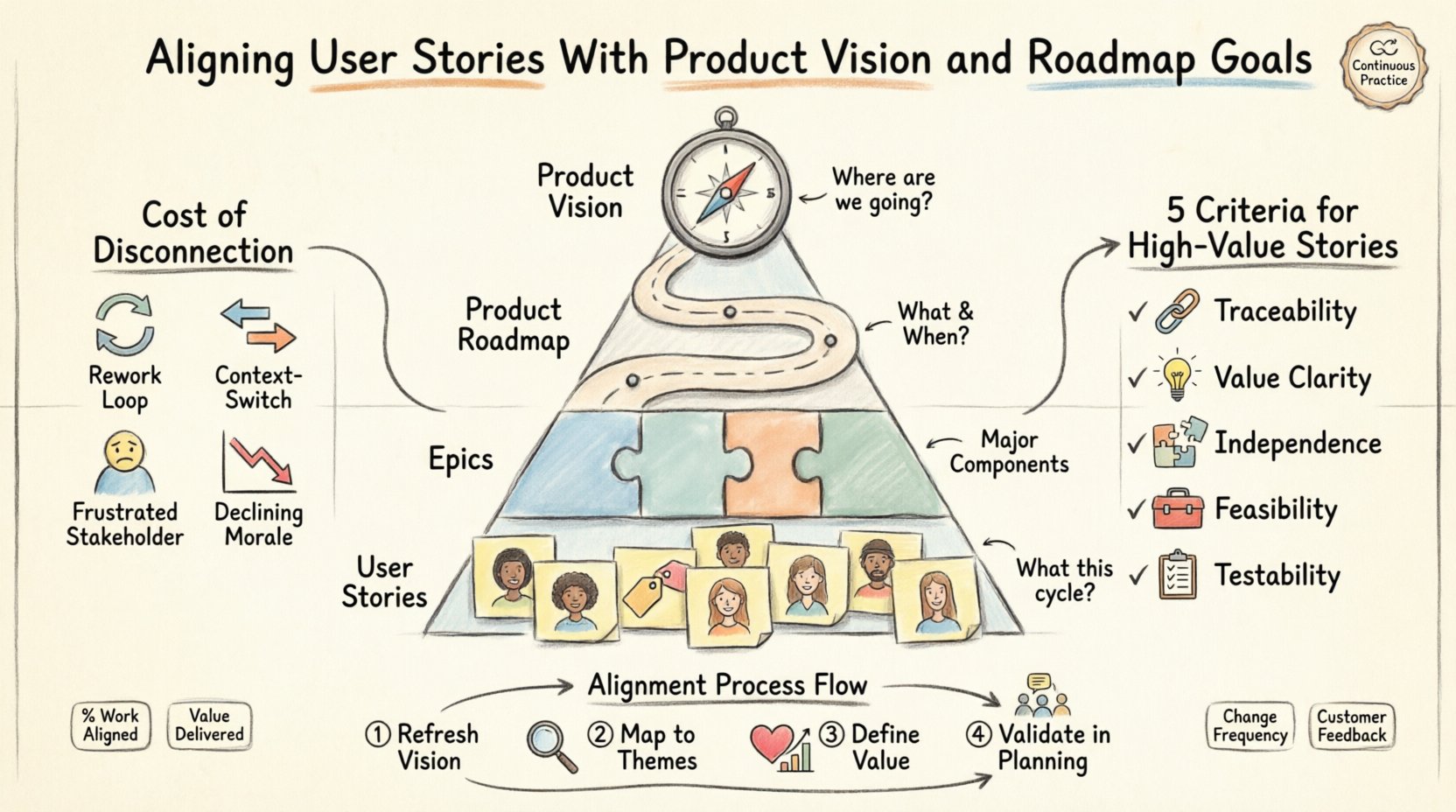
- Product Vision: This is the long-term aspiration. It defines the problem the product solves and the value it creates for users over the next several years. It answers the question, “Where are we going?”
- Product Roadmap: The roadmap translates the vision into a timeline of capabilities and themes. It outlines the major milestones and the order in which they will be delivered. It answers the question, “What are we building and when?”
- Epics: Epics are large bodies of work that span multiple iterations. They group related stories that contribute to a specific roadmap theme. They answer the question, “What are the major components needed?”
- User Stories: These are the smallest units of value. They describe a specific functionality from the perspective of the end user. They answer the question, “What exactly are we building in this cycle?”
When a user story exists without a connection to an epic, which connects to a theme, which connects to the roadmap, and ultimately the vision, it becomes an orphan. Orphaned stories are the primary source of wasted effort in agile environments.
The Cost of Disconnection 💸
Working without alignment creates tangible negative outcomes for the organization. It is not merely an administrative issue; it is a financial and operational risk.
- Rework and Refactoring: If a team builds a feature that does not fit the evolving vision, that code must eventually be changed or removed. This doubles the effort required for the feature.
- Context Switching: Teams lose focus when the priority shifts unexpectedly. Constantly re-prioritizing work to match a shifting vision disrupts flow and reduces productivity.
- Stakeholder Frustration: Business leaders invest in the roadmap expecting specific outcomes. When the output does not match the expectation, trust erodes.
- Team Morale: Engineers want to build meaningful things. Working on tasks that feel arbitrary or disconnected from the bigger picture reduces engagement and increases turnover.
Steps to Ensure Strategic Fit 🔄
Aligning user stories requires a structured approach. This process moves from the abstract vision down to the concrete acceptance criteria. The following steps outline how to maintain this connection throughout the development lifecycle.
1. Review and Refresh the Vision
Before writing stories, the team must understand the current state of the vision. Vision documents can become outdated or be interpreted differently by different people. Ensure that the Product Owner and key stakeholders agree on the current North Star.
- Check for recent changes in market conditions.
- Confirm the target user persona has not shifted.
- Verify the core value proposition remains relevant.
2. Map Stories to Roadmap Themes
Every story should be tagged or linked to a specific roadmap theme. A theme is a category of work that supports a strategic goal. For example, if the goal is “Improve Retention,” the theme might be “Onboarding Optimization.” Stories within this theme should all contribute to making the onboarding process smoother or faster.
3. Define the Value Proposition
Each story must include a clear statement of value. This is not just about the technical implementation. It is about the benefit to the user and the business. A well-defined value proposition helps the team make decisions when requirements change.
4. Validate During Planning
During backlog refinement or sprint planning, the team should explicitly discuss the connection between the story and the goal. This is not a formality. It is a critical checkpoint. If a team member cannot explain why a story is being worked on, it needs to be re-evaluated.
Criteria for High-Value Stories ✅
Not all user stories are created equal. To ensure alignment, stories must meet specific criteria beyond just being testable. They must also be strategically relevant. Use the following checklist to evaluate potential stories.
| Criteria | Description | Why It Matters |
|---|---|---|
| Traceability | The story links back to an Epic and a Roadmap Theme. | Ensures no work is done without strategic purpose. |
| Value Clarity | The benefit to the user is explicit and measurable. | Helps prioritize work that drives real outcomes. |
| Independence | The story can be delivered and tested without blocking others. | Allows for flexible scheduling and faster feedback. |
| Feasibility | The team has the skills and resources to build it. | Prevents commitment to work that cannot be completed. |
| Testability | Acceptance criteria define clear pass/fail conditions. | Ensures the delivered work meets the definition of done. |
Managing Misalignment 🚧
Even with the best intentions, misalignment occurs. It is important to recognize the signs early and implement corrective measures. The following are common anti-patterns that indicate a breakdown in the alignment process.
- Scope Creep: Adding features to a story that do not serve the original goal. This often happens when stakeholders request “just one more thing.” Every addition must be weighed against the strategic objective.
- Context Loss: When teams work in isolation, they may forget the broader context. Regular syncs with product leadership help maintain context.
- Technical Debt Accumulation: Sometimes alignment is sacrificed to meet short-term deadlines. This creates a debt that must be paid later, often stalling progress on strategic initiatives.
- Stakeholder Drift: If the roadmap changes frequently without communication, the team cannot align their work. Stakeholders must commit to a stable timeline or clearly communicate changes.
To mitigate these risks, establish a governance process for changes. If a roadmap theme changes, the stories associated with it should be re-evaluated. If a story no longer serves the theme, it should be removed from the backlog.
Measuring Alignment Effectiveness 📊
You cannot improve what you do not measure. However, measuring alignment is different from measuring velocity. Velocity measures speed; alignment measures direction. Use the following metrics to assess how well your work matches your strategy.
- Percentage of Work Aligned: Track how many stories in a sprint are linked to a strategic theme. A low percentage indicates a drift.
- Value Delivered per Sprint: Instead of counting stories, count outcomes. Did the work released in this sprint move a metric toward the vision?
- Change Frequency: Monitor how often stories are added or removed during a sprint. High churn often signals a lack of initial alignment.
- Customer Feedback: Are users responding positively to the features being released? If the vision is customer-centric, user sentiment is a leading indicator of alignment.
Roles in the Alignment Process 👥
Alignment is a shared responsibility. Different roles play specific parts in ensuring the connection between vision and stories remains strong.
Product Owner
The Product Owner acts as the bridge. They must translate the vision into backlog items. They are responsible for maintaining the backlog hierarchy and ensuring every story has a clear “Why.” They must say no to work that does not fit the strategy.
Development Team
The team provides the technical perspective. They should question the feasibility of stories and suggest alternatives that might better serve the goal. They are the guardians of quality and efficiency.
Stakeholders
Stakeholders define the vision and provide the resources. They must respect the prioritization process. When they intervene with urgent requests, they must understand the trade-offs involved.
Maintaining Alignment Over Time ⏳
A product vision is not static. Markets change, user needs evolve, and new technologies emerge. Alignment is a dynamic state, not a fixed destination. To maintain it over time, adopt the following practices.
- Quarterly Strategy Reviews: Every quarter, review the roadmap against the vision. Adjust themes if necessary. This ensures the roadmap remains a reflection of the current reality.
- Regular Backlog Refinement: Use refinement sessions to re-evaluate older stories. Some may no longer be relevant. Pruning the backlog keeps the team focused.
- Transparent Communication: Share the vision and roadmap updates with the entire team. Use newsletters, town halls, or dashboard updates. Visibility creates accountability.
- Retrospective Analysis: Include alignment in retrospective discussions. Ask, “Did we build the right thing?” rather than just, “Did we build the thing right?”
Practical Implementation Example 🛠️
Consider a scenario where a company wants to reduce churn. The vision is “To be the most reliable platform for our users.” The roadmap theme is “Stability and Performance.”
Aligned Story:
- Title: Optimize database query for user dashboard.
- Theme: Stability and Performance.
- Goal: Reduce load time by 50%.
- Impact: Faster access leads to higher retention.
Unaligned Story:
- Title: Add social sharing button to dashboard.
- Theme: User Engagement (Unrelated to Stability).
- Goal: Increase virality.
- Impact: Does not directly address the core vision of reliability.
In this example, the unaligned story might be interesting, but it does not serve the immediate strategic goal. It should be moved to a different theme or the roadmap adjusted to reflect a shift in priority.
Tools and Documentation 📝
While specific software is not required, the structure of documentation is vital. Use a system that allows linking between items. Whether it is a spreadsheet, a database, or a project management tool, the relationships must be visible.
- Visual Maps: Create a visual map showing the path from Vision to Stories. This helps new team members understand the context quickly.
- Living Documents: Keep the vision and roadmap documents accessible and updated. Static documents lose value over time.
- Story Templates: Use a standard template for user stories that includes a field for “Strategic Goal.” This forces the writer to consider alignment before submission.
Conclusion on Strategic Consistency
Aligning user stories with product vision and roadmap goals is the foundation of effective product management. It transforms development from a task-based activity into a value-driven process. By understanding the hierarchy, enforcing criteria, measuring outcomes, and fostering a culture of communication, teams can ensure that every line of code serves a purpose.
This alignment does not happen by accident. It requires discipline, regular review, and a willingness to cut work that does not fit. When executed well, the result is a product that delivers real value to users and sustains the business over the long term.
The path from vision to value is paved with intentional decisions. Treat every story as a step on that path. Ensure it leads in the right direction.