Organizational success depends on more than just having a plan; it requires a clear understanding of the underlying motivations that drive decision-making. The Business Motivation Model (BMM) provides a standardized framework to articulate these drivers. Aligning high-level strategy with these models ensures that every action taken by the enterprise contributes directly to its core purpose. This guide explores the mechanics of this alignment, offering a structured approach for business architects and strategists.
Understanding the Business Motivation Model Framework 🧩
The Business Motivation Model is a conceptual framework used to describe business motivations, goals, and the capabilities required to achieve them. It serves as a bridge between high-level strategic intent and the operational realities of an organization. By modeling the “why” behind business actions, leaders can ensure resources are directed toward meaningful outcomes.
At its core, the model distinguishes between what a business wants to achieve and the means used to achieve it. This distinction prevents the common error of focusing on tools rather than outcomes. The framework is vendor-neutral, allowing it to be applied across various industries without dependency on specific technology stacks.
Why Alignment Matters 🤝
Without alignment, organizations often suffer from siloed efforts where departments pursue conflicting objectives. A marketing team might prioritize brand awareness, while operations focus on cost reduction, leading to friction. The Business Motivation Model provides a unified language to resolve these tensions. It creates a traceable link from a strategic goal down to the specific capability required to fulfill it.
- Clarity: Everyone understands the primary drivers of the organization.
- Consistency: Decisions at the tactical level reflect strategic priorities.
- Agility: Changes in strategy can be traced through the model to assess impact.
Core Components of the Business Motivation Model 🔄
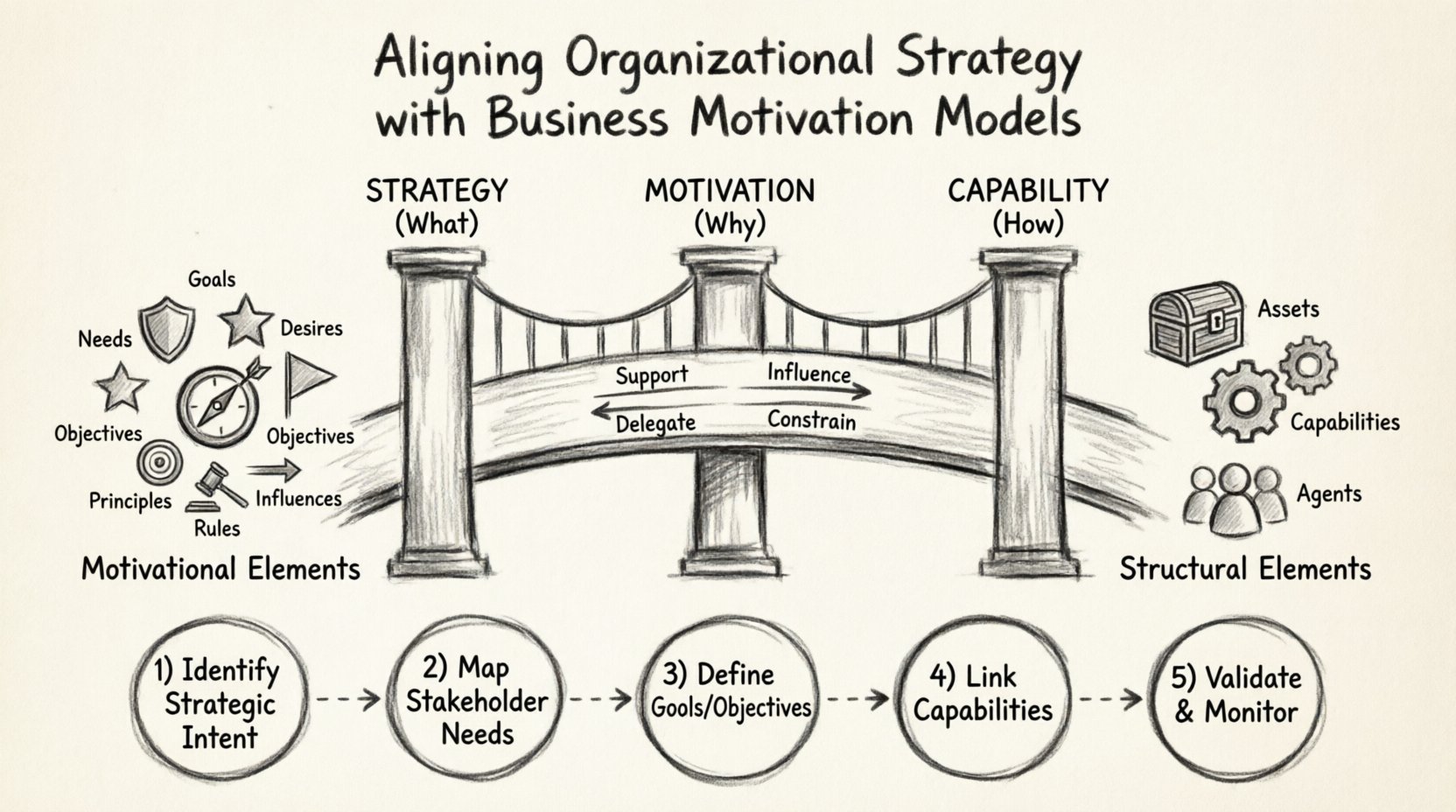
To align strategy effectively, one must understand the specific elements that constitute the model. These elements are categorized into Motivational Elements and Structural Elements. Understanding the relationship between these categories is crucial for accurate modeling.
Motivational Elements
These elements describe the business will. They answer the question: What does the business want?
- Needs: Basic requirements that must be met. These are often non-negotiable, such as compliance or safety standards.
- Desires: Aspirational goals. These represent the ideal state the business seeks, such as market leadership.
- Goals: High-level targets that guide the organization. They are often qualitative or broad in nature.
- Objectives: Specific, measurable targets derived from goals. They provide the metrics for success.
- Principles: Guidelines that constrain or direct behavior. They define how work should be done.
- Rules: Mandatory constraints. Unlike principles, rules are strict requirements that must be followed.
- Influences: Factors that affect the motivation. These can be internal or external, such as market trends or regulatory changes.
Structural Elements
These elements describe the business capability. They answer the question: How does the business do it?
- Assets: Valuable resources owned or controlled by the business. Examples include physical infrastructure, intellectual property, or financial capital.
- Capabilities: The ability to perform tasks or achieve outcomes. A capability is often a function or skill set that utilizes assets.
- Agents: The entities (people, roles, or systems) that exercise capabilities to influence motivations.
The Bridge Between Strategy and Motivation 🌉
Aligning strategy with the Business Motivation Model involves mapping strategic intent to specific motivational and structural elements. This process ensures that the “what” (strategy) is supported by the “why” (motivation) and the “how” (capability).
Strategy is not merely a document; it is a living system of motivations. When a strategy changes, the model must be updated to reflect new goals, adjusted objectives, or different capabilities. This dynamic relationship keeps the organization responsive to change.
Key Relationships in the Model 🔗
The power of the model lies in the relationships between elements. These relationships define the flow of influence and support.
- Support: A structural element (like a capability) supports a motivational element (like a goal). This creates a direct line of evidence that resources are being used to achieve targets.
- Influence: One element affects the likelihood of another. For example, an external influence might impact the feasibility of a goal.
- Delegate: A higher-level element passes responsibility to a lower-level element. Strategic goals delegate to tactical objectives.
- Constrain: Principles and rules limit the actions available to agents. This ensures alignment with governance.
Step-by-Step Alignment Process 📝
Implementing this alignment requires a disciplined approach. The following steps provide a roadmap for integrating the Business Motivation Model into strategic planning.
1. Identify Strategic Intent 🎯
Begin by defining the high-level purpose of the organization. What is the primary reason for its existence? This often translates into a set of overarching goals. Avoid vague language; ensure the intent is clear enough to guide decision-making.
- Document the vision and mission statements.
- Identify the core value proposition.
- Define the strategic goals that support the vision.
2. Map Stakeholder Needs 🗣️
Strategies fail when they ignore the stakeholders driving them. Identify who has a need or desire in the business context. These stakeholders could be customers, employees, regulators, or shareholders.
- List all key stakeholder groups.
- Document their specific needs and desires.
- Map these needs to the strategic goals identified in the previous step.
3. Define Goals and Objectives 📊
Translate the strategic intent into measurable objectives. Goals should be broad, while objectives must be specific. This distinction prevents confusion during execution.
- Ensure objectives are SMART (Specific, Measurable, Achievable, Relevant, Time-bound).
- Link each objective to a higher-level goal.
- Define the criteria for success for each objective.
4. Link Capabilities to Motivations 🔨
This is the critical alignment step. Determine which capabilities are required to achieve the objectives. This reveals the gap between current state and required state.
- List existing capabilities within the organization.
- Identify gaps where capabilities are missing or insufficient.
- Map assets to the capabilities they enable.
- Ensure every objective has at least one supporting capability.
5. Validate and Monitor ✅
Alignment is not a one-time activity. It requires continuous monitoring to ensure that the strategy remains valid as the business environment changes.
- Establish feedback loops to review progress.
- Update the model when strategic priorities shift.
- Track the effectiveness of capabilities in meeting objectives.
Structuring Information: Elements vs. Definitions 📋
To aid in understanding, the following table summarizes the key elements and their definitions within the context of alignment.
| Element | Category | Definition | Example |
|---|---|---|---|
| Need | Motivational | Basic requirement | Compliance with safety regulations |
| Desire | Motivational | Aspirational outcome | Expand into international markets |
| Goal | Motivational | High-level target | Improve customer satisfaction |
| Objective | Motivational | Measurable target | Reduce response time to 24 hours |
| Capability | Structural | Ability to perform | Customer support hotline |
| Asset | Structural | Owned resource | Ticketing software system |
| Rule | Motivational | Mandatory constraint | Data must be encrypted |
| Principle | Motivational | Guiding guideline | Customer privacy first |
Bridging Strategy and Execution 🔗
One of the most common failures in organizational strategy is the disconnect between planning and execution. The Business Motivation Model addresses this by explicitly linking the structural elements to the motivational elements. This linkage ensures that execution is not arbitrary but is driven by defined motivations.
Principles vs. Rules
Understanding the difference between principles and rules is vital for governance. Rules are hard constraints; they must be followed. Principles are soft constraints; they guide behavior but allow for flexibility. When aligning strategy, you must decide where the line is drawn.
- Use Rules for compliance, security, and legal requirements.
- Use Principles for culture, ethics, and best practices.
Assets vs. Capabilities
Assets are what you have; capabilities are what you can do. A strategy might require a new capability, which then necessitates acquiring new assets. Aligning strategy means ensuring that asset investment matches capability needs.
- Do not invest in assets without a defined capability.
- Do not define capabilities without identifying the required assets.
- Regularly audit assets to ensure they still support the necessary capabilities.
Common Challenges in Alignment ⚠️
Implementing this alignment is not without obstacles. Recognizing these challenges early can help organizations navigate them effectively.
1. Siloed Information 🧱
Departments often hoard information, making it difficult to create a holistic view. This leads to incomplete models where the dependencies between functions are missed.
- Establish a central governance body for the model.
- Encourage cross-functional collaboration during the modeling process.
- Use a shared repository for all model elements.
2. Ambiguous Goals 🌫️
Goals that are too vague lead to confusion. If a goal is not clear, the objectives derived from it will be misaligned. This creates a cascade of ambiguity down to the execution level.
- Review goals for clarity before deriving objectives.
- Involve stakeholders in the definition of goals.
- Iterate on goal definitions until consensus is reached.
3. Resistance to Change 🚫
Aligning strategy often requires changes to existing processes and capabilities. Employees may resist these changes if they do not understand the motivation behind them.
- Communicate the “why” clearly to all stakeholders.
- Highlight the benefits of alignment for individual roles.
- Provide training on how to use the model in daily work.
Measuring Alignment Effectiveness 📈
How do you know if the alignment is working? Metrics must be established to measure the connection between strategy and execution. These metrics should track the health of the relationships within the model.
Key Performance Indicators (KPIs)
Link KPIs directly to the objectives defined in the model. This ensures that performance measurement is not generic but specific to the strategic intent.
- Track the percentage of capabilities linked to active objectives.
- Monitor the achievement rate of specific objectives.
- Measure the time taken to update the model when strategy changes.
Feedback Loops
Establish regular review cycles. These cycles should involve stakeholders who can validate whether the current model still reflects reality. If the business environment shifts, the model must adapt.
- Schedule quarterly reviews of the motivation model.
- Conduct post-project reviews to assess capability effectiveness.
- Update influences based on external market data.
Conclusion: A Foundation for Sustainable Growth 🌱
Aligning organizational strategy with Business Motivation Models is a rigorous process that yields significant benefits. It transforms strategy from a static document into a dynamic framework that guides decision-making. By clearly defining motivations, goals, and capabilities, organizations can ensure that every resource contributes to the overarching purpose.
The path to alignment requires discipline and continuous effort. It demands that leaders look beyond the immediate tasks and understand the underlying drivers of the business. When executed correctly, this alignment creates a resilient organization capable of navigating complexity and achieving long-term success.
Start by mapping your current motivations. Identify the gaps between your strategy and your capabilities. Then, begin the process of linking them together. The result will be a coherent, actionable plan that drives real value.