



Designing a robust database schema requires more than just knowing which tables hold which data. It demands a clear, universal language to communicate structure, constraints, and relationships to stakeholders, developers, and future maintainers. Entity Relationship Diagrams (ERDs) serve as the blueprint for this structure. However, not all blueprints look the same. Over the decades, several notations have emerged, each with distinct visual syntax and specific use cases.
The three dominant standards in modern data modeling are Chen Notation, Crow’s Foot Notation, and UML Class Diagrams. Selecting the right one depends heavily on your technology stack, the audience reviewing the design, and the specific requirements of the system architecture. Understanding the nuances of each prevents misinterpretation and ensures the final implementation aligns with the intended data logic.
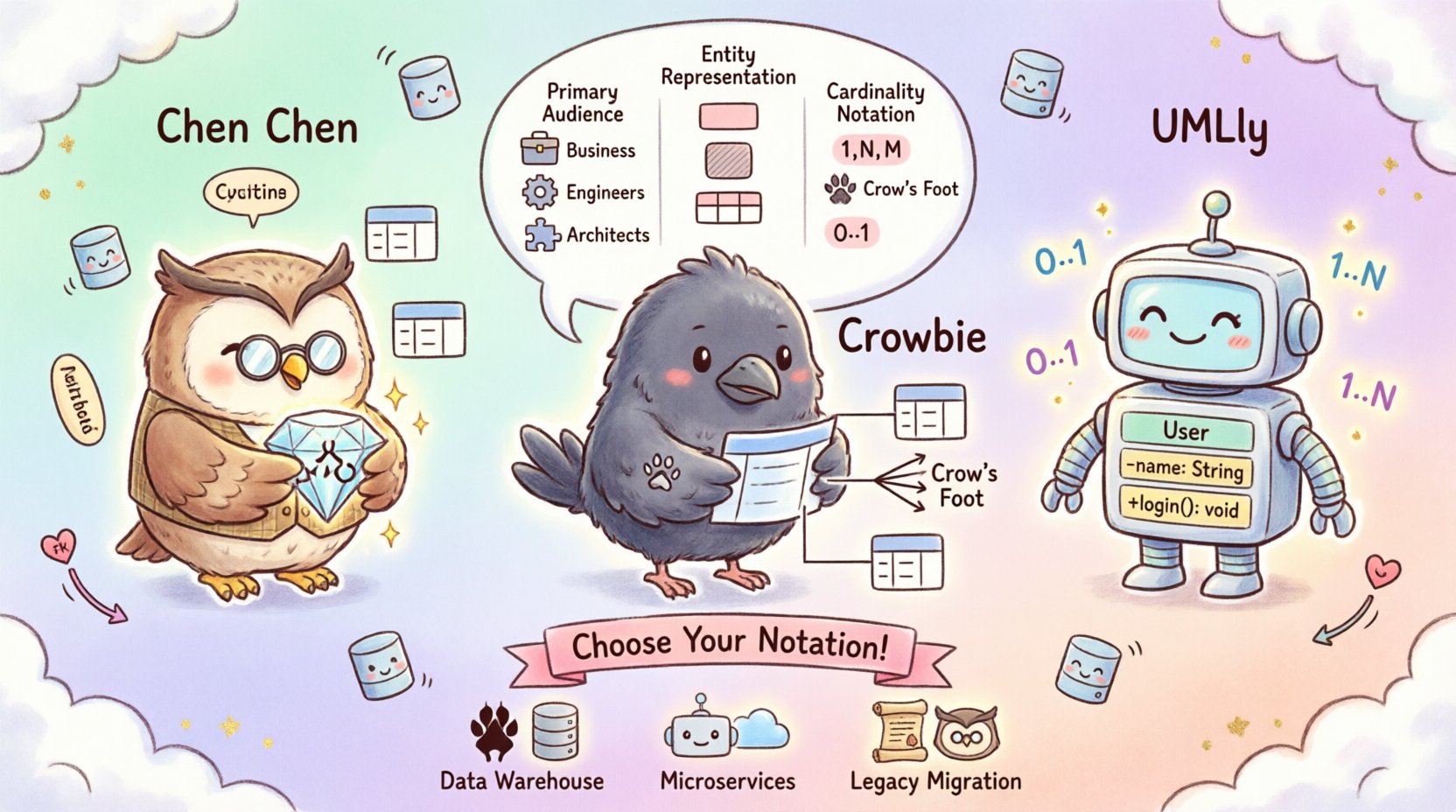
🏛️ Chen Notation: The Historical Foundation
Introduced by Peter Chen in 1976, Chen Notation is the grandfather of ER modeling. It was designed to be intuitive for business analysts and non-technical stakeholders. The visual language is distinct, relying heavily on geometric shapes to represent the core concepts of database theory.
Core Syntax and Visual Elements
Entities: Represented by rectangles. These contain the primary key and attributes.
Attributes: Represented by ovals connected to the entity rectangle. Primary keys are often underlined.
Relationships: Represented by diamonds connecting two entities.
Cardinality: Indicated by lines connecting the diamond to the entities, often labeled with numbers or letters (1, N, M).
Weak Entities: Shown as double rectangles, indicating dependency on a parent entity for existence.
Identifying Relationships: Shown as double lines connecting the weak entity to its parent.
Strengths and Use Cases
Chen notation excels in scenarios where the database design needs to be explained to people who do not write SQL. Its use of ovals and diamonds makes the distinction between a thing (entity) and an action (relationship) very clear.
Legacy System Documentation: Many older systems were designed using this standard. Maintaining consistency with historical diagrams is crucial.
High-Level Business Analysis: When discussing data requirements with product managers, the diamond shape clearly signals a link between two business concepts.
Academic and Theoretical Contexts: Computer science curricula often teach Chen notation first to establish theoretical grounding before moving to implementation-specific styles.
However, the notation can become cluttered when relationships are complex. Ternary relationships (relationships between three entities) are easy to visualize in Chen but can be difficult to map directly to relational database constraints without additional interpretation.
🦵 Crow’s Foot Notation: The Relational Standard
Also known as IE (Information Engineering) Notation, Crow’s Foot became the de facto standard for relational database design in the late 20th century. It is highly practical for database administrators and backend engineers. The name comes from the shape used to represent the “many” side of a relationship, which resembles the foot of a crow.
Core Syntax and Visual Elements
Entities: Represented by rectangles (often just table names in modern tools).
Relationships: Represented by straight lines connecting the tables.
Cardinality (The “Crow’s Foot”): A three-pronged symbol (like a crow’s foot) indicates the “many” side of the relationship.
Modality: A bar (|) indicates mandatory participation (must exist), while a circle (o) indicates optional participation (can be null).
Primary Keys: Usually denoted by a key icon or specific text annotation next to the attribute.
Strengths and Use Cases
Crow’s Foot notation is optimized for mapping directly to SQL DDL statements. If you are writing the schema, this is likely the visual language you are using.
Relational Database Design: It maps cleanly to foreign keys and primary keys in SQL databases like PostgreSQL, MySQL, or SQL Server.
Schema Documentation: It is the industry standard for technical documentation within engineering teams.
Data Integrity Clarity: The use of bars and circles explicitly defines nullability constraints, which is critical for backend logic.
The notation is less abstract than Chen. It assumes the audience understands the concept of a table and a foreign key. This makes it less suitable for high-level business meetings but ideal for technical sprint planning.
📐 UML Class Diagrams: The Object-Oriented Bridge
The Unified Modeling Language (UML) was developed to standardize software design across various paradigms. While UML covers many diagram types, the Class Diagram is the one most often used for database modeling in object-oriented contexts. It bridges the gap between the code structure and the data structure.
Core Syntax and Visual Elements
Classes: Rectangles divided into three sections: Name, Attributes, and Operations (methods).
Relationships: Lines connecting classes with specific arrowheads to denote direction and type.
Association: A simple line. Indicates a relationship exists.
Aggregation: A hollow diamond on one end. Indicates a “whole-part” relationship where parts can exist independently.
Composition: A filled diamond. Indicates a strict lifecycle dependency; if the whole dies, the parts die.
Multiplicity: Numbers placed near the ends of lines (e.g., 0..1, 1..*, 0..*). This is functionally similar to Crow’s Foot but uses mathematical notation.
Strengths and Use Cases
UML Class Diagrams are essential when the database is not the sole focus. They are the connective tissue between the backend code and the persistent storage layer.
ORM Mapping: Object-Relational Mappers (ORMs) rely heavily on UML-style relationships to understand how to map classes to tables.
Full-Stack Architecture: When frontend, backend, and database teams need to align on data structures, UML provides a common vocabulary.
Complex Relationships: UML handles inheritance, generalization, and interface implementation better than purely relational notations.
The downside is verbosity. A simple table relationship in Crow’s Foot might require a complex class definition in UML, including methods and attributes that are irrelevant to the database itself. This can lead to confusion if the diagram is used purely for schema generation.
📊 Side-by-Side Comparison
To make the decision easier, here is a breakdown of how these notations handle specific modeling scenarios.
Feature | Chen Notation | Crow’s Foot Notation | UML Class Diagram |
|---|---|---|---|
Primary Audience | Business Analysts, Academics | DBAs, Backend Engineers | Full-Stack Developers, Architects |
Entity Representation | Rectangle | Rectangle (Table) | Class Box (Name/Props/Methods) |
Relationship Representation | Diamond | Line with Symbols | Line with Arrowheads/Diamonds |
Cardinality Notation | Labels (1, N, M) | Crow’s Foot + Bar/Circle | Mathematical (0..1, *) |
Nullability Indication | Implicit or Text | Explicit (Circle = Optional) | Explicit (Multiplicity) |
Best For | Conceptual Models | Logical/Physical Models | Implementation Models |
Complexity | High for ternary links | Medium | High for inheritance |
🔍 Choosing the Right Notation for Your Stack
There is no single “best” notation. The right choice depends on the lifecycle stage of the project and the technologies involved.
Scenario 1: Pure Relational Data Warehouse
If you are designing a data warehouse or a transactional system where the focus is entirely on SQL tables and query performance, Crow’s Foot is the most efficient choice. It minimizes cognitive load regarding object concepts and maximizes clarity on constraints. When a developer looks at a Crow’s Foot diagram, they know exactly what foreign key to write.
Focus: Data integrity and query speed.
Recommendation: Use Crow’s Foot for the physical schema layer.
Scenario 2: Microservices and Domain Driven Design
In a microservices architecture, teams often operate on bounded contexts. UML Class Diagrams are valuable here to define the boundaries between services. They help visualize how an entity in one service relates to an entity in another, often through API contracts rather than direct database joins.
Focus: Service boundaries and object mapping.
Recommendation: Use UML for the domain model, then translate to Crow’s Foot for the specific service database.
Scenario 3: Legacy Migration and Audit
When auditing an existing system or migrating from a legacy platform, Chen Notation might appear in the documentation. Understanding it is vital for accurate migration. You must be able to translate the diamonds and ovals back into modern table structures.
Focus: Preservation of business logic.
Recommendation: Translate Chen to Crow’s Foot for implementation, keeping the original Chen for reference.
🛠️ Best Practices for Data Modeling
Regardless of the notation selected, certain principles apply universally to ensure a maintainable and scalable system.
Consistency is Key: Do not mix notations within the same document. If you start with Crow’s Foot, finish with Crow’s Foot. Switching halfway creates confusion regarding what a specific symbol means.
Naming Conventions: Ensure entity and attribute names follow a consistent snake_case or camelCase standard throughout the diagram. Ambiguous names like “Data” or “Info” are red flags.
Normalization: Apply normalization rules (up to 3NF or BCNF) before finalizing the diagram. A diagram that is not normalized will lead to redundancy and update anomalies.
Document Constraints: Explicitly document unique constraints and check constraints. Visual symbols show relationships, but text notes often clarify business rules.
Version Control: Treat ER diagrams as code. Store them in your version control system. Changes to the schema should be reviewed just like code changes.
🚫 Common Pitfalls to Avoid
Even experienced architects make mistakes when visualizing data structures. Being aware of these common errors can save significant time during development.
1. Ignoring Nullability
A relationship line without a circle or bar implies a default, which varies by tool. Always explicitly state if a foreign key can be null. In Crow’s Foot, this is a circle. In UML, it is a multiplicity of 0..1. Assuming is a dangerous habit.
2. Over-Modeling Ternary Relationships
While Chen handles ternary relationships well, relational databases do not natively support them. A relationship between three tables usually needs to be broken down into binary relationships or an associative entity. Modeling a direct three-way link can lead to implementation headaches.
3. Confusing Aggregation with Composition
In UML, the difference between a hollow and filled diamond is critical. A hollow diamond means the child can exist without the parent. A filled diamond means it cannot. Mixing these up can lead to data orphaning issues where child records are deleted or persisted incorrectly.
4. Circular Dependencies
A circular reference occurs when Table A references Table B, and Table B references Table A. While sometimes valid (e.g., a hierarchy), it complicates backups and restores. Ensure the diagram clearly indicates the direction of the dependency to avoid creation order errors.
5. Neglecting Soft Deletes
Modern systems often require soft deletes (marking a row as inactive rather than removing it). A diagram should indicate where a `deleted_at` or `is_active` column resides. This is a logical change that affects the physical schema.
🔄 Transitioning Between Notations
It is common for a project to start with Chen for high-level planning and end with Crow’s Foot for implementation. Understanding the mapping between them ensures data integrity is preserved during the transition.
Chen to Crow’s Foot: Convert the diamond to a line. Convert the labels (1, N) to the crow’s foot symbol. Add the modality bars/circles based on the business rules implied by the original design.
UML to Crow’s Foot: Remove the class operations (methods). Simplify the aggregation/composition lines into standard foreign keys. Adjust the multiplicity notation to match the Crow’s Foot symbols.
Crow’s Foot to UML: Add the class box structure. Map the relationship lines to association arrows. Decide if the relationship is an aggregation or composition based on the lifecycle of the data.
📝 Final Thoughts on Data Modeling
The choice of notation is not merely aesthetic; it is a communication tool that dictates how the database is understood and built. Chen provides the conceptual clarity, Crow’s Foot offers the relational precision, and UML delivers the object-oriented integration.
By selecting the notation that aligns with your team’s expertise and your system’s architecture, you reduce the risk of miscommunication. A well-documented schema serves as a contract between the data and the application. Whether you are drawing diamonds, crow’s feet, or class boxes, the goal remains the same: to create a stable foundation for your data.
Invest time in the modeling phase. The cost of changing a diagram is negligible compared to the cost of refactoring a deployed database. Choose your visual language wisely, and ensure every stakeholder speaks the same dialect.
Related posts:
 Case Study: How a Complex ER Diagram Solved Data Redundancy in a Legacy Migration
 Deep Dive into ER Diagrams: Advanced Strategies for Handling Many-to-Many Relationships
 The overlooked Power of Attributes in ER Diagrams: Why They Matter More Than You Think
 The Strategic Value of ER Diagrams in Large-Scale Backend Development Teams