

The modern organizational landscape is shifting beneath our feet. Digital tools, automation, and artificial intelligence are no longer just support functions; they are central to how work gets done. Yet, as technology advances, a critical question remains: how do we keep human motivation aligned with these digital shifts? This is where the Business Motivation Model (BMM) becomes essential. It provides a structured way to connect the why of business with the how of execution, specifically within a tech-heavy environment.
When we talk about the future of work, we often focus on the gadgets and platforms. We forget the underlying drivers that make people use them effectively. Motivation is not a soft skill; it is a strategic asset. By applying the BMM framework, organizations can ensure that technology investments directly support core goals rather than becoming distractions or burdens. This guide explores how to integrate these models for a resilient, motivated, and efficient future workplace.
🧠 Understanding the Business Motivation Model (BMM)
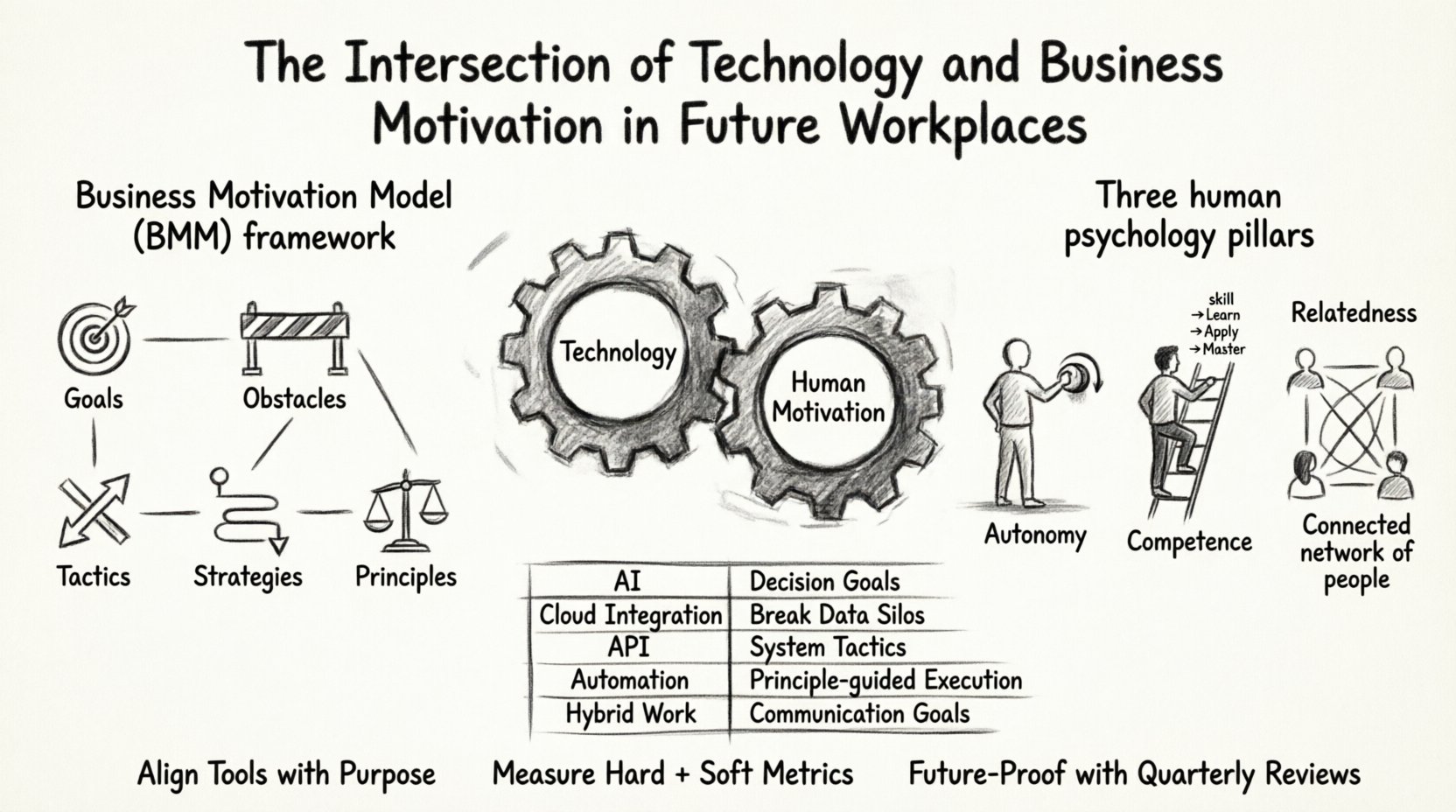
The Business Motivation Model is a standard for modeling the motivation behind business decisions. It is not a software tool; it is a conceptual framework. It breaks down organizational intent into manageable components. To understand its application in a tech-driven workplace, we must first define its core elements clearly.
- Goals: These are the desired outcomes. In a future workplace, goals might include “increase remote collaboration efficiency” or “reduce manual data entry by 40%.” Goals must be specific and measurable.
- Obstacles: These are factors that hinder the achievement of goals. In a digital context, obstacles could be legacy system incompatibility, employee resistance to new workflows, or cybersecurity risks.
- Tactics: These are the specific actions taken to overcome obstacles and achieve goals. A tactic might involve implementing a specific type of communication protocol or training staff on new data visualization tools.
- Strategies: These are the broader plans that guide tactics. Strategies answer the question, “What is our general approach to solving this problem?” For example, a strategy might be “Adopt a cloud-first architecture to improve scalability.”
- Principles: These are the rules that constrain tactics. They define what is acceptable behavior. A principle could be “Data privacy is never compromised for the sake of speed.”
When applied to workplace technology, these elements create a map. They prevent the common pitfall of buying technology without a clear purpose. Instead of asking, “What tool can we buy?” the model asks, “What obstacle are we facing, and what goal are we trying to reach?”
🚀 Technology as a Catalyst for Strategic Change
Technology acts as both an enabler and a disruptor. In the past, technology was often a utility used to speed up existing processes. Today, technology often changes the process itself. This shift requires a recalibration of the Business Motivation Model.
Consider the move toward remote and hybrid work. The goal was often framed as “cost reduction.” However, the BMM reveals deeper motivations. The true goal might be “access to global talent pools” or “improved employee work-life balance.” When technology is aligned with these deeper goals, adoption rates improve. When aligned only with cost, morale often suffers.
Here is how technology impacts the BMM components:
- Impact on Goals: Technology allows for more ambitious goals. Real-time data analytics enable goals that were previously impossible to track, such as “customer satisfaction monitoring in real-time.”
- Impact on Obstacles: Technology creates new obstacles. Automation can lead to job security anxiety. Integration of disparate systems creates complexity.
- Impact on Tactics: Tactics become more automated. Instead of manual reporting, the tactic is “configure automated dashboards.”
- Impact on Strategies: Strategies shift from “paper-based” to “digital-first.” The strategy becomes about agility and data-driven decision-making.
Organizations must recognize that introducing new technology changes the motivational landscape. If a new tool removes autonomy, motivation drops. If it removes friction, motivation rises. The BMM helps predict these outcomes by forcing the organization to define the goal before selecting the tool.
🤝 Aligning Human Motivation with Digital Tools
Technology does not operate in a vacuum. It is used by people. Therefore, the motivation of the workforce is just as critical as the performance of the software. The intersection of tech and business motivation relies on understanding human needs.
Research into workplace psychology suggests that motivation stems from autonomy, competence, and relatedness. Technology can support or undermine these needs.
1. Autonomy
Employees need to feel in control of their work. Surveillance software that tracks mouse movements or keystrokes often violates this need, even if it is intended to ensure productivity. A better approach within the BMM framework is to define the goal as “output quality” rather than “time spent.”
- Bad Alignment: Goal = Track hours. Tool = Time monitoring software. Result = Resentment.
- Good Alignment: Goal = Deliverables on time. Tool = Project management software. Result = Trust.
2. Competence
Technology should empower employees to do better work, not make them feel less capable. Training programs are a vital tactic to support this. When a new system is introduced, the obstacle is often a lack of skill. The strategy must include upskilling.
- Strategy: Continuous learning culture.
- Tactic: Weekly workshops on new tools.
- Principle: No employee is left behind during transition.
3. Relatedness
Remote work can lead to isolation. Technology must facilitate connection, not just task completion. Collaboration platforms should be used to foster community, not just to assign tickets.
By mapping these psychological needs to the BMM, leaders can design technology implementations that support rather than hinder motivation.
📊 Mapping BMM Elements to Modern Tech Trends
To visualize how these concepts interact, we can look at specific technology trends and how they fit into the Business Motivation Model. The following table outlines this relationship.
| BMM Element | Technology Trend | Application in Future Workplace |
|---|---|---|
| Goal | Artificial Intelligence | Enhance decision-making speed and accuracy. |
| Obstacle | Data Silos | Information is trapped in legacy systems, hindering collaboration. |
| Strategy | Cloud Integration | Centralize data access to break down silos. |
| Tactic | API Development | Build connections between old and new systems. |
| Principle | Automation | Automate repetitive tasks only if it preserves human oversight. |
| Goal | Hybrid Work Models | Maintain productivity without physical presence. |
| Obstacle | Communication Lag | Delays in information flow between remote and on-site teams. |
| Strategy | Unified Communication | Use a single platform for all internal messaging. |
| Tactic | Video Conferencing | Schedule regular check-ins to maintain team cohesion. |
This mapping helps leaders see that technology is not an end in itself. It is a resource used to address specific obstacles and achieve specific goals.
⚙️ Tactics and Strategies in an Automated Environment
As automation increases, the nature of tactics changes. In a traditional setting, a tactic might be “assign a team member to process these invoices.” In an automated environment, the tactic becomes “configure the bot to process invoices and flag exceptions.”
This shift requires a change in how we define success. The metric is no longer “how many invoices did the human process?” It is “how many exceptions did the bot catch?”
Strategies also need to evolve. A strategy of “efficiency at all costs” often fails in the long run because it ignores the motivation of the workforce. A better strategy is “Efficiency with Empowerment.” This ensures that automation removes drudgery, allowing humans to focus on high-value activities.
Key considerations for defining tactics in this context include:
- Feasibility: Can the technology actually do this? Not just in theory, but in practice with current data quality?
- Acceptability: Will the team accept this change? Is it perceived as helpful or intrusive?
- Scalability: If this works for one department, can it work for the whole organization?
By rigorously applying the BMM, organizations can avoid the trap of automating processes that should be human-led. Sometimes, the best tactic is to keep the human in the loop for complex judgment calls.
🛡️ Managing Obstacles in a Digital Transformation
Obstacles are the friction points in the Business Motivation Model. In a digital transformation, obstacles are often technical, but they are frequently cultural.
1. Resistance to Change
Employees often fear that technology will replace them. This is a significant obstacle. To overcome this, the strategy must focus on transparency. The goal should be explicitly linked to job enrichment, not replacement.
- Tactic: Town halls explaining the “why” behind the tech.
- Tactic: Pilot programs that allow employees to test tools safely.
2. Data Security
As more work moves online, the risk of data breaches increases. Security is a principle that constrains tactics. You cannot sacrifice security for speed.
- Principle: Security by design.
- Obstacle: User convenience vs. security protocols.
- Strategy: Implement single sign-on to reduce password fatigue while maintaining security.
3. Integration Complexity
New tools rarely play nice with old tools. This creates technical debt. The strategy must account for technical debt management.
- Tactic: Regular audits of software stack.
- Tactic: Phased rollout of new systems.
Ignoring these obstacles leads to failed projects. The BMM forces the organization to acknowledge them before they become blockers.
📈 Measuring Success Beyond Efficiency
Traditional metrics focus on output volume. In a future workplace driven by motivation, we need metrics that reflect engagement and sustainability. The Business Motivation Model suggests that Goals should be measurable. These measurements should include both hard and soft indicators.
Hard Metrics
- Task Completion Time: How long does it take to finish a workflow?
- System Uptime: Is the technology reliable?
- Adoption Rates: Are employees actually using the new tools?
Soft Metrics
- Employee Satisfaction: Regular surveys regarding tool usability and impact on stress.
- Retention Rates: Are people staying longer with the new systems in place?
- Innovation Rate: Are employees proposing new ideas, or are they just following orders?
If efficiency goes up but satisfaction goes down, the strategy is flawed. The BMM helps identify this imbalance. If the Goal is “Sustainable Growth,” then a drop in satisfaction is a sign that the Obstacles (stress, burnout) are outweighing the Tactics (efficiency tools).
🔮 Future-Proofing Your Organizational Strategy
The technology landscape changes rapidly. What is standard today may be obsolete tomorrow. To survive this volatility, the Business Motivation Model must be treated as a living document. It needs regular reviews.
Here are steps to ensure long-term alignment:
- Quarterly Reviews: Revisit Goals and Obstacles. Has the technology landscape shifted? Has a new competitor changed the market?
- Feedback Loops: Create channels for employees to report on how technology affects their motivation. This feeds back into the “Obstacle” definition.
- Flexible Principles: Ensure Principles are ethical and adaptable. Do not lock yourself into rigid rules that prevent innovation.
- Scenario Planning: Use the BMM to model different futures. “If AI takes over X task, what is our new Goal?”
By maintaining this discipline, organizations avoid the reactive scramble that often accompanies tech adoption. They move from reacting to technology to steering it.
The intersection of technology and business motivation is not a one-time project. It is a continuous alignment process. When technology serves the human element, and the human element drives the technology, the result is a workplace that is both productive and humane. The Business Motivation Model provides the structure to keep this balance. It turns vague aspirations into concrete plans, and it turns abstract tools into strategic assets.
As you move forward, remember that the goal is not just to implement the latest tools. The goal is to build a system where technology amplifies human potential. Use the framework to question every investment. Ask what goal it serves, what obstacle it removes, and how it impacts the people using it. This disciplined approach will define the future of your organization.
Related posts:
 Strategic Planning Made Simple: Using Business Motivation Models Effectively
 Step-by-Step Tutorial: Building Your First Business Motivation Model from Scratch
 Transforming Business Goals into Actionable Models: A Practical Guide
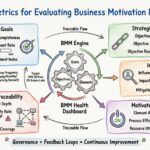 Essential Metrics for Evaluating the Health of Your Business Motivation Model