

In the modern landscape of global commerce, large-scale enterprises operate within an environment defined by intricate dependencies, shifting regulatory requirements, and rapidly evolving market demands. Managing this complexity requires more than just efficient processes; it demands a coherent understanding of why actions are taken and how they align with broader organizational goals. This is where the Business Motivation Model (BMM) becomes indispensable.
For organizations managing thousands of employees and multiple business units, misalignment between strategy and execution can lead to significant resource drain. A structured approach to modeling motivation provides a clear map of the driving forces behind business decisions. This guide explores the architecture of BMM, its application in enterprise contexts, and the strategic advantages it offers without reliance on specific proprietary tools.
🔍 Understanding the Core of Business Motivation
The Business Motivation Model is a conceptual framework designed to describe the motivations that drive business activity. It creates a common language for stakeholders to discuss goals, strategies, and the capabilities required to achieve them. Unlike technical models that focus solely on data flow or system architecture, BMM centers on human and organizational intent.
At its foundation, BMM distinguishes between different types of drivers:
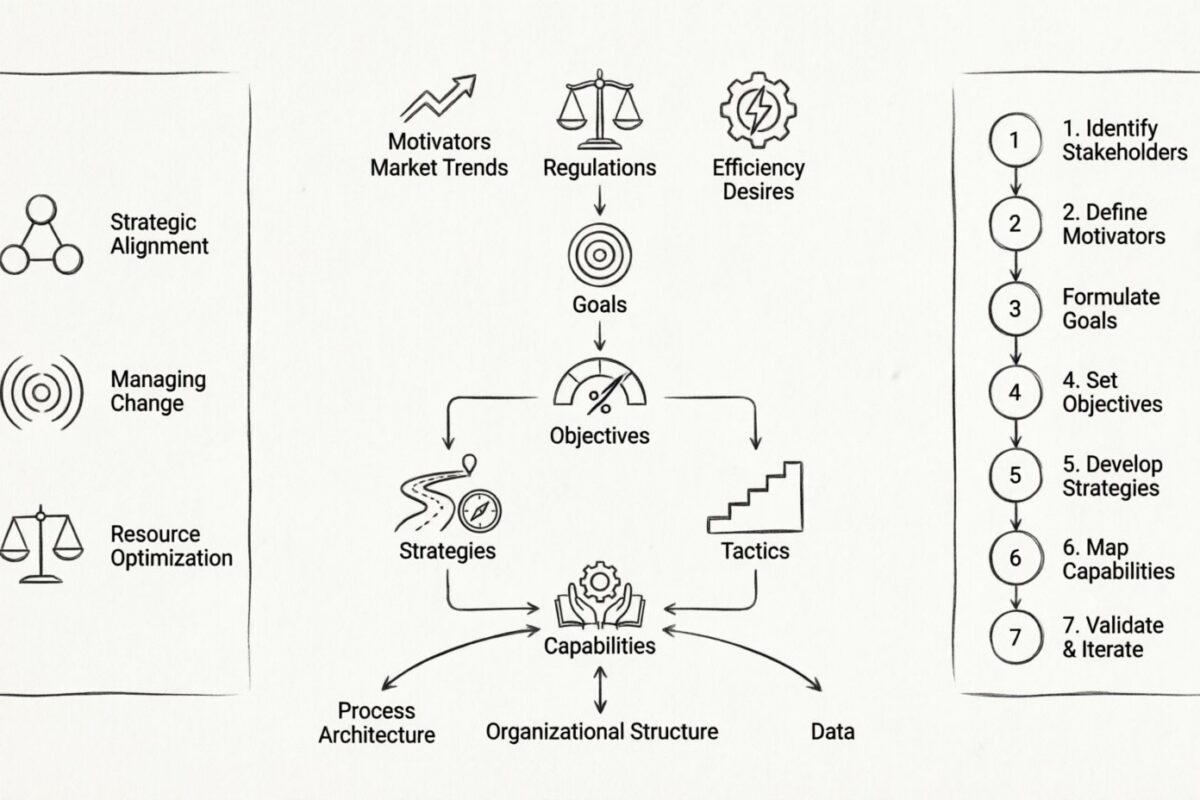
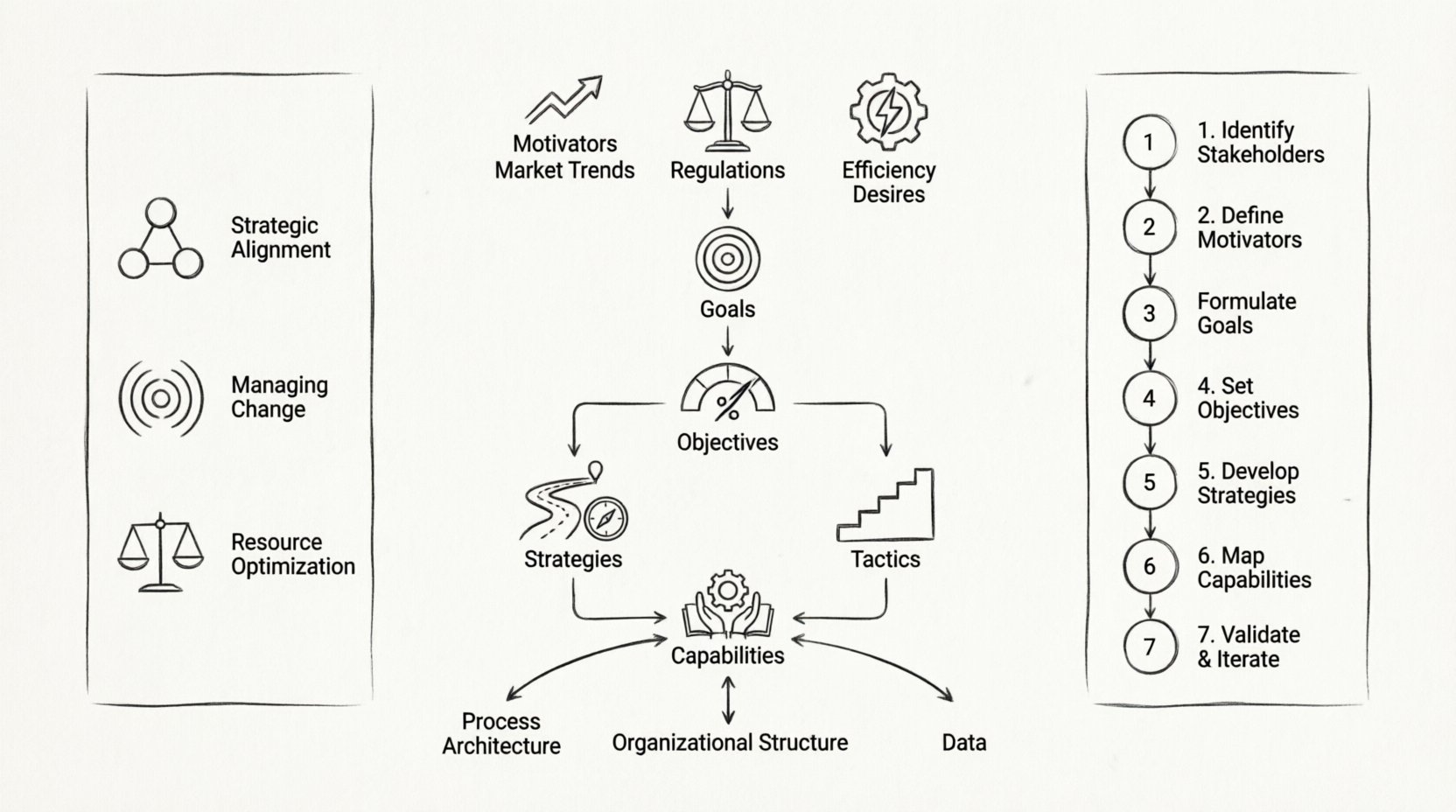
- Motivators: The external or internal forces that influence an organization. These can be market trends, regulatory changes, or internal desires for efficiency.
- Goals: Specific outcomes that an organization seeks to achieve, often driven by motivators.
- Objectives: Quantifiable measures used to assess the achievement of a goal.
- Intentions: The commitment to pursue a goal or objective, often forming the basis for strategic planning.
By categorizing these elements, enterprises can visualize the chain of command from high-level vision down to daily operations. This hierarchy ensures that every task performed by an employee can be traced back to a strategic motivator.
🏗️ Key Components of the Model
To implement this framework effectively, one must understand the specific building blocks that constitute a complete business motivation architecture. These components interact to form a dynamic system that adapts to change.
The following table outlines the primary components and their functions within the enterprise context:
| Component | Description | Enterprise Relevance |
|---|---|---|
| Motivator | External or internal force influencing behavior | Identifies market pressures or compliance needs |
| Goal | Desired end-state or outcome | Aligns departments with corporate vision |
| Strategy | High-level plan to achieve a goal | Defines the approach to competitive advantage |
| Tactic | Specific action taken to support a strategy | Operationalizes plans into executable steps |
| Capability | Ability to perform an activity | Links skills and resources to required outcomes |
📉 Why Large Enterprises Need This Framework
Small organizations often operate with informal communication channels. However, as an enterprise scales, informal communication fails. Information silos emerge, and strategic directives become diluted before reaching execution teams. The Business Motivation Model addresses these specific pain points.
1. Strategic Alignment
Large enterprises frequently struggle with the “strategic drift” phenomenon. While leadership sets high-level goals, middle management and operational teams may interpret them differently. BMM forces a formalization of these links. When a tactic is linked to a strategy, and a strategy to a goal, any deviation is immediately visible. This creates a transparent line of sight from the boardroom to the front line.
2. Managing Change
Change management is a constant requirement in large organizations. When a new regulation is introduced or a market shift occurs, the impact must be assessed. BMM allows analysts to trace the ripple effects. If a new motivator enters the system, which goals are affected? Which strategies must be revised? Which capabilities are no longer sufficient? This traceability reduces the risk of unintended consequences during transformation.
3. Resource Optimization
Resources in large enterprises are finite. Capital, talent, and time must be allocated where they generate the most value. By modeling motivations, organizations can identify which initiatives are tied to critical motivators and which are peripheral. This clarity supports better budgeting decisions and prioritization frameworks.
🛠️ Implementing the Model: A Step-by-Step Approach
Implementing a Business Motivation Model does not require purchasing specific software packages. It requires a disciplined process of discovery, mapping, and validation. The following steps outline a robust approach to establishing this framework within an organization.
- Identify Stakeholders: Begin by engaging leaders from various business units. Their input is crucial for identifying authentic motivators. Do not rely solely on executive mandates; operational staff often understand the true drivers of their work.
- Define Motivators: Catalog the forces influencing the business. These should be categorized as internal (e.g., culture, financial health) or external (e.g., competitor activity, legislation).
- Formulate Goals: For each motivator, define what the organization wants to achieve. Goals should be meaningful but not necessarily quantifiable at this stage.
- Set Objectives: Attach measurable criteria to the goals. This transforms abstract desires into trackable metrics.
- Develop Strategies: Determine the high-level paths to reach the goals. Strategies should be distinct from tactics; they represent the “how” at a macro level.
- Map Capabilities: Identify the skills, technologies, and processes required to execute the strategies. This bridges the gap between planning and doing.
- Validate and Iterate: Review the model with stakeholders to ensure accuracy. As the business evolves, the model must be updated to reflect new realities.
🔗 Integration with Business Architecture
A Business Motivation Model does not exist in isolation. It is a core component of a broader Business Architecture. To maximize its value, it must integrate seamlessly with other architectural layers.
Linking to Process Architecture
Strategies and tactics must be executed through processes. When a capability is mapped to a process, the motivation model provides the context for *why* that process exists. If a process becomes obsolete, the motivation model reveals the loss of capability, signaling a need for process redesign rather than just automation.
Linking to Organizational Structure
Capabilities are often held by specific departments or roles. By mapping capabilities to the organizational chart, leaders can see if the right people are assigned to the right motivational drivers. This helps in identifying gaps in talent or authority that hinder strategic execution.
Linking to Data and Information
Objectives require data to be measured. The motivation model highlights which data points are critical for success. This informs data governance strategies, ensuring that high-priority metrics are accurate, accessible, and secure.
⚠️ Common Challenges and Solutions
Adopting this model introduces complexity of its own. Without careful management, the framework can become a bureaucratic burden rather than an enabler. Recognizing these pitfalls early is essential for success.
- Over-Modeling: Attempting to model every single goal and tactic can lead to analysis paralysis. Focus on the critical path items that drive the most value. Use a top-down approach to start with high-level drivers and drill down only where necessary.
- Static Documentation: A model that is created once and filed away is useless. It must be a living document. Schedule regular reviews to ensure the motivations and strategies still reflect current business conditions.
- Lack of Ownership: Who maintains the model? Assign ownership to specific roles, such as Enterprise Architects or Strategy Officers. Without clear ownership, the model will drift and lose relevance.
- Resistance to Transparency: Some stakeholders may prefer ambiguity. Transparency can reveal inefficiencies or misalignments that people prefer to hide. Communicate the benefits of the model clearly: it is a tool for clarity, not a tool for policing.
📊 Measuring the Impact of the Model
How do you know if the Business Motivation Model is working? Success is not measured by the size of the diagram or the number of elements. It is measured by the quality of decisions and the speed of adaptation.
Key performance indicators for the model itself include:
- Decision Latency: Does the model help reduce the time it takes to make strategic decisions? When a new opportunity arises, can you quickly determine if it aligns with existing goals?
- Execution Consistency: Are operational teams executing tasks that directly support the stated goals? High alignment indicates the model is effective.
- Change Adoption: How quickly does the organization adapt when a motivator changes? A well-modeled architecture allows for rapid reconfiguration of strategies.
- Stakeholder Understanding: Surveys or interviews can gauge whether employees understand the link between their daily work and the company’s broader mission.
🔄 Feedback Loops and Continuous Improvement
The dynamic nature of business requires that the motivation model supports feedback loops. When a tactic fails to produce the expected result, the model should help identify whether the issue lies in the tactic itself, the strategy, or the underlying motivator.
Consider a scenario where a goal is to increase market share (Motivator: Competition). The Strategy is to launch a new product line. The Tactic is to reduce production costs. If market share does not increase, the feedback loop allows you to test hypotheses. Did the cost reduction affect quality? Did the product launch fail to reach the right audience? The model provides the structure to ask these questions systematically.
🌐 Future-Proofing Your Strategy
As enterprises look toward the future, the need for clarity will only grow. Emerging technologies, such as artificial intelligence and automation, introduce new capabilities and new risks. A Business Motivation Model provides the stable foundation upon which these technologies can be evaluated.
Instead of asking “What technology should we buy?”, the question becomes “What capability do we need to achieve this goal, and does this technology provide it?” This shifts the focus from technology procurement to value creation. It ensures that investments are driven by business motivation rather than technological novelty.
🤝 Building a Culture of Alignment
Ultimately, the success of a Business Motivation Model depends on culture. It requires a shift from siloed thinking to systemic thinking. Leaders must champion the use of the model, using its terminology in meetings and reports.
Training programs should be developed to ensure that all employees understand the basic concepts. When a project manager understands what a “Motivator” is, they can better justify their project’s relevance. When an IT developer understands the “Goal” behind a feature, they can make better architectural decisions.
This shared language reduces friction and accelerates collaboration. It turns the abstract concept of “strategy” into a tangible set of connected elements that everyone can see and influence.
🎯 Conclusion on Strategic Clarity
Navigating the complexity of a large-scale enterprise is a formidable challenge. It requires tools that can handle scale, nuance, and change. The Business Motivation Model offers a structured way to capture the “why” behind the “what”. By focusing on motivators, goals, strategies, and capabilities, organizations can ensure that their efforts are directed toward meaningful outcomes.
Implementation is not a one-time event but a continuous practice of alignment. It demands discipline, regular review, and a commitment to transparency. For enterprises that choose to adopt this framework, the reward is a clearer vision, more efficient execution, and a stronger ability to adapt to the future.
Start by mapping your current drivers. Identify the gaps between your intentions and your actions. Build the model step by step. In doing so, you build a foundation that supports not just today’s operations, but tomorrow’s growth.