

In the complex landscape of modern enterprise architecture, aligning technical capabilities with business intent is a persistent challenge. Organizations often struggle to connect high-level strategy with the underlying systems that support operations. This is where the Business Motivation Model (BMM) becomes a critical component. It serves as a structured framework for understanding why an enterprise exists, what it wants to achieve, and how it plans to get there. By integrating BMM into Enterprise Architecture (EA), organizations can ensure that every technological decision supports a defined business purpose.
Enterprise Architecture is not merely about drawing diagrams or managing databases. It is about governance, strategy, and alignment. When business motivation is modeled explicitly, the architecture team gains clarity on the drivers behind system changes. This reduces waste, improves agility, and ensures that investments yield measurable value. This guide explores the mechanics of BMM, its integration into EA, and the practical steps to implement this alignment effectively.
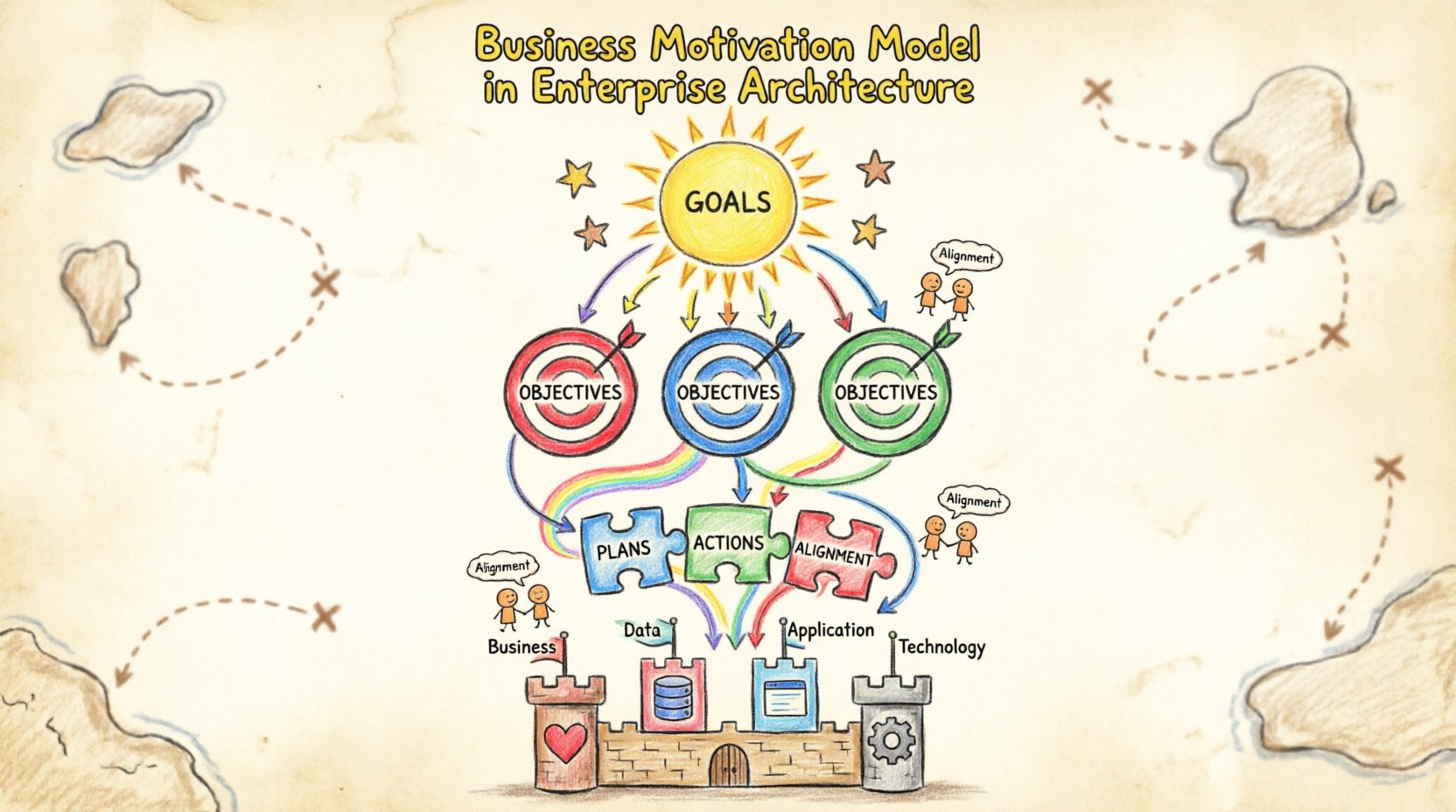
🧩 Understanding the Business Motivation Model
The Business Motivation Model is a standard defined by the Object Management Group (OMG). It provides a vocabulary and structure for describing the business environment. Unlike other architectural frameworks that focus primarily on the structure of the system, BMM focuses on the why and the what before addressing the how. It breaks down organizational intent into manageable components.
Core Components of BMM
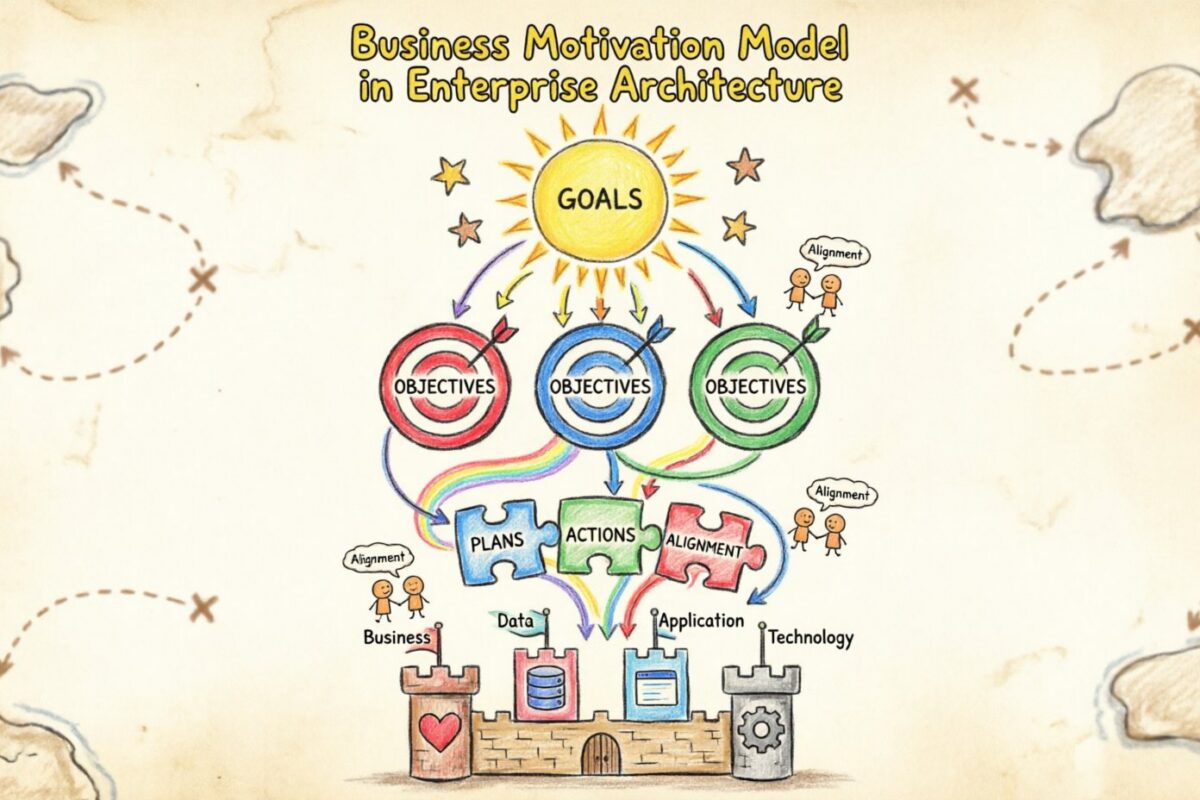
To understand how BMM functions within an architecture, one must understand its fundamental elements. These elements create a chain of logic from abstract desire to concrete action.
- Goals: These are the desired end states. They are broad and strategic. For example, “Increase Market Share” is a goal.
- Objectives: These are specific, measurable targets that support goals. They are often time-bound. For example, “Achieve 10% growth in Q3”.
- Influences: Factors that affect the achievement of goals or objectives. These can be internal (budget, culture) or external (regulations, competitors).
- Assessments: Evaluations of the current state against the desired state. They provide the gap analysis needed to plan.
- Plans: The strategies and courses of action designed to close the gap identified in assessments.
- Actions: The specific tasks or activities executed to fulfill the plans.
These components do not exist in isolation. They form a network of relationships. A goal influences a plan. An action achieves an objective. Understanding these relationships allows architects to trace a technical requirement back to a strategic goal.
🔗 Integrating BMM with Enterprise Architecture
Enterprise Architecture typically covers four main domains: Business, Data, Application, and Technology. The Business Motivation Model sits primarily within the Business Architecture domain but exerts influence over the entire stack. Without BMM, the other domains often operate in silos, leading to systems that function well technically but fail to deliver business value.
The Alignment Mechanism
Integration happens through mapping. Business goals are mapped to business capabilities. Business capabilities are mapped to applications. Applications are mapped to technology infrastructure. This creates a traceability line. If a technology project is initiated, the team can trace it back to the specific goal it supports.
Consider a scenario where an organization wants to improve customer satisfaction (Goal). This goal drives an objective to reduce response times. This objective influences a plan to implement a new ticketing system. The architecture team then designs a data model and application layer to support this ticketing system. Without the BMM, the architecture team might focus on optimizing the database speed without addressing the actual business need of faster customer response.
Table: Mapping BMM Elements to Architecture Domains
| BMM Element | Business Architecture | Application Architecture | Technology Architecture |
|---|---|---|---|
| Goal | Strategic Vision | System Purpose | Infrastructure Support |
| Objective | KPIs and Metrics | Functional Requirements | Performance Specs |
| Plan | Initiatives | Project Roadmap | Deployment Schedule |
| Action | Operational Tasks | Feature Development | Configuration Management |
This table illustrates how abstract concepts translate into technical specifications. It highlights that BMM is not just a business document; it is the blueprint for the entire technical ecosystem.
💡 Benefits of BMM-Driven Architecture
Implementing a Business Motivation Model within the EA practice offers several tangible advantages. These benefits extend beyond simple documentation and impact the operational efficiency of the organization.
- Improved Decision Making: When architects know the underlying motivation, they can prioritize projects better. Resources are directed toward initiatives that support high-priority goals.
- Reduced Redundancy: Clear visibility into business objectives prevents duplicate efforts. If two departments are building similar tools, the BMM reveals that they are working toward the same goal, allowing for consolidation.
- Enhanced Agility: Business environments change. When the model is clear, architects can quickly assess the impact of a new goal on the existing architecture. They know which systems are critical and which are expendable.
- Better Stakeholder Communication: BMM provides a common language. Business leaders speak in goals and objectives. IT leaders speak in systems and data. BMM bridges this gap, allowing for more productive conversations.
- Risk Management: By identifying influences and assessments early, organizations can spot potential blockers before they become critical failures. For example, if a regulatory change is an influence, the architecture can be designed to be compliant by default.
🛠️ Implementation Strategies
Adopting BMM requires a shift in mindset and process. It is not a quick fix but a foundational change. The following steps outline a logical path for implementation.
1. Conduct a Strategic Analysis
Begin by gathering information about the organization’s current state. Interview key stakeholders to identify existing goals and objectives. Document the current influences, both positive and negative. This step establishes the baseline.
2. Define the Motivation Model
Structure the gathered information into the BMM components. Ensure that every goal has supporting objectives. Ensure every plan has actionable tasks. This creates a cohesive model that can be visualized.
3. Map to Architectural Assets
Link the BMM elements to the existing enterprise architecture artifacts. This involves connecting goals to capabilities, and capabilities to applications. Use a repository or modeling tool to maintain these links.
4. Establish Governance
Integrate the BMM into the governance framework. Any new project or architectural change must reference a specific goal or objective. This ensures that the model remains active and relevant.
5. Review and Iterate
Business motivation is dynamic. Regular reviews are necessary to update the model. As goals shift, the architecture must adapt. This creates a feedback loop that keeps the enterprise aligned.
⚠️ Common Challenges and Mitigation
While the benefits are clear, implementing BMM is not without obstacles. Understanding these challenges helps in planning for success.
- Complexity: The model can become overly complex if not managed. Mitigation: Start with high-level goals. Do not attempt to model every single task immediately. Focus on the strategic drivers first.
- Resistance to Change: Stakeholders may view the modeling as administrative overhead. Mitigation: Demonstrate value early. Show how the model simplifies decision-making or reduces rework.
- Data Quality: Inaccurate goals or objectives lead to poor architecture. Mitigation: Validate all inputs with senior leadership. Ensure goals are SMART (Specific, Measurable, Achievable, Relevant, Time-bound).
- Tooling Limitations: Standard tools may not support BMM natively. Mitigation: Use flexible modeling tools or integrate BMM data into existing EA repositories via custom mappings.
📈 The Future of Business Motivation in Architecture
As enterprises become more data-driven and automated, the role of BMM will evolve. The integration of BMM with data analytics and artificial intelligence offers new possibilities. For instance, real-time data can feed into the “Assessment” component of the BMM, providing instant feedback on goal progress. This allows for dynamic architecture adjustments.
Furthermore, the rise of agile and DevOps practices aligns well with BMM. Agile teams work in sprints with clear objectives. These objectives map directly to BMM goals. This synergy allows for a continuous flow of value from strategy to code.
🤝 Best Practices for Success
To ensure the BMM remains effective over time, adhere to these best practices.
- Keep it Simple: Avoid over-engineering the model. A simple model that is used is better than a complex one that is ignored.
- Involve Stakeholders: Do not build the model in isolation. Involve business leaders, architects, and developers to ensure buy-in and accuracy.
- Visualize: Use diagrams to represent the model. Visual representations are easier to understand than text-heavy documents.
- Connect to Metrics: Link objectives to key performance indicators. This allows for the measurement of success.
- Maintain Traceability: Ensure that the link between the BMM and the technical architecture is maintained throughout the lifecycle of the system.
🌐 Conclusion
The integration of Business Motivation Models into Enterprise Architecture is a strategic necessity for modern organizations. It provides the clarity needed to navigate complex business environments. By defining goals, objectives, and plans explicitly, organizations can build architectures that are robust, adaptable, and aligned with business intent. The path forward involves careful planning, stakeholder engagement, and a commitment to maintaining the model over time. When executed correctly, BMM transforms architecture from a technical function into a strategic asset.
Organizations that prioritize this alignment will find themselves better equipped to handle change. They will make fewer mistakes, spend resources more efficiently, and deliver solutions that truly meet business needs. The Business Motivation Model is not just a framework; it is a roadmap for sustainable growth and operational excellence.