

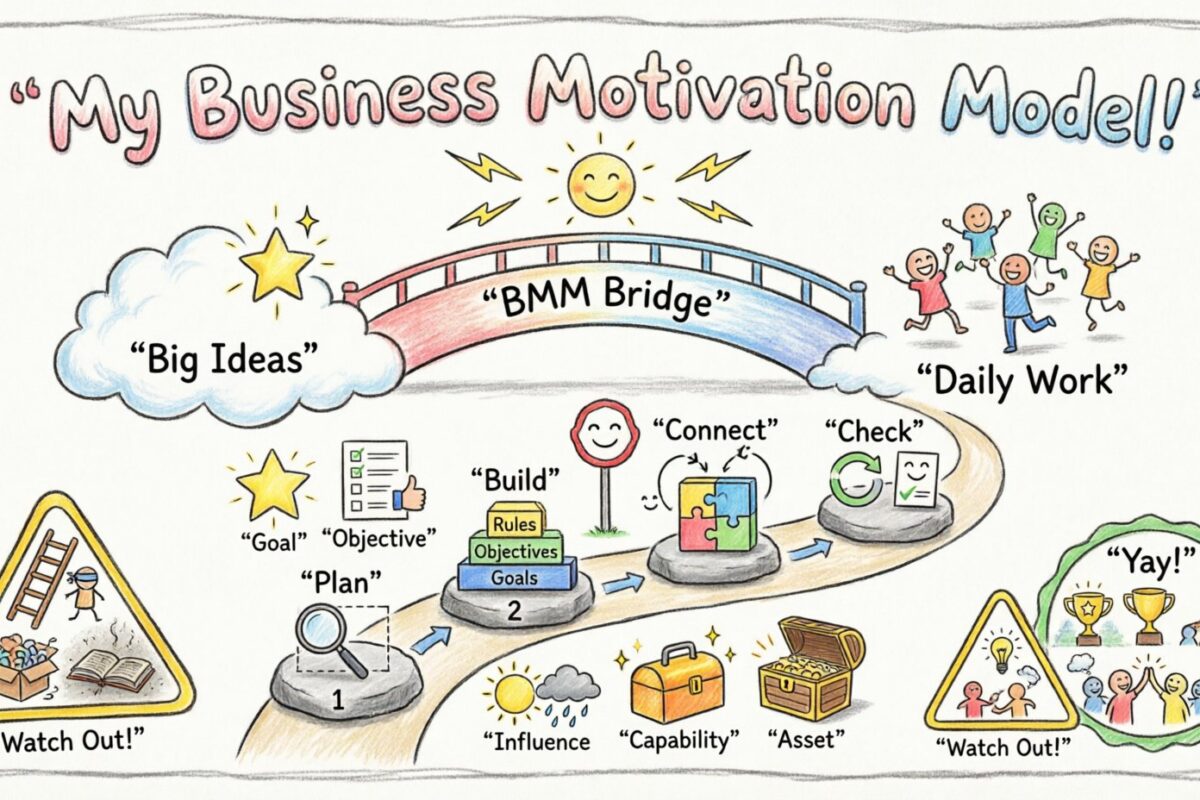
Establishing a clear line of sight between high-level strategy and day-to-day execution is one of the most persistent challenges organizations face. Without a structured approach, intentions often become vague, and resources are misaligned. The Business Motivation Model (BMM) provides a standardized framework to capture this complexity. It allows stakeholders to articulate what they want to achieve, the rules that govern those achievements, and the capabilities required to get there.
This guide details the process of constructing a BMM from the ground up. We will move beyond abstract theory into practical application, ensuring every element serves a specific purpose in your strategic architecture.
Understanding the Business Motivation Model (BMM) 🧠
The Business Motivation Model is a standard developed by the Object Management Group (OMG). It is not merely a diagramming technique; it is a conceptual model designed to represent the “why” and “how” of a business operation. Unlike process models that focus on flow, the BMM focuses on intent.
By defining the model, you create a living document that connects:
- Intent: What the organization wants to happen.
- Rules: The constraints and regulations that must be followed.
- Capabilities: The abilities needed to execute the intent.
- Assets: The tangible and intangible resources available.
When these elements are linked correctly, you gain visibility into dependencies. You can see how a change in a business rule might impact a specific objective, or how a lack of capability could stall a high-priority goal.
Core Concepts and Terminology 📚
Before building the model, it is essential to establish a shared vocabulary. Ambiguity in terms leads to misalignment in the model. The following distinctions are critical for accurate modeling.
Goals vs. Objectives
These terms are often used interchangeably in casual conversation, but in the BMM, they hold distinct meanings.
| Concept | Definition | Timeframe | Example |
|---|---|---|---|
| Business Goal | A high-level desired outcome that drives the business direction. | Long-term | Increase market share in the APAC region. |
| Business Objective | A specific, measurable target that contributes to a goal. | Short/Medium-term | Launch 3 new products by Q4. |
Rules and Influences
- Business Rule: A constraint that must be satisfied. It can be a regulation, a policy, or a condition.
- Influence: Something that affects the achievement of a goal or objective. Influences can be positive (enablers) or negative (impediments).
Capabilities and Assets
- Business Capability: The ability to perform a specific activity or function.
- Business Asset: A resource (people, equipment, data) that is used to fulfill a capability.
Phase 1: Preparation and Scope Definition 📋
Starting without a defined scope often leads to a model that is too broad to be useful. Before drawing any connections, establish the boundaries of your model.
Identify Stakeholders
Who owns the intent? Who defines the rules? You need input from:
- Executive leadership (for strategic goals).
- Process owners (for operational objectives).
- Compliance officers (for business rules).
- IT and Operations (for capabilities and assets).
Determine the Scope
Decide which business unit or function the model will cover. Is this for the entire enterprise, or specifically for the Supply Chain department? A focused scope ensures the model remains manageable and relevant.
Phase 2: Constructing the Model Step-by-Step 🛠️
Building the BMM is a logical progression. You start with the intent and work your way down to the resources. Follow these steps to ensure structural integrity.
Step 1: Define Business Intent
Begin with the “Why.” This is the overarching purpose of the model. It sets the context for all subsequent elements.
- Activity: Document the primary mission statement for the scope.
- Check: Is this clear enough to guide decision-making?
Step 2: Establish Business Goals
Translate the intent into strategic outcomes. Goals should be directional but not necessarily quantifiable yet.
- Activity: List the 3 to 5 primary goals.
- Check: Do these goals directly support the defined intent?
Step 3: Break Down into Objectives
Goals become actionable through objectives. This is where specificity enters the conversation.
- Activity: For each goal, define the measurable steps required.
- Check: Can each objective be measured against a timeline?
Step 4: Identify Business Rules
Rules act as the guardrails. They define what is allowed and what is prohibited within the context of the objectives.
- Activity: Gather constraints from compliance, legal, and policy documents.
- Check: Are these rules mandatory (must be true) or optional (should be true)?
Step 5: Map Influences
Identify factors that will help or hinder the achievement of your goals and objectives. These can be internal or external.
- Positive Influences: Market trends, new technology, skilled workforce.
- Negative Influences: Regulatory changes, competitor actions, budget cuts.
Step 6: Define Capabilities and Assets
Finally, determine what is needed to make the objectives happen. This links the motivation to the execution.
- Capabilities: List the skills and functions required (e.g., “Data Analysis,” “Customer Support”).
- Assets: Identify the resources supporting these capabilities (e.g., “CRM Software,” “Analytics Team”).
Phase 3: Mapping Relationships 🔗
The power of the BMM lies in the connections between elements. A flat list of goals and rules is not a model; a connected web is.
Motivated Relationships
Link objectives to goals. This shows how the smaller targets support the larger vision. If an objective is removed, does the goal still hold? This analysis helps prioritize work.
Influence Relationships
Link rules and influences to goals or objectives. This visualizes risk and opportunity. If a rule changes, you can trace the impact up to the strategic level.
Realization Relationships
Link capabilities and assets to objectives. This ensures that every target has a concrete means of delivery. If a capability is missing, the objective is at risk.
Phase 4: Validation and Maintenance 🔄
A model built today may be obsolete tomorrow. Business environments are dynamic, and your model must reflect that reality.
Validation Checklist
- Completeness: Are all major goals and rules represented?
- Consistency: Do rules contradict each other?
- Clarity: Can a new stakeholder understand the model without extensive training?
Review Cycles
Schedule regular reviews. Align these with your strategic planning cycles (quarterly or annually). During reviews:
- Check if objectives have been met.
- Identify new rules introduced by regulations.
- Assess if new capabilities are needed to support changed goals.
Common Pitfalls to Avoid ⚠️
Even with a solid process, errors can occur during construction. Be vigilant against these common issues.
1. Mixing Levels of Abstraction
Do not mix high-level strategic goals with low-level task lists. Keep goals distinct from operational tasks. A goal is “Increase Revenue,” not “Call 10 clients today.”
2. Ignoring External Influences
It is easy to focus only on internal capabilities. However, external market forces often dictate success. Ensure you map external factors that influence your objectives.
3. Over-Modeling
Do not attempt to model every single rule in existence. Focus on the rules that directly impact the critical objectives. Excessive detail can obscure the main message.
4. Static Documentation
Do not treat the model as a one-time artifact. If the model is not updated, it becomes a historical record rather than a planning tool. It must remain a living document.
Benefits of a Robust BMM ✅
Investing time in building this model yields tangible returns for the organization.
- Improved Alignment: Everyone understands how their work contributes to the bigger picture.
- Risk Management: You can see how rule changes impact goals before they happen.
- Better Resource Allocation: You know exactly which capabilities are needed for which objectives.
- Clear Communication: The model serves as a visual language for stakeholders and technical teams.
Final Thoughts on Strategic Modeling 💡
Constructing a Business Motivation Model is a discipline that requires patience and precision. It is not about creating a perfect diagram immediately; it is about starting the conversation about intent and execution. By following the steps outlined above, you establish a foundation that supports decision-making and strategic clarity.
Remember that the value lies in the understanding gained during the creation process. The resulting artifact is secondary to the shared knowledge of the team. Keep the model simple, keep it updated, and ensure it remains a tool for guidance rather than a burden of documentation.
As you move forward, treat the BMM as the backbone of your enterprise architecture. It connects the vision of the executive suite to the reality of the operational floor. With a solid model in place, you can navigate change with confidence and ensure that every effort is directed toward meaningful outcomes.
Related posts:
 Strategic Planning Made Simple: Using Business Motivation Models Effectively
 Deep Dive into the Six Core Elements of Business Motivation Models
 Why Traditional Strategic Planning Fails and How Business Motivation Models Fix It
 Navigating Complexity: Business Motivation Models for Large-Scale Enterprises