

Organizations strive for coherence between their strategic ambitions and daily operations. When this coherence falters, the result is often inefficiency, wasted resources, and frustrated teams. The Business Motivation Model (BMM) provides a structured way to map these relationships, yet even the most robust frameworks can suffer from internal contradictions. Diagnosing misalignment requires a systematic approach, moving beyond surface-level symptoms to understand the root causes within your strategic architecture.
This guide addresses the technical aspects of identifying and resolving dissonance within a Business Motivation Framework. It focuses on the structural relationships between goals, tactics, assets, and stakeholders, ensuring that every action taken supports the overarching vision. We will explore the mechanics of alignment, common failure points, and the methodologies used to restore harmony without relying on proprietary tools.
🧩 Understanding the Core Components of BMM
Before diagnosing issues, it is necessary to establish a clear understanding of the elements that constitute a healthy Business Motivation Model. Misalignment often stems from a misunderstanding of these components or their interdependencies.
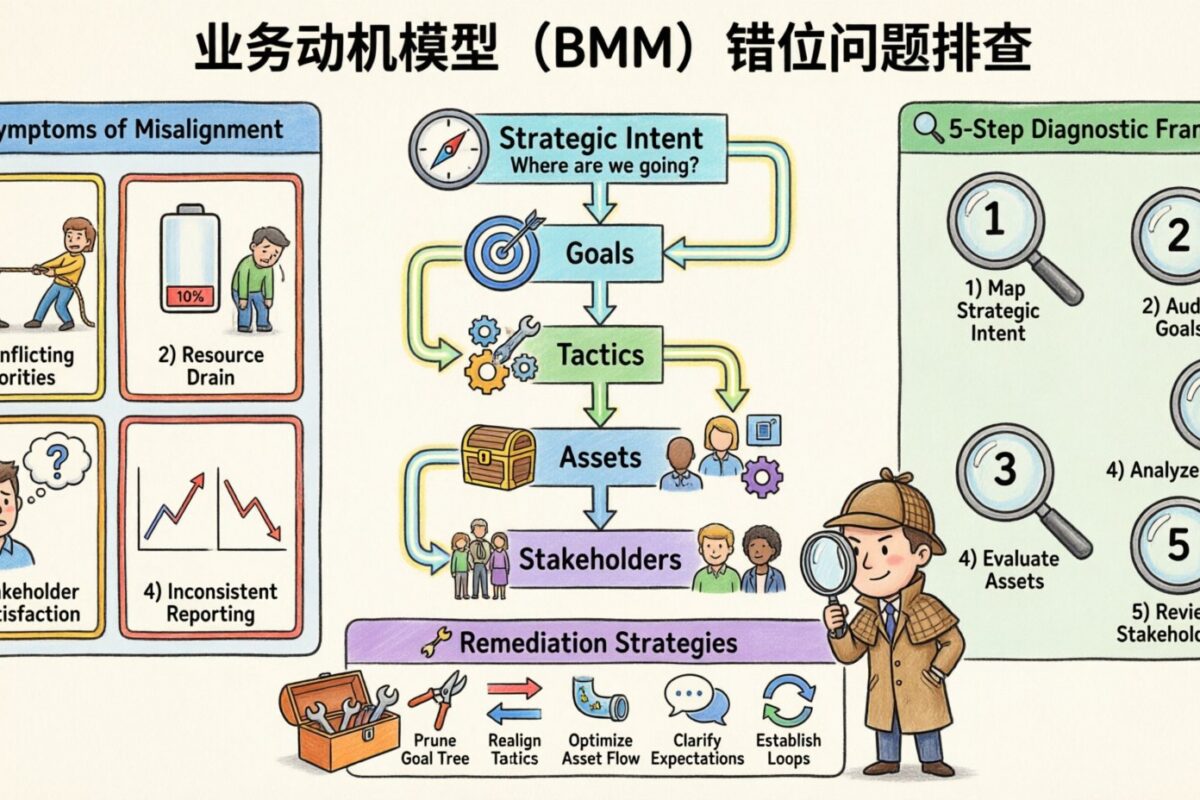
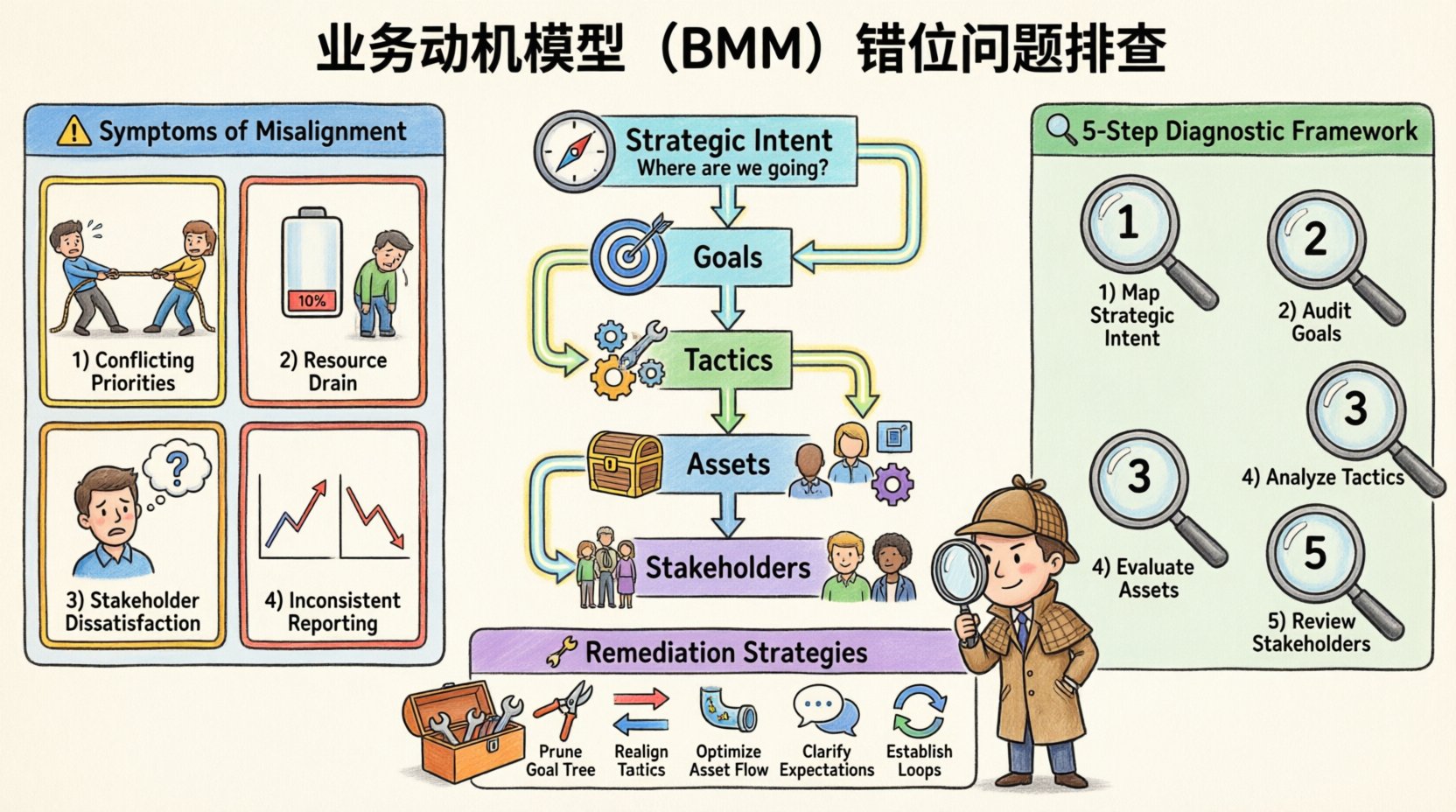
- Strategic Intent: This is the high-level direction. It encompasses the mission and vision that guide the organization. It answers the question: “Where are we going?”
- Goals: Specific, measurable targets that represent the desired end states. Goals provide the criteria for success and are derived directly from strategic intent.
- Tactics: The actions or plans designed to achieve the goals. Tactics are the “how” in the strategy execution process.
- Assets: The resources available to the organization. These include human capital, technology, financial reserves, and intellectual property.
- Stakeholders: Individuals or groups who have an interest in the outcomes. This includes employees, customers, investors, and partners.
- Influencers: External or internal factors that impact the organization but are not directly controlled by it. Market trends, regulatory changes, and competitor actions fall into this category.
When these components function correctly, they form a cohesive chain of motivation. Strategic Intent drives Goals, which dictate Tactics. Assets enable the execution of Tactics, while Stakeholders are influenced by the outcomes. Disruption in any link of this chain creates misalignment.
🚩 Identifying Symptoms of Misalignment
Misalignment rarely announces itself with a single error message. Instead, it manifests as a pattern of operational friction. Recognizing these signs early allows for corrective action before significant damage occurs.
1. Conflicting Priorities
Teams often report working on different things despite having the same leadership. If Department A is optimizing for speed while Department B is optimizing for cost, and neither metric is subordinate to a unified Goal, resources are being split inefficiently. This indicates a failure in the Means-End relationship between Tactics and Goals.
2. Resource Drain
When Assets are deployed in ways that do not support the primary Goals, the organization experiences “burnout.” Employees work harder, but the output does not move the needle on Strategic Intent. This suggests a disconnect between Assets and Tactics.
3. Stakeholder Dissatisfaction
If Stakeholders feel their needs are ignored or if their expectations are not met, the Stakeholder Influence relationship is broken. This often happens when Tactics are designed without considering the impact on the end-user or investor base.
4. Inconsistent Reporting
Data that contradicts itself across different departments is a red flag. If Sales reports growth but Operations reports delays, the Goals are likely not defined with shared metrics. This points to a lack of Commonality in how success is measured.
🔍 The Diagnostic Framework
Diagnosing misalignment requires a forensic approach. You must trace the lines of motivation from the top down and from the bottom up to find where the logic breaks.
Step 1: Map the Strategic Intent
Begin by documenting the current Strategic Intent. Is it clearly articulated? Can every employee explain it in one sentence? If the answer is no, the foundation is weak. Write down the core mission and vision statements. Ensure they are not vague abstractions but actionable directives.
- Check for clarity: Are the words specific?
- Check for alignment: Do all senior leaders agree on this definition?
- Check for relevance: Does this still reflect the current market reality?
Step 2: Audit the Goals
Review the list of active Goals. Do they directly trace back to the Strategic Intent? Use a line-of-logic test. For every Goal, ask: “If we achieve this, does it advance the Strategic Intent?”
If a Goal cannot be traced back, it is a candidate for elimination. It is likely a legacy initiative that no longer serves the current direction. Ensure that Goals are SMART (Specific, Measurable, Achievable, Relevant, Time-bound).
Step 3: Analyze the Tactics
Tactics are the vehicles for Goals. Review the projects and initiatives currently underway. Are they linked to a specific Goal? A tactic without a Goal is a distraction. A tactic linked to a low-priority Goal is a misallocation of effort.
Look for the following indicators:
- Redundancy: Multiple tactics trying to achieve the same Goal without coordination.
- Gaps: Important Goals with no corresponding Tactics assigned.
- Drift: Tactics that have evolved away from their original purpose over time.
Step 4: Evaluate Asset Allocation
Resources must follow strategy. Review where the budget and personnel are allocated. Do the high-priority Goals have the necessary Assets? Or are the best people assigned to low-value projects? This is often where the most visible friction occurs.
Step 5: Review Stakeholder Impact
Ensure that the outcomes of your Tactics are acceptable to key Stakeholders. Map the Stakeholders to the Goals. Does the customer benefit? Does the employee benefit? If a Goal is achieved but the Stakeholder relationship is damaged, the Goal was not truly successful.
📊 Common Misalignment Scenarios
The following table outlines frequent structural issues found in Business Motivation Frameworks. Identifying which scenario matches your situation can speed up the diagnosis.
| Scenario | Definition | Primary Symptom | Root Cause |
|---|---|---|---|
| Strategic Drift | Goals no longer match the current market or mission. | Team feels the work is pointless. | Outdated Strategic Intent. |
| Tactical Overload | Too many Tactics competing for limited Assets. | Projects are consistently delayed. | Uncontrolled Goal expansion. |
| Asset Mismatch | Skills or tools do not fit the Goals. | Low quality output despite high effort. | Poor resource planning. |
| Stakeholder Blindness | Goals ignore key Influencers. | Resistance from users or partners. | Lack of external analysis. |
| Goal Ambiguity | Success criteria are undefined. | Disagreement on whether work is complete. | Poor Goal definition. |
🛠️ Remediation Strategies
Once the diagnosis is complete, the focus shifts to remediation. This involves restructuring the relationships within the framework to restore logical flow.
1. Prune the Goal Tree
Not all goals are created equal. Some are strategic; others are operational. Review the hierarchy and remove Goals that do not serve the Strategic Intent. This creates space for the remaining Goals to receive proper attention.
- Identify “Legacy Goals” that persist without active support.
- Consolidate similar Goals to reduce complexity.
- Ensure every remaining Goal has a clear owner.
2. Realign Tactics
Assign every active project to a specific Goal. If a project cannot be assigned, pause it. This prevents “zombie projects” that consume resources without driving value. Ensure that Tactics are not just tasks, but strategic actions designed to move the Goal.
3. Optimize Asset Flow
Shift resources to where they are needed most. This may mean reassigning staff, reallocating budget, or investing in new technology. The goal is to ensure that the critical path for your Strategic Intent has the fuel it needs.
4. Clarify Stakeholder Expectations
Re-engage with key Stakeholders. Update them on the revised Goals and Tactics. Ensure they understand how their needs are being addressed. This builds trust and reduces resistance to change.
5. Establish Feedback Loops
Create mechanisms to monitor alignment continuously. Regular reviews should check if the Tactics are still leading to the Goals. If the market changes, the Strategic Intent may need adjustment, which cascades down to the Goals and Tactics.
🔄 Maintaining Long-Term Alignment
Alignment is not a one-time fix. It is a dynamic state that requires constant maintenance. The business environment changes, and the framework must adapt.
Regular Audits
Schedule quarterly reviews of the Business Motivation Model. Use the diagnostic steps outlined earlier to check for new signs of misalignment. Look for new Goals that have emerged and ensure they are integrated correctly.
Communication Protocols
Ensure that changes to the framework are communicated clearly. If a Goal is shifted, everyone involved in the Tactics must know. Silence creates uncertainty, which leads to misalignment.
Training and Culture
Build a culture where alignment is valued. Train employees to think in terms of Goals and Tactics, not just tasks. When employees understand the “why” behind their work, they are better equipped to make decisions that support the Strategic Intent.
Adaptability
Be willing to pivot. If the data shows that a Goal is no longer relevant, change it. Rigidity is the enemy of alignment. The framework should be a living document, not a static policy.
📝 Summary of Diagnostic Best Practices
To summarize the technical approach to troubleshooting misalignment:
- Start High: Validate the Strategic Intent first. If the foundation is wrong, the building will not stand.
- Trace the Lines: Follow the logical connections between Intent, Goals, Tactics, and Assets.
- Measure Impact: Use data to verify if the current state matches the intended state.
- Engage People: Stakeholder feedback is a critical diagnostic tool.
- Iterate: Alignment is a continuous process of adjustment and refinement.
By applying these principles, organizations can move from a state of confusion to one of clarity. The Business Motivation Model serves as the blueprint for this transformation. When the relationships between its components are healthy, the organization operates with precision and purpose. Misalignment is not inevitable; it is a solvable problem when approached with the right technical rigor.
Remember that the goal is not perfection, but coherence. As long as the Framework supports the Strategic Intent and the Assets support the Tactics, the organization is on the right path. Regular maintenance and honest diagnosis ensure that path remains clear.
Take the time to audit your current setup. Identify the weak links. Rebuild the connections. This investment in structure pays dividends in execution and performance. A well-aligned framework is the backbone of a resilient enterprise.
Related posts:
 Top 10 Best Practices for Implementing Business Motivation in Enterprises
 Comparative Analysis: Choosing the Right Business Motivation Approach for Your Firm
 Mastering the Art of Business Motivation: Insights from Industry Leaders
 The Intersection of Technology and Business Motivation in Future Workplaces