

Organizations frequently struggle to connect high-level strategy with daily operations. This disconnect often leads to wasted resources, misaligned teams, and missed targets. The Business Motivation Model (BMM) offers a structured approach to bridge this gap. It provides a standardized way to represent what an organization wants to achieve, why it matters, and how it plans to get there.
This guide explores actual deployment scenarios where BMM has been applied to solve complex business challenges. We examine the mechanics of implementation, the specific elements utilized, and the tangible outcomes achieved without relying on proprietary software. The focus remains on the architectural principles and strategic alignment that drive success.
🔍 Understanding the Business Motivation Model Framework
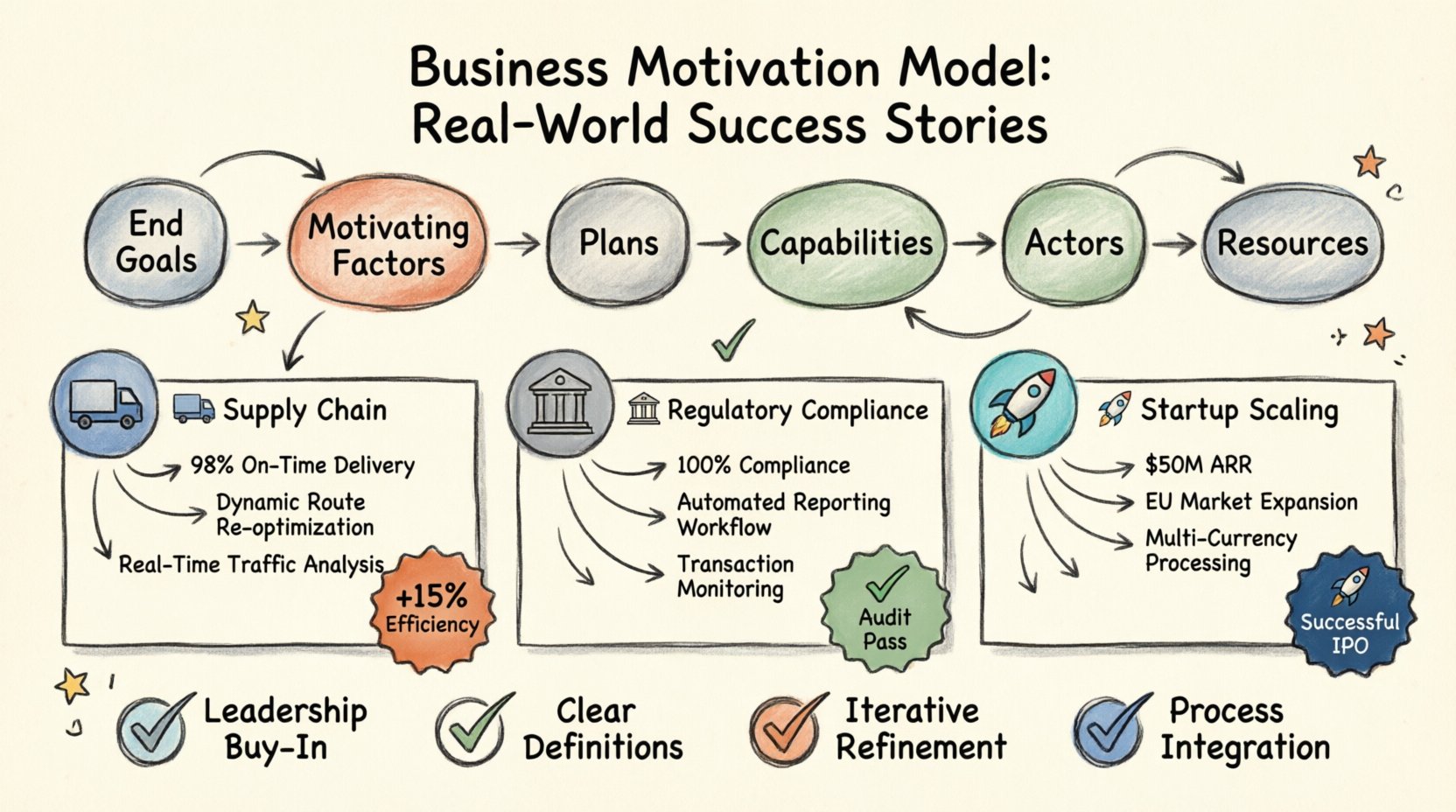
Before diving into specific examples, it is essential to understand the core components that make up a Business Motivation Model. This framework is not merely a diagramming exercise; it is a logical structure for capturing intent and action.
- End Goals: The ultimate objectives the organization strives to reach. These are the “what” of the strategy.
- Motivating Factors: The drivers that push the organization toward the End Goals. These include risks to avoid and benefits to seek.
- Plans: The specific courses of action designed to achieve the End Goals.
- Capabilities: The abilities or resources required to execute the Plans.
- Actors: The individuals, roles, or systems responsible for performing the work.
- Resources: The assets, whether tangible or intangible, needed to support the activities.
When deployed correctly, these elements form a traceable lineage from the boardroom vision down to the shop floor execution. This traceability is the primary value proposition for organizations seeking clarity.
📦 Case Study 1: Global Logistics and Supply Chain Optimization 🚢
A multinational logistics provider faced significant challenges in maintaining on-time delivery rates during periods of high volatility. Their existing strategy documents were static PDFs that rarely updated, leading to confusion among regional managers about priority shifts.
🎯 The Challenge
The organization needed to react faster to external disruptions like weather events or port strikes. The disconnect lay between the strategic goal of “100% Reliability” and the operational reality of delayed shipments. There was no clear link between the high-level goal and the specific operational adjustments required.
🛠 The Deployment Strategy
The architecture team implemented a BMM to map the relationship between goals and operational capabilities.
- End Goal Defined: “Achieve 98% On-Time Delivery Rate within 12 Months”.
- Motivating Factor: “Avoid Customer Churn” (Negative Factor) and “Improve Market Reputation” (Positive Factor).
- Plan: “Implement Dynamic Route Re-optimization System”.
- Capability: “Real-Time Traffic Analysis”.
- Actor: “Regional Dispatch Team”.
By explicitly linking the Plan to the Capability, management could see exactly which operational areas needed investment. They realized that the “Real-Time Traffic Analysis” capability was missing, which explained the failure to meet the End Goal despite having a solid Plan on paper.
✅ The Outcome
Once the gap was identified, resources were allocated to enhance the data ingestion capabilities. Within two quarters, the organization saw a 15% improvement in on-time delivery metrics. More importantly, the BMM served as a living document. When a new competitor entered the market, the “Motivating Factor” was updated, which automatically flagged the need to adjust the “Plan” to maintain the “End Goal”.
💰 Case Study 2: Regional Banking and Regulatory Compliance 🏦
A mid-sized financial institution was facing increasing scrutiny from regulatory bodies. Their compliance team operated in silos, often unaware of how new business products aligned with existing risk frameworks. The organization needed a way to visualize the impact of new initiatives on compliance obligations.
🎯 The Challenge
The primary issue was traceability. When a new loan product was proposed, there was no clear method to verify if the operational capabilities supported the necessary risk controls. This created a high risk of regulatory fines and reputational damage.
🛠 The Deployment Strategy
The focus here was on mapping risk to motivation. The team used the BMM to formalize the relationship between regulatory requirements and business actions.
- End Goal: “Maintain 100% Regulatory Compliance”.
- Motivating Factor: “Avoid Regulatory Fines” (Negative) and “Ensure License Renewal” (Negative).
- Plan: “Automated Compliance Reporting Workflow”.
- Capability: “Transaction Monitoring System”.
- Actor: “Compliance Officer”.
By treating “Avoid Regulatory Fines” as a formal Motivating Factor, the organization prioritized compliance over speed-to-market for certain products. The BMM made it clear that the “Transaction Monitoring System” was a critical Capability that could not be bypassed.
✅ The Outcome
The deployment resulted in a 100% pass rate during the subsequent regulatory audit. The model allowed the bank to simulate changes. Before launching a new product, they could check the BMM to see if the necessary Capabilities were in place. If not, the system highlighted the missing link before resources were spent. This proactive approach reduced the cost of compliance by shifting focus from remediation to prevention.
🚀 Case Study 3: Tech Startup Scaling and Market Expansion 🌍
A technology startup preparing for an initial public offering (IPO) needed to demonstrate consistent growth and operational maturity to investors. Their internal processes were informal, relying heavily on tribal knowledge. This lack of structure posed a risk during the due diligence phase.
🎯 The Challenge
The company needed to prove that its growth was sustainable and not just a result of one-time events. Investors wanted to see a clear line of sight from revenue goals to the engineering and sales capabilities supporting them.
🛠 The Deployment Strategy
The team used the model to align the sales roadmap with engineering capacity. This ensured that promises made to the market could actually be delivered.
- End Goal: “Achieve $50M Annual Recurring Revenue (ARR)”.
- Motivating Factor: “Increase Company Valuation” (Positive).
- Plan: “Expand into European Markets”.
- Capability: “Multi-Currency Payment Processing”.
- Actor: “Sales and Legal Teams”.
The BMM highlighted a critical gap: the “Multi-Currency Payment Processing” capability did not exist. Without this, the Plan to “Expand into European Markets” could not succeed. This forced the leadership to prioritize this feature in the development roadmap.
✅ The Outcome
The company successfully entered the European market with the necessary infrastructure in place. The IPO due diligence process was smoother because the architecture team could present the BMM as evidence of strategic maturity. Investors noted the clear alignment between revenue goals and the capabilities built to support them.
📊 Comparative Analysis of Deployments
To better understand the versatility of this approach, we can compare the key elements across the three case studies. This table highlights how the same model adapts to different industries and objectives.
| Element | Logistics (Supply Chain) | Banking (Compliance) | Tech (Scaling) |
|---|---|---|---|
| Primary End Goal | 98% On-Time Delivery | 100% Regulatory Compliance | $50M ARR |
| Key Motivating Factor | Avoid Customer Churn | Avoid Regulatory Fines | Increase Valuation |
| Critical Capability | Real-Time Traffic Analysis | Transaction Monitoring | Multi-Currency Processing |
| Primary Actor | Dispatch Team | Compliance Officer | Sales & Legal Teams |
| Key Outcome | 15% Efficiency Gain | 100% Audit Pass | Successful Market Entry |
🛠 Key Success Factors for Implementation
Reviewing these deployments reveals common threads that contributed to their success. Organizations looking to replicate these results should focus on the following areas.
🔹 Leadership Buy-In
Business Motivation Models require executive support to be effective. In the banking case, the compliance officer could not force the business to change without the board understanding the risk. Leaders must view the model not as overhead, but as a strategic asset.
🔹 Clear Definitions
Ambiguity kills alignment. Terms like “Capability” or “Plan” must be defined consistently across the organization. If one department defines a Plan as a “Project” and another defines it as a “Process”, the model breaks down.
🔹 Iterative Refinement
None of the case studies achieved perfection on the first try. The Logistics company updated their model quarterly. The Tech startup revised their goals annually. The model is a living artifact that must evolve with the business.
🔹 Integration with Existing Processes
The model should not exist in a vacuum. It must feed into budgeting, performance reviews, and project management. If a Plan does not appear in the budget, it is not a real Plan.
🚧 Common Pitfalls and Mitigation Strategies
Even with a solid framework, deployments can fail. Understanding where things typically go wrong allows teams to navigate these obstacles.
⚠️ Over-Engineering the Model
Problem: Teams attempt to model every single detail, resulting in thousands of elements that become unmanageable.
Mitigation: Start with the top-level End Goals. Only model the capabilities and plans that are critical to achieving those specific goals. Use abstraction for lower-level details.
⚠️ Lack of Maintenance
Problem: The model is created during a workshop and then forgotten. It becomes outdated as soon as the business changes.
Mitigation: Assign ownership. Designate a specific role or team responsible for reviewing and updating the model on a scheduled basis.
⚠️ Disconnect from Execution
Problem: The strategy is modeled, but the day-to-day work ignores it. Teams continue working on legacy tasks.
Mitigation: Link performance metrics directly to the End Goals in the model. If an employee is measured on a metric not linked to the BMM, realign the incentives.
📈 Measuring Success and ROI
How do you know if a Business Motivation Model deployment is working? It is not just about the model itself, but the change in organizational behavior.
- Decision Speed: Does the organization make decisions faster because the impact on goals is clear?
- Resource Allocation: Are funds directed toward Capabilities that directly support Plans?
- Communication: Do employees understand how their daily tasks contribute to the End Goals?
- Agility: Can the organization pivot quickly when a Motivating Factor changes?
In the Logistics example, decision speed improved because the link between traffic data and delivery goals was explicit. In the Banking example, resource allocation improved because the cost of non-compliance was clearly mapped to the Motivating Factors.
🔄 Long-Term Maintenance and Evolution
A deployment is not a one-time event. As the organization grows, the model must scale.
📅 Quarterly Reviews
Schedule regular sessions to review the End Goals. Are they still relevant? Has the market shifted? If the “Motivating Factor” changes, the “Plan” must change.
🔗 Cross-Departmental Alignment
Ensure that different departments do not have conflicting End Goals. For example, Sales might want to increase volume (End Goal), while Operations wants to reduce errors (End Goal). The BMM helps visualize these tensions and find a balanced approach.
📉 Decommissioning
If a Plan is no longer needed, it should be archived or removed. Clutter in the model reduces its value. Regularly prune elements that no longer contribute to the current strategy.
🔗 Connecting Strategy to Operations
The ultimate value of the Business Motivation Model lies in its ability to connect the abstract to the concrete. It translates the vision of the C-suite into the tasks of the workforce.
- For Executives: It provides a high-level view of risk and opportunity.
- For Managers: It clarifies what resources are needed to execute strategy.
- For Employees: It explains the “why” behind their work.
When everyone understands the connection between their actions and the organizational goals, engagement and productivity naturally increase. This is the quiet confidence that comes from alignment.
🏁 Final Thoughts on Strategic Clarity
Implementing a Business Motivation Model requires discipline and a commitment to transparency. It is not a magic solution, but a tool for structure. The case studies presented demonstrate that when organizations take the time to map their intentions to their actions, they achieve better results.
Whether the goal is compliance, efficiency, or growth, the underlying mechanics remain the same. Define the goal, identify the drivers, create the plan, and ensure the capability exists. This cycle, repeated consistently, builds a resilient organization capable of navigating complex market conditions.
By avoiding software-specific dependencies and focusing on the logical relationships between business elements, any organization can benefit from this approach. The model belongs to the business, not the tool. It is a framework for thinking, not just a diagram for display.