

Enterprises operate within complex ecosystems where strategy, execution, and adaptation must coexist. The Business Motivation Model (BMM) offers a standardized framework to map these interactions, ensuring that every action taken aligns with the overarching purpose of the organization. Implementing this model requires more than just documentation; it demands a structural shift in how an enterprise defines value, measures success, and allocates resources. This guide outlines ten essential practices for embedding business motivation principles into the fabric of organizational architecture.
🧩 Understanding the Foundation of Business Motivation
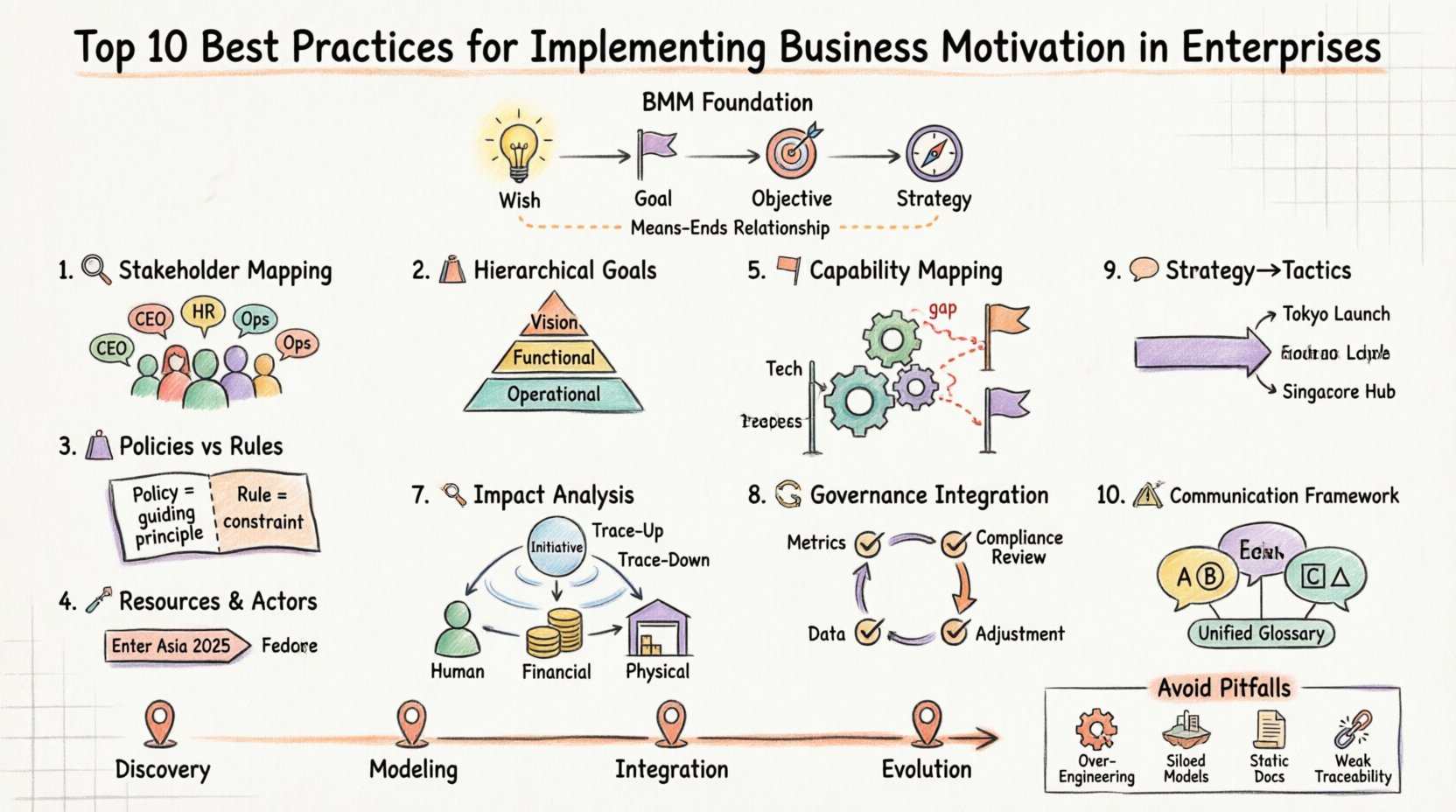
Before diving into implementation steps, it is vital to understand the core components of the Business Motivation Model. Unlike traditional planning methods that focus solely on financial outputs, BMM addresses the why and how behind business decisions. It structures the relationship between the Wish (what we want), Goal (what we commit to), Objective (what we measure), and Strategy (how we plan to achieve it).
By treating business motivation as a distinct layer of architecture, organizations can create traceability from high-level vision down to daily operations. This reduces ambiguity and ensures that stakeholders at all levels understand their contribution to the whole.
📋 Top 10 Best Practices for Implementation
1. Identify and Categorize Stakeholders Early 🔍
The first step in any motivation implementation is recognizing who holds the influence. In a BMM context, stakeholders are not just people; they are roles that possess Wishes or Goals that must be satisfied.
- Internal Stakeholders: Executives, department heads, and operational teams.
- External Stakeholders: Customers, regulators, investors, and partners.
- System Actors: Automated systems or external services that perform tasks.
Documenting these roles early prevents later conflicts where a departmental goal might contradict a corporate objective. A clear map of stakeholders allows for precise assignment of responsibility for specific motivations.
2. Establish a Hierarchical Goal Structure 🏛️
Goals must not exist in isolation. They require a hierarchy to show how lower-level objectives support higher-level strategic aims. This is known as the Means-Ends Relationship.
- Top-Level Goals: Define the long-term vision and mission.
- Mid-Level Goals: Translate vision into functional areas like finance, operations, or IT.
- Operational Goals: Specific targets for teams or individuals.
When establishing this hierarchy, ensure that every lower-level goal can be traced back to a parent goal. This traceability is crucial for impact analysis when changes occur.
3. Distinguish Clearly Between Policies and Rules 📜
Confusion often arises between Business Policies and Business Rules. In the BMM framework, they serve different functions and must be defined distinctly.
| Component | Definition | Example |
|---|---|---|
| Policy | A plan of action or set of principles that guide decisions. | “Customer data must be encrypted at rest.” |
| Rule | A constraint or condition that must be true or false. | “Age must be greater than 18 to purchase.” |
Maintaining this distinction ensures that governance frameworks remain flexible. Policies can be high-level directives that change less frequently, while rules are specific constraints that enforce those policies.
4. Link Strategies Directly to Tactics 🎯
A strategy without a tactic is merely a wish. The BMM framework emphasizes the Support relationship between strategies and tactics. A strategy defines the approach, while tactics are the specific steps taken to execute that approach.
- Strategy: “Enter the Asian market by 2025.”
- Tactic 1: Hire local sales representatives in Tokyo.
- Tactic 2: Establish a logistics partner in Singapore.
Documenting this linkage prevents resource wastage. If a tactic does not support a strategy, it should be re-evaluated or discontinued.
5. Map Capabilities to Business Goals 🛠️
Capabilities represent the organization’s ability to perform activities. To ensure motivation is actionable, capabilities must be mapped to the goals they enable. This creates a capability model that supports the motivation model.
- Identify Gaps: Determine which capabilities are missing to achieve a specific goal.
- Assess Strength: Evaluate if existing capabilities are sufficient.
- Investment Planning: Direct resources toward building or enhancing capabilities.
Without this mapping, organizations may pursue goals without the necessary operational engine to deliver them.
6. Define Resources and Actors Explicitly 🤝
Resources are the assets used to perform activities, and Actors are the entities that perform them. A robust implementation requires a clear inventory of both.
- Human Resources: Skills, roles, and time.
- Financial Resources: Budget, capital, and funding.
- Physical Resources: Facilities, equipment, and technology.
By explicitly linking resources to goals, management can see exactly where investment is required. If a goal is critical, the resources supporting it must be protected from cuts during budget cycles.
7. Implement Impact Analysis Mechanisms 📉
Change is constant. When a goal, policy, or resource changes, the ripple effect must be understood. The BMM framework supports Influence Relationships that allow for impact analysis.
- Trace Down: If a high-level goal changes, which tactics are affected?
- Trace Up: If a specific capability fails, which goals are at risk?
- Dependency Mapping: Understand if a policy relies on a specific rule.
Automating or systematizing this analysis reduces the risk of unintended consequences when strategic shifts occur.
8. Integrate Governance into the Model 🏛️
Governance is not an afterthought; it is embedded within the motivation structure. Policies and rules should be reviewed regularly to ensure they still align with current goals.
- Review Cycles: Set schedules for policy reviews.
- Compliance Checks: Verify that actions adhere to defined rules.
- Decision Rights: Clearly define who has the authority to modify goals or policies.
This integration ensures that the motivation model remains a living document rather than a static archive.
9. Create Dynamic Adaptation Loops 🔄
Static plans fail in dynamic markets. The implementation must include feedback loops where performance data informs the motivation model.
- Performance Metrics: Define how success is measured against objectives.
- Feedback Channels: Establish routes for frontline data to reach strategy teams.
- Adjustment Protocols: Define the process for updating goals based on data.
This loop allows the enterprise to pivot quickly. If an objective is no longer realistic, the model supports adjusting the target rather than ignoring the reality.
10. Standardize Communication Frameworks 📢
Even the best model fails if the organization does not understand it. Communication must be standardized across all levels.
- Visualizations: Use diagrams to show relationships between goals and tactics.
- Terminology: Ensure everyone uses the same definitions for terms like “Goal” and “Objective”.
- Reporting: Create consistent reports that highlight motivation alignment.
Clarity in communication reduces friction and ensures that stakeholders at all levels are working toward the same motivations.
⚠️ Common Pitfalls and Mitigation Strategies
During implementation, certain pitfalls frequently arise. Recognizing them early can save significant time and effort.
| Pitfall | Consequence | Mitigation Strategy |
|---|---|---|
| Over-Engineering | Complexity slows down decision-making. | Start with high-priority goals only. |
| Siloed Models | Information is not shared between departments. | Use a centralized repository for the model. |
| Static Documentation | The model becomes outdated quickly. | Implement regular review cycles. |
| Weak Traceability | Links between strategy and execution are broken. | Enforce mandatory field connections in data entry. |
🚀 Phased Implementation Approach
Adopting these practices does not happen overnight. A phased approach ensures stability.
Phase 1: Discovery and Alignment
Focus on identifying key stakeholders and defining the primary goals. Gather existing documentation and interview leadership to understand current motivations.
Phase 2: Modeling and Mapping
Create the initial BMM structure. Link strategies to tactics and map capabilities. Validate the model with key stakeholders to ensure accuracy.
Phase 3: Integration and Governance
Embed the model into existing workflows. Establish governance rules and impact analysis processes. Train staff on the new terminology and processes.
Phase 4: Monitoring and Evolution
Begin tracking performance against objectives. Use the feedback loops to refine goals and policies. Treat the model as a dynamic asset.
🔗 The Value of Structural Alignment
Implementing business motivation practices transforms how an enterprise operates. It moves the organization from reactive problem-solving to proactive strategy execution. By clarifying the relationships between wishes, goals, policies, and capabilities, leaders gain visibility into the true drivers of performance.
The Business Motivation Model provides a common language. When a developer, a manager, and a board member all use the same definitions for Goal and Strategy, collaboration becomes seamless. The risk of misalignment decreases, and the speed of decision-making increases.
Ultimately, the goal is not just to document motivation, but to operationalize it. When every resource allocation and every tactical decision can be traced back to a core business goal, the enterprise becomes more resilient. It can weather market shifts because its foundation is built on clear, articulated motivations rather than vague intentions.
Adopting these ten practices creates a robust architecture for decision-making. It ensures that the energy of the organization is directed toward meaningful outcomes. For any enterprise seeking clarity in complexity, the Business Motivation Model offers a proven path forward.
Related posts:
 Common Pitfalls in Business Motivation Modeling and How to Avoid Them
 Comparative Analysis: Choosing the Right Business Motivation Approach for Your Firm
 Mastering the Art of Business Motivation: Insights from Industry Leaders
 The Intersection of Technology and Business Motivation in Future Workplaces