

Strategic planning often feels like navigating a ship through dense fog. Organizations set high-level goals, but translating those aspirations into actionable daily tasks can be elusive. Without a clear framework, initiatives drift, resources scatter, and progress stalls. To cut through the ambiguity, many enterprises turn to structured modeling techniques. One of the most robust frameworks available is the Business Motivation Model (BMM). 🧭
This guide explores how to leverage the Business Motivation Model to bring clarity to your strategic planning processes. We will break down the core elements, explain the relationships that bind them, and outline a practical approach to implementation. By the end of this article, you will understand how to construct a model that connects vision to execution without relying on specific software tools.
🔍 Understanding the Business Motivation Model
The Business Motivation Model is a standard specification originally developed by the Object Management Group (OMG). It provides a way to model the motivations behind business activities. In simple terms, it answers the questions: Why are we doing this? What are we trying to achieve? And how do we get there?
Unlike traditional flowcharts that focus on process flow, BMM focuses on intent. It separates the what (the business activity) from the why (the motivation). This distinction is crucial for alignment. When you know the motivation, you can evaluate whether a specific activity contributes to the desired outcome.
Key characteristics of the model include:
- Structured Abstraction: It allows you to view the organization at different levels of detail, from high-level vision to specific tactics.
- Independence: The model is independent of the implementation. It does not dictate technology or specific organizational structure.
- Connectivity: It links drivers and goals directly to the actions taken to achieve them.
🧩 Core Elements of the Model
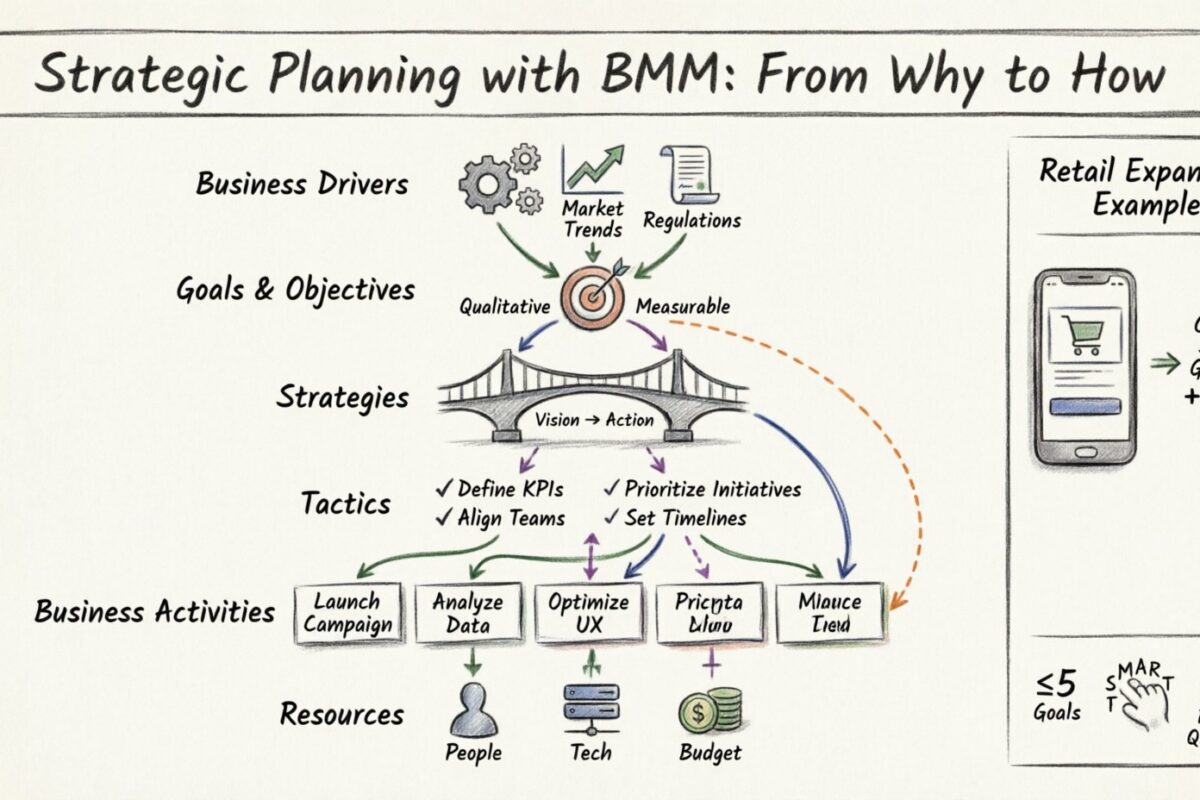
To use the Business Motivation Model effectively, you must understand its building blocks. Each element serves a specific purpose in the hierarchy of planning. Below is a breakdown of the primary components.
1. Goals and Objectives
These are the destinations. However, there is a nuanced difference between them.
- Goal: A high-level desired result. Goals are often qualitative and long-term. They represent the vision.
- Objective: A specific, measurable target that supports a goal. Objectives are concrete and time-bound.
2. Business Drivers
These are the forces that push the organization toward action. Drivers can be internal or external.
- Internal Drivers: Issues within the organization, such as low efficiency, high costs, or poor morale.
- External Drivers: Market forces, regulatory changes, competitor actions, or customer demand.
3. Strategies
A strategy is a plan of action designed to achieve a long-term or overall aim. It bridges the gap between the high-level goal and the day-to-day work. A strategy defines the approach.
4. Tactics
Tactics are the specific steps or actions taken to implement a strategy. They are more granular than strategies and often have shorter timelines.
5. Business Activities
These are the actual work being performed. They are the processes, tasks, and functions that consume resources to produce outputs.
6. Resources
Resources are the assets required to perform activities. This includes people, technology, facilities, and information.
The table below summarizes these elements and their roles.
| Element | Definition | Example |
|---|---|---|
| Goal | Desired outcome | Improve customer satisfaction |
| Objective | Measurable target | Achieve 90% CSAT score by Q4 |
| Driver | Motivating force | Competitor released a better product |
| Strategy | Plan to achieve goal | Launch new customer support training program |
| Tactic | Specific step | Conduct weekly workshops for support staff |
🔗 Understanding Relationships
Defining the elements is only the first step. The power of the Business Motivation Model lies in the relationships between them. These relationships explain how one element influences another.
Means-Ends Relationships
This is the most common connection. It describes how a lower-level element helps achieve a higher-level element.
- Strategy to Goal: The strategy is the means to achieve the goal.
- Tactic to Strategy: The tactic is the means to implement the strategy.
- Activity to Objective: The activity produces the result needed for the objective.
Satisfaction Relationships
This relationship indicates that a lower-level element contributes to the satisfaction of a higher-level element. It is similar to Means-Ends but often implies a contribution rather than a direct cause-and-effect.
- For example, an employee training program (Activity) satisfies the Objective of improved skills.
- Improved skills contribute to the Goal of higher productivity.
Influence Relationships
Not all connections are direct. Some elements influence others without being the direct means to an end. For instance, a new regulation (Driver) might influence a Strategy without being a Goal itself.
Dependency Relationships
This indicates that one element cannot exist or function without another. If you remove a resource, the activity dependent on it cannot proceed.
🛠️ Implementing the Model: A Step-by-Step Approach
Implementing this model does not require a specific software suite. It requires disciplined thinking and structured documentation. Follow these steps to build your own model.
Step 1: Define the Vision and Drivers
Start at the top. Identify the core drivers forcing change or improvement. Ask stakeholders what is pushing them. Is it a drop in revenue? A new law? A desire for innovation? Document these clearly.
Step 2: Establish Goals and Objectives
Translate the drivers into clear goals. Ensure these are broad enough to guide strategy but specific enough to measure. Then, break goals down into measurable objectives. Use the SMART criteria (Specific, Measurable, Achievable, Relevant, Time-bound) for objectives.
Step 3: Formulate Strategies
Once you know where you want to go (Goal) and what you need to hit (Objective), decide how to get there. Brainstorm strategies. These should be distinct paths that could lead to the goal. Select the most viable ones.
Step 4: Develop Tactics and Activities
For each strategy, define the tactics. What specific actions are required? List the business activities involved. This is where the work gets defined.
Step 5: Assign Resources
Identify what is needed to execute these activities. Do you need more staff? New software? Additional budget? Map resources to the activities that require them.
Step 6: Map the Relationships
Draw the connections. Link activities to tactics, tactics to strategies, strategies to goals, and drivers to goals. Use the relationship types discussed earlier (Means-Ends, Satisfaction, Influence). This creates the visual map of your organization’s intent.
🚀 Benefits of Using Business Motivation Models
Why invest time in modeling? The benefits extend beyond simple documentation. Here is how organizations gain value from this approach.
- Improved Alignment: Everyone understands how their daily work connects to the top-level vision. There is less confusion about priorities.
- Better Decision Making: When a new proposal arises, you can check the model. Does this proposal support a goal? If not, it might be a distraction.
- Agility: If a driver changes (e.g., a market shift), you can trace the impact through the model. You can see which strategies need adjustment without dismantling the whole plan.
- Clear Communication: The model provides a common language for business leaders and IT teams. It bridges the gap between strategy and execution.
- Resource Optimization: By mapping resources to activities, you can identify bottlenecks or redundancies.
⚠️ Common Pitfalls and How to Avoid Them
Even with a solid framework, mistakes can happen. Be aware of these common issues when building your model.
1. Too Many Goals
Organizations often list too many goals. This dilutes focus. If everything is a priority, nothing is. Limit your top-level goals to a manageable number, perhaps three to five.
2. Confusing Goals and Objectives
Ensure you distinguish between the vision (Goal) and the metric (Objective). A common error is writing a goal that is too tactical. Goals should remain high-level.
3. Ignoring the Drivers
Planning without understanding the drivers leads to solutions that do not solve the real problem. Always start by identifying the root causes or external pressures.
4. Static Models
A model that sits on a shelf is useless. Business environments change. Review and update the model regularly. Treat it as a living document.
5. Over-Modeling
Do not try to model every single task in the organization. Focus on the strategic layer. If you go too deep, the model becomes unmanageable.
🔄 Integration with Enterprise Architecture
The Business Motivation Model does not exist in isolation. It is often part of a larger Enterprise Architecture (EA) strategy. How does it fit with other models?
With Business Process Model and Notation (BPMN)
BPMN focuses on the flow of work. BMM focuses on the intent behind the work. You can link BMM goals to BPMN processes. For example, a Goal to “Reduce Delivery Time” might be achieved by optimizing a specific BPMN process. This ensures the process change is justified by a strategic need.
With IT Architecture
IT systems support business activities. By mapping activities in BMM to IT systems, you can justify IT investments. You can show that a specific software purchase directly supports a business strategy, making the budget request stronger.
With Risk Management
Risks can be treated as negative drivers. A risk that could damage a goal acts as a negative influence on that goal. BMM allows you to model mitigation strategies as tactics to reduce that risk.
💡 Practical Example: Retail Expansion
Let us look at a concrete scenario to see how these pieces fit together. Imagine a retail company planning to expand online.
- Driver: Competitors are capturing online market share. Customers prefer shopping via mobile devices.
- Goal: Become a market leader in digital retail.
- Objective: Increase online sales revenue by 25% within 18 months.
- Strategy: Invest in a mobile-first e-commerce platform.
- Tactic: Hire a dedicated mobile app development team.
- Activity: Develop user authentication module.
- Resource: Cloud hosting services, Senior Developers.
In this example, the connection is clear. The Driver forces the Goal. The Objective makes the Goal measurable. The Strategy defines the approach. The Tactic and Activity define the work. The Resource enables the work. If the cloud hosting is delayed, the Activity is delayed, which impacts the Tactic, Strategy, and eventually the Objective and Goal.
📊 Maintaining Model Integrity
Once the model is built, maintaining it is critical. A model that is not maintained becomes a relic. Here are best practices for upkeep.
- Regular Reviews: Schedule quarterly reviews to check if drivers are still valid.
- Stakeholder Feedback: Ask the people doing the work if the model reflects reality. They will spot disconnections quickly.
- Version Control: Keep records of changes. If you change a strategy, document why and when. This helps with auditing and learning.
- Training: Ensure new employees understand the model. It is part of the organizational culture.
🌐 The Future of Strategic Planning
As organizations become more complex, the need for clear motivation models will grow. Automation and AI are changing how we work. While tools can help manage data, the human element of defining motivation remains essential. A model ensures that automation is used for the right reasons.
Focusing on the why prevents the trap of optimizing the wrong things. You might become faster at doing something that no longer matters. BMM keeps the focus on the value provided to the business and its customers.
🎓 Summary
Building a Business Motivation Model requires discipline, but the payoff is significant. It transforms abstract strategy into concrete action. It aligns resources with intent. It provides a map for navigating change.
By understanding the core elements like Goals, Drivers, Strategies, and Tactics, and by mapping the relationships between them, you create a living framework for your organization. You do not need expensive software to start. You need clarity, communication, and a commitment to structure.
Start small. Identify one goal and trace it back to the drivers. Connect it to the activities. Expand from there. Over time, this practice will refine your strategic planning process, ensuring that every step taken moves the organization toward its true objectives. 🏁
Related posts:
 Top 10 Best Practices for Implementing Business Motivation in Enterprises
 Deep Dive into the Six Core Elements of Business Motivation Models
 Why Traditional Strategic Planning Fails and How Business Motivation Models Fix It
 Navigating Complexity: Business Motivation Models for Large-Scale Enterprises