

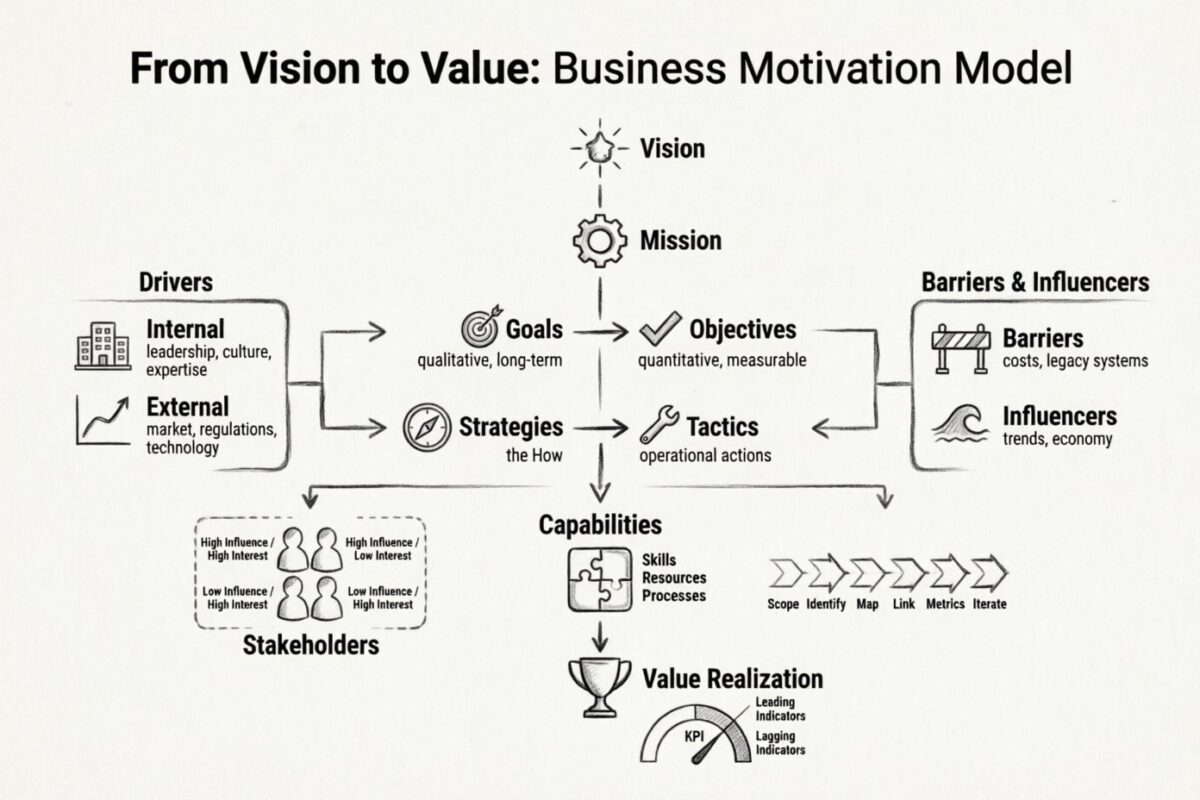
Organizations often struggle to translate high-level aspirations into tangible results. The gap between what a company envisions and what it delivers is frequently where value is lost. To bridge this divide, a structured approach to understanding intent and alignment is necessary. The Business Motivation Model (BMM) provides this structure. It serves as a blueprint for defining, analyzing, and executing the motivations that drive an organization forward. This guide explores how to move from abstract vision to concrete value through systematic modeling.
Understanding the Business Motivation Model 🧠
The Business Motivation Model is a framework designed to clarify the reasons behind business decisions. It maps the relationships between strategic intent and operational execution. Without this clarity, resources are misallocated, and efforts become disjointed. The model does not prescribe specific software or tools. Instead, it defines the conceptual elements required for coherent business architecture.
- Clarity of Purpose: It ensures every action links back to a primary driver.
- Consistency: It aligns different departments toward shared outcomes.
- Adaptability: It allows for adjustments when external conditions shift.
By adopting this model, an enterprise creates a living document of its own strategy. This document evolves as the business evolves, maintaining relevance over time.
The Hierarchy of Intent 📉
At the heart of the model is a hierarchical structure. This structure organizes motivations from the most abstract to the most concrete. Understanding these levels is critical for effective communication across the organization. Each level answers a specific question regarding the organization’s direction.
1. Vision and Mission
The Vision represents the desired future state. It is the destination. The Mission defines the scope of operations required to reach that destination. Together, they set the boundaries for all subsequent planning.
- Vision: What does success look like in five or ten years? 🌟
- Mission: What do we do today to make that future possible? 🛠️
2. Goals and Objectives
Goals are broad statements of desired outcomes. Objectives are specific, measurable targets that support the goals. Distinguishing between these two is often a source of confusion. The table below clarifies the distinction.
| Element | Definition | Characteristics |
|---|---|---|
| Goal | Broad desired outcome | Qualitative, long-term, directional |
| Objective | Specific target | Quantitative, short-term, measurable |
For example, a goal might be to “Improve Customer Satisfaction.” An objective supporting this would be “Reduce response time to under two hours by Q3.” This specificity allows for tracking progress.
3. Strategies and Tactics
Strategies are the approaches used to achieve goals. Tactics are the specific actions taken to execute strategies. This layer bridges the gap between planning and doing.
- Strategy: The “How” at a high level.
- Tactic: The “How” at an operational level.
If the strategy is “Market Expansion,” a tactic might be “Launch localized marketing campaign in Region X.” This granular view ensures that daily activities contribute to the broader strategy.
Motivators: Drivers and Barriers 🎯
Why does the organization pursue these goals? The motivations are influenced by factors that push or pull the organization. These factors are categorized as Drivers and Barriers.
Internal Drivers
These originate within the organization. They include:
- Leadership vision 👔
- Financial capacity 💰
- Organizational culture 🏢
- Employee expertise 🧑💼
External Drivers
These originate outside the organization. They include:
- Market demand 📈
- Regulatory changes ⚖️
- Competitor actions 🏁
- Technological advancements 📱
Barriers and Influencers
Not all factors are positive. Barriers represent obstacles that must be overcome. Influencers are factors that affect the outcome but are not necessarily obstacles. Recognizing these allows for risk mitigation.
- Barriers: High entry costs, legacy systems, regulatory hurdles.
- Influencers: Seasonal trends, economic shifts, public opinion.
The Role of Stakeholders 👥
Motivation is not abstract; it belongs to people. Stakeholders hold the motivations that drive the business. Identifying who holds which motivation is a critical step in the model.
Primary vs. Secondary Stakeholders
- Primary: Those with a direct interest in the outcome (e.g., shareholders, customers). 🤝
- Secondary: Those indirectly affected (e.g., community, suppliers). 🌍
Mapping Influence
Not all stakeholders have equal power. A matrix can be used to map stakeholders based on their influence and interest.
- High Influence, High Interest: Manage closely. These are key decision-makers.
- High Influence, Low Interest: Keep satisfied. They can block progress if ignored.
- Low Influence, High Interest: Keep informed. They can provide valuable feedback.
- Low Influence, Low Interest: Monitor. Minimal engagement required.
Connecting Motivation to Capabilities 🛠️
Motivation must translate into capability. A business cannot achieve its objectives without the necessary skills, resources, and processes. The model links motivation to the Business Capabilities required to execute the plan.
Capability Gaps
Analysis often reveals gaps between current capabilities and required capabilities. Addressing these gaps is essential for value realization.
- Skills Gap: Lack of training or expertise among staff.
- Resource Gap: Insufficient budget or technology.
- Process Gap: Inefficient workflows that hinder performance.
Business Processes
Processes are the mechanisms by which capabilities are applied. They turn inputs into outputs. The model ensures that processes are designed to support the strategic objectives, not just operational convenience.
| Process Type | Strategic Alignment |
|---|---|
| Core Processes | Directly deliver value to customers |
| Support Processes | Enable core processes to function |
| Management Processes | Monitor and control overall performance |
Implementation Strategy 📋
Applying the Business Motivation Model requires a disciplined approach. It is not a one-time exercise but an ongoing practice. The following steps outline how to integrate this model into organizational operations.
Step 1: Define the Scope
Begin by determining the boundaries of the analysis. Is this for the entire enterprise or a specific division? Defining scope prevents the model from becoming too complex to manage.
Step 2: Identify Motivations
Gather input from leadership and key stakeholders. Document the Vision, Mission, Goals, and Objectives. Ensure they are written clearly and without ambiguity.
Step 3: Map Influencers
Conduct an analysis of internal and external factors. List all potential drivers, barriers, and influencers. This creates a risk and opportunity register.
Step 4: Link to Capabilities
Review current business capabilities. Identify which ones support the identified goals. Highlight any deficiencies that need addressing.
Step 5: Establish Metrics
Define how success will be measured. These metrics should align directly with the objectives. This ensures accountability and provides data for future adjustments.
Step 6: Review and Iterate
Business environments change. Regular reviews ensure the model remains relevant. Schedule periodic assessments to update the motivations and strategies.
Challenges in Application ⚠️
While the model offers structure, implementing it comes with challenges. Recognizing these early helps in navigating the process effectively.
- Complexity: The interconnections between elements can become overwhelming. Keeping the model simple is vital.
- Resistance to Change: Stakeholders may resist new ways of aligning motivation with action. Communication is key.
- Data Availability: Measuring objectives requires accurate data. Incomplete data leads to poor decision-making.
- Static Planning: Treating the model as a static document rather than a dynamic guide reduces its utility.
Measuring Value Realization 📊
The ultimate purpose of the Business Motivation Model is value realization. This means the organization achieves the intended benefits of its strategies. Measuring this requires a focus on outcomes rather than outputs.
Key Performance Indicators (KPIs)
KPIs are the metrics used to track progress. They must be:
- Relevant: Directly tied to an objective.
- Measurable: Quantifiable data points.
- Actionable: Information that leads to decisions.
Leading vs. Lagging Indicators
- Leading Indicators: Predict future performance (e.g., training hours completed).
- Lagging Indicators: Reflect past performance (e.g., revenue generated).
A balanced scorecard approach often works best. It combines financial and non-financial measures to provide a holistic view of performance.
Integrating with Business Architecture 🏗️
The Business Motivation Model is a cornerstone of Business Architecture. It provides the “why” that informs the “what” and “how” of other architectural layers.
- Strategy: The model defines the strategic direction.
- Organization: It clarifies roles and responsibilities.
- Information: It identifies data needs to track objectives.
- Technology: It dictates the capabilities required to support processes.
When these layers are aligned, the organization operates with coherence. When they are misaligned, friction occurs, and efficiency drops.
Case Study Scenarios 📝
Consider a scenario where an organization wants to transition to a digital-first model.
- Vision: Become the leading digital provider in the sector.
- Goal: Increase digital transaction volume by 50%.
- Objective: Launch mobile app by end of year.
- Driver: Customer preference for mobile access.
- Barrier: Legacy infrastructure costs.
- Strategy: Phased migration of services.
- Tactic: Invest in API modernization.
Without this model, the objective (launch app) might proceed without addressing the barrier (legacy costs), leading to failure. The model forces the consideration of the barrier before the tactic is chosen.
Sustaining the Framework 🔄
Maintaining the integrity of the Business Motivation Model requires ongoing commitment. It is not enough to build the model once. It must be embedded in the organizational rhythm.
- Training: Ensure staff understand the concepts and their role in the model.
- Communication: Regularly update stakeholders on progress and changes.
- Governance: Establish a governance body to oversee alignment and updates.
- Feedback Loops: Create channels for feedback from the operational level to the strategic level.
This sustains the alignment between what is planned and what is delivered. It turns the model into a living system rather than a static document.
Key Takeaways 📌
Effective business motivation requires more than good intentions. It requires a structured framework that connects intent to action. The Business Motivation Model offers this structure.
- Alignment: Ensure all activities support the Vision and Mission.
- Clarity: Distinguish clearly between Goals and Objectives.
- Responsiveness: Adapt strategies based on Drivers and Barriers.
- Measurement: Use KPIs to track value realization.
- Integration: Embed the model into broader business architecture.
By following these principles, organizations can navigate complexity with confidence. They can ensure that every step taken moves them closer to their defined value. This systematic approach reduces risk and increases the likelihood of success in a dynamic market.
Frequently Asked Questions ❓
Q: How often should the model be updated?
A: Updates should occur whenever there is a significant shift in the business environment or strategy. Annual reviews are common, with ad-hoc updates as needed.
Q: Can small businesses use this model?
A: Yes. While the model is robust, it can be scaled down for smaller organizations. The core concepts of motivation and alignment apply regardless of size.
Q: What is the difference between a goal and a strategy?
A: A goal is the desired outcome. A strategy is the plan to achieve that outcome. One defines the destination; the other defines the route.
Q: Does this model require specific software?
A: No. The model is conceptual. It can be implemented using standard documentation tools, spreadsheets, or specialized business architecture platforms, though the choice of tool is separate from the model itself.
Q: How do we handle conflicting motivations?
A: Conflicts arise when different stakeholders have different drivers. This requires negotiation and prioritization. The model helps visualize these conflicts so they can be addressed explicitly.
Related posts:
 Top 10 Best Practices for Implementing Business Motivation in Enterprises
 Deep Dive into the Six Core Elements of Business Motivation Models
 Why Traditional Strategic Planning Fails and How Business Motivation Models Fix It
 Navigating Complexity: Business Motivation Models for Large-Scale Enterprises