

Organizations often struggle to connect high-level aspirations with daily operations. The disconnect between what a business intends to achieve and how it actually operates creates friction, wasted resources, and missed opportunities. To address this, the Business Motivation Model (BMM) provides a standardized framework for understanding the drivers of organizational behavior. This guide explores how to leverage BMM for effective strategic alignment without relying on specific software tools.
By defining the relationship between goals, plans, and the factors that influence them, leaders can create a coherent structure that supports decision-making. This approach ensures that every action taken contributes to the broader vision. We will examine the core components, the mechanics of alignment, and practical steps for implementation.
🏗️ What is a Business Motivation Model?
A Business Motivation Model is a conceptual framework used in enterprise architecture to represent the factors that motivate an organization. It describes the “why” behind business actions. The model allows stakeholders to visualize the connections between strategic intent and operational execution. It does not prescribe a specific methodology but rather offers a vocabulary and structure for modeling motivation.
Key characteristics of this model include:
- Abstraction: It works at a level of detail that is appropriate for strategic planning.
- Flexibility: It can be applied to entire enterprises or specific departments.
- Connectivity: It explicitly links outcomes to the actions required to achieve them.
- Clarity: It reduces ambiguity regarding who is responsible for what.
When implemented correctly, the model acts as a blueprint for organizational coherence. It helps answer critical questions such as why a certain project was initiated, how it supports a goal, and what external pressures might affect its success.
🧩 Core Components Explained
The BMM relies on three primary categories of elements. Understanding these distinctions is vital for accurate modeling. Each category serves a unique purpose in the architecture of organizational intent.
1. Ends
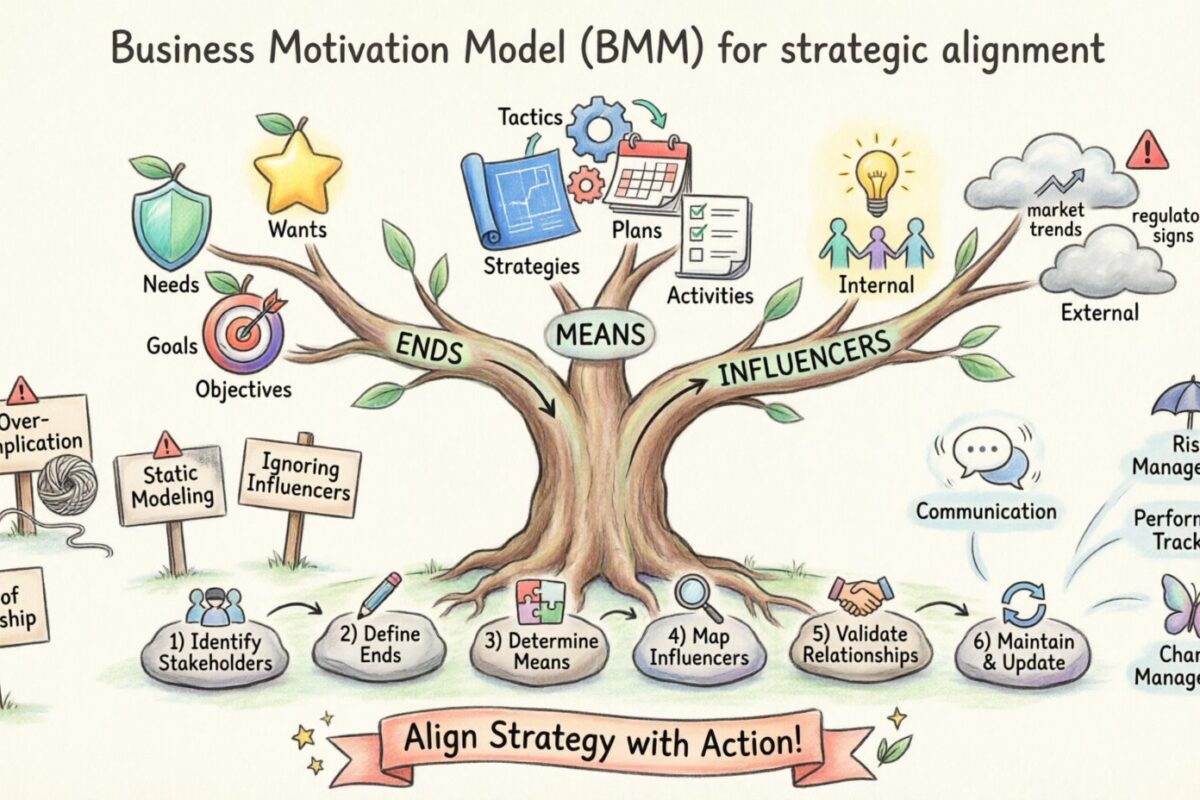
Ends represent the desired states or outcomes that an organization seeks. These are the targets of motivation. They are generally categorized into:
- Needs: Essential requirements that must be met for the organization to survive. These are non-negotiable.
- Wants: Desirable outcomes that improve performance but are not strictly necessary for existence.
- Goals: Specific, measurable targets derived from Needs and Wants.
- Objectives: High-level statements of purpose that guide the setting of Goals.
For example, a Need might be regulatory compliance. A Want could be market expansion. A Goal would be to increase market share by 10% in the next fiscal year. An Objective might be to become the industry leader in sustainability.
2. Means
Means are the actions, strategies, or resources used to achieve the Ends. They are the “how” of the model. The hierarchy typically flows from broad strategies down to specific activities.
- Strategies: High-level approaches to achieving objectives.
- Tactics: Specific methods employed to implement strategies.
- Plans: Documented sequences of actions with timelines.
- Activities: The actual tasks performed by individuals or teams.
Continuing the example above, a Strategy might involve digital transformation. A Tactic could be migrating to cloud infrastructure. A Plan would be the budget and schedule for the migration. Activities would include server provisioning and data migration scripts.
3. Influencers
Influencers are the internal or external factors that affect the ability to achieve Ends through Means. They are the context in which the model operates. These can be positive (enablers) or negative (constraints).
- Internal Influencers: Budget constraints, organizational culture, employee skills, and technology availability.
- External Influencers: Market trends, competitor actions, regulatory changes, and economic conditions.
Understanding these influences allows organizations to anticipate risks and leverage opportunities before they become critical issues.
🔄 Connecting Means and Ends
The core value of the Business Motivation Model lies in the relationships between these components. It is not enough to list goals and activities; the links between them must be explicit. This linkage ensures traceability.
A Means is linked to an End to show how it contributes. An Influencer is linked to a Means or End to show how it impacts success. The strength of these links can vary. Some activities are critical to a goal, while others are supportive.
Consider the following matrix to understand how these elements interact:
| Element Type | Primary Question | Example |
|---|---|---|
| End | What do we want to achieve? | Increase customer satisfaction score by 15% |
| Mean | How will we achieve it? | Implement a new feedback loop system |
| Influencer | What affects the result? | Staff training availability |
When mapping these connections, organizations often discover gaps. A common issue is having a Goal without a corresponding Strategy. Another is having a Strategy with no defined Activities. The model forces these gaps to surface, allowing for correction before resources are committed.
🎯 The Role of Strategic Alignment
Strategic alignment refers to the process of ensuring that an organization’s activities support its strategy. In many companies, strategy exists in documents, but execution happens in silos. The BMM bridges this gap by providing a visual and logical structure.
Why Alignment Matters
Without alignment, departments may work at cross-purposes. Marketing might promise features that Engineering cannot deliver. Sales might push discounts that Finance deems unprofitable. A unified model ensures everyone is pulling in the same direction.
Benefits of strategic alignment include:
- Resource Optimization: Budget and personnel are directed toward high-value initiatives.
- Cultural Cohesion: Employees understand how their work fits into the bigger picture.
- Agility: When external Influencers change, the model helps identify which Strategies need adjustment.
- Accountability: Clear links between activities and goals make ownership easier to define.
Aligning IT and Business
One of the most common areas requiring alignment is between Information Technology (IT) and Business units. Often, IT is viewed as a cost center rather than an enabler. Using the BMM, IT capabilities can be mapped directly to Business Goals.
For instance, if a Business Goal is “Real-time Data Analytics,” the IT Strategy must support data infrastructure. The Influencers might include data security regulations. By modeling this, IT leaders can justify infrastructure investments as direct contributors to business success rather than technical necessities.
🚀 Implementation Steps
Implementing a Business Motivation Model is a structured process. It requires involvement from leadership and key stakeholders. The following steps outline a typical workflow for adoption.
Step 1: Identify Stakeholders
Begin by identifying who has a stake in the organization’s success. This includes executives, department heads, and key operational staff. Their input is necessary to define the Ends accurately.
Step 2: Define the Ends
Work with stakeholders to articulate the Needs, Wants, Goals, and Objectives. Ensure these are distinct and not duplicated. Use SMART criteria (Specific, Measurable, Achievable, Relevant, Time-bound) for Goals.
Step 3: Determine the Means
For each Goal, identify the Strategies and Tactics required. Break these down into Plans and Activities. Avoid skipping levels; ensure there is a clear path from activity to goal.
Step 4: Map Influencers
List the factors that could help or hinder the execution of the Means. Distinguish between internal and external factors. Assign owners to manage specific Influencers where possible.
Step 5: Validate Relationships
Review the connections. Does Activity A actually contribute to Goal B? Is Influencer C accurately represented? This validation step often reveals logical errors or missing links.
Step 6: Maintain and Update
The model is not static. Business conditions change. Influencers shift. Goals evolve. Establish a review cycle to update the model regularly. This ensures it remains relevant.
💡 Benefits of Using BMM
Adopting this framework offers tangible advantages for organizations seeking clarity. It moves decision-making from intuition to evidence-based planning.
- Improved Communication: Provides a common language for discussing strategy across different levels of the organization.
- Risk Management: By identifying Influencers, organizations can proactively mitigate risks rather than reacting to crises.
- Performance Tracking: Since Goals are linked to Activities, it becomes easier to measure whether actions are moving the needle on objectives.
- Change Management: When change is required, the model shows which Goals and Activities are affected, minimizing disruption.
Furthermore, the model supports documentation standards. It creates a repository of organizational intent that can be referenced during audits, planning sessions, or onboarding new leaders.
⚠️ Common Pitfalls to Avoid
While the framework is robust, it can be misapplied. Recognizing common mistakes helps ensure a successful rollout.
- Over-complication: Trying to model every single activity leads to paralysis. Focus on high-level strategies and critical goals first.
- Static Modeling: Creating the model and filing it away. It must be a living document used in active decision-making.
- Ignoring Influencers: Focusing only on Goals and Plans while neglecting external factors leads to brittle strategies.
- Lack of Ownership: If no one is responsible for updating the model, it will become outdated quickly.
- Confusing Needs and Wants: Treating Wants as Needs can lead to resource misallocation. Be precise about what is essential versus what is desirable.
✅ Best Practices for Success
To maximize the value of the Business Motivation Model, adhere to these guidelines.
- Start Small: Pilot the model in one department before expanding enterprise-wide.
- Visualize: Use diagrams to represent the links between Ends, Means, and Influencers. Visuals aid comprehension.
- Engage Leadership: Ensure senior management champions the initiative to secure buy-in.
- Link to Budget: Where possible, tie financial allocations to the Means in the model. This enforces alignment.
- Train Teams: Provide training on how to use the model. Ensure staff understand the terminology.
- Review Regularly: Schedule quarterly reviews to update the model based on new data and market conditions.
❓ Frequently Asked Questions
Is BMM a software tool?
No, BMM is a conceptual framework. While software tools exist that support modeling, the concept itself is independent of technology. It can be implemented using whiteboards, documents, or specialized platforms.
How does BMM differ from SWOT analysis?
SWOT focuses on Strengths, Weaknesses, Opportunities, and Threats. BMM is more detailed, focusing on the specific causal links between Goals and Actions. They can be used together, with BMM providing the structure for SWOT insights.
Can this be used for personal development?
Yes. Individuals can apply the principles to career planning. Personal Goals, Strategies, and Influencers can be mapped to ensure personal efforts align with professional aspirations.
What is the difference between a Strategy and a Plan?
A Strategy is the approach or direction taken to achieve an Objective. A Plan is the specific schedule and resource allocation for executing the Tactics derived from that Strategy. Strategy is the “what” and “how” at a high level; Plan is the “when” and “who”.
How often should the model be updated?
This depends on the volatility of the industry. In stable industries, an annual review may suffice. In dynamic sectors, quarterly or even monthly updates may be necessary to maintain accuracy.
🔗 Summary of Key Takeaways
The Business Motivation Model offers a powerful way to align organizational intent with execution. By clearly defining Ends, Means, and Influencers, leaders can create a transparent roadmap for success. The framework supports better communication, risk management, and resource allocation.
Successful implementation requires commitment to regular updates and clear ownership. It is not a one-time exercise but an ongoing discipline. When used effectively, it transforms strategy from a static document into a dynamic tool for driving performance.
Organizations that prioritize this alignment are better positioned to navigate complexity and achieve their long-term vision. The focus remains on clarity, coherence, and measurable progress across all levels of the enterprise.
Related posts:
 Top 10 Best Practices for Implementing Business Motivation in Enterprises
 Deep Dive into the Six Core Elements of Business Motivation Models
 Why Traditional Strategic Planning Fails and How Business Motivation Models Fix It
 Navigating Complexity: Business Motivation Models for Large-Scale Enterprises