

In the modern landscape of software engineering, a persistent challenge remains the disconnect between those who build systems and those who define the business needs. Developers speak in logic, data structures, and algorithms. Business stakeholders speak in goals, workflows, and outcomes. When these two groups attempt to collaborate without a shared vocabulary, the result is often rework, missed requirements, and delayed delivery. This is where Business Process Model and Notation (BPMN) serves a critical function. It is not merely a diagramming tool; it is a standardized language that translates business intent into technical specifications.
This guide explores how BPMN facilitates clear communication between development teams and business units. We will examine the structural elements of the notation, the psychological benefits of visual modeling, and the practical steps to integrate this methodology into your workflow. By adopting this standard, organizations can reduce ambiguity and ensure that the final product aligns perfectly with strategic objectives. 🚀
Understanding the Communication Gap in Software Projects 🛑
Before diving into the solution, it is necessary to understand the problem. The gap between business and technology is not new, but it has become more pronounced as software complexity increases. Business teams often describe processes in natural language. Natural language is inherently ambiguous. Words like “process,” “handle,” or “approve” can mean different things to different people. A business analyst might describe a workflow as “submitting a form,” while a developer interprets this as “creating a database entry with a specific status flag.”
These discrepancies lead to several common issues:
- Misinterpreted Requirements: Features are built based on assumptions rather than explicit specifications.
- Scope Creep: Changes are introduced mid-development without understanding the impact on the overall process flow.
- Inefficient Testing: QA teams test against incomplete or misunderstood logic, missing critical edge cases.
- Rework Cycles: Code must be rewritten because the underlying business logic was not captured accurately at the start.
BPMN addresses these issues by replacing ambiguous text with a visual syntax. It forces the business and technical teams to agree on the exact sequence of events before a single line of code is written. This alignment reduces the cognitive load on developers, allowing them to focus on implementation rather than interpretation.
What is Business Process Model and Notation? 📐
BPMN is a standard defined by the Object Management Group (OMG). It provides a graphical notation for specifying business processes in a Business Process Model. The primary goal of this standard is to be understandable by all business stakeholders, from technical users to process owners, without requiring extensive training.
Unlike proprietary diagramming methods, BPMN is an industry standard. This means the symbols and rules are consistent across different organizations and tools. When a developer sees a specific shape, they know exactly what it represents, regardless of the software they use to view it.
The notation is designed to be executable. This means that a BPMN diagram is not just a drawing; it represents a model that can be executed by a process engine. However, even when not executed, the model serves as a precise blueprint. It defines the start, the end, the logic gates, the data involved, and the actors responsible for each step.
The Visual Language of Development 🎨
One of the most powerful aspects of BPMN is its ability to abstract complexity. A developer does not need to see the SQL queries or the API endpoints to understand the flow of a transaction. They need to see the flow of the decision. BPMN provides a visual grammar that mirrors human thought processes.
Consider the concept of a decision point. In code, this might look like a nested if-else statement spanning ten lines. In BPMN, this is a single diamond shape. This abstraction allows business stakeholders to validate the logic without being overwhelmed by syntax. They can ask, “Is this the correct path for a rejected application?” and get an immediate visual answer.
Furthermore, BPMN introduces the concept of Swimlanes. Swimlanes categorize activities by the actor or system responsible for them. This clarifies handoffs. In a digital system, a handoff is often where data gets lost or errors occur. By visualizing the handoff between a “User” lane and a “System” lane, teams can identify where errors might happen and build safeguards.
Key Symbols That Bridge the Divide 📊
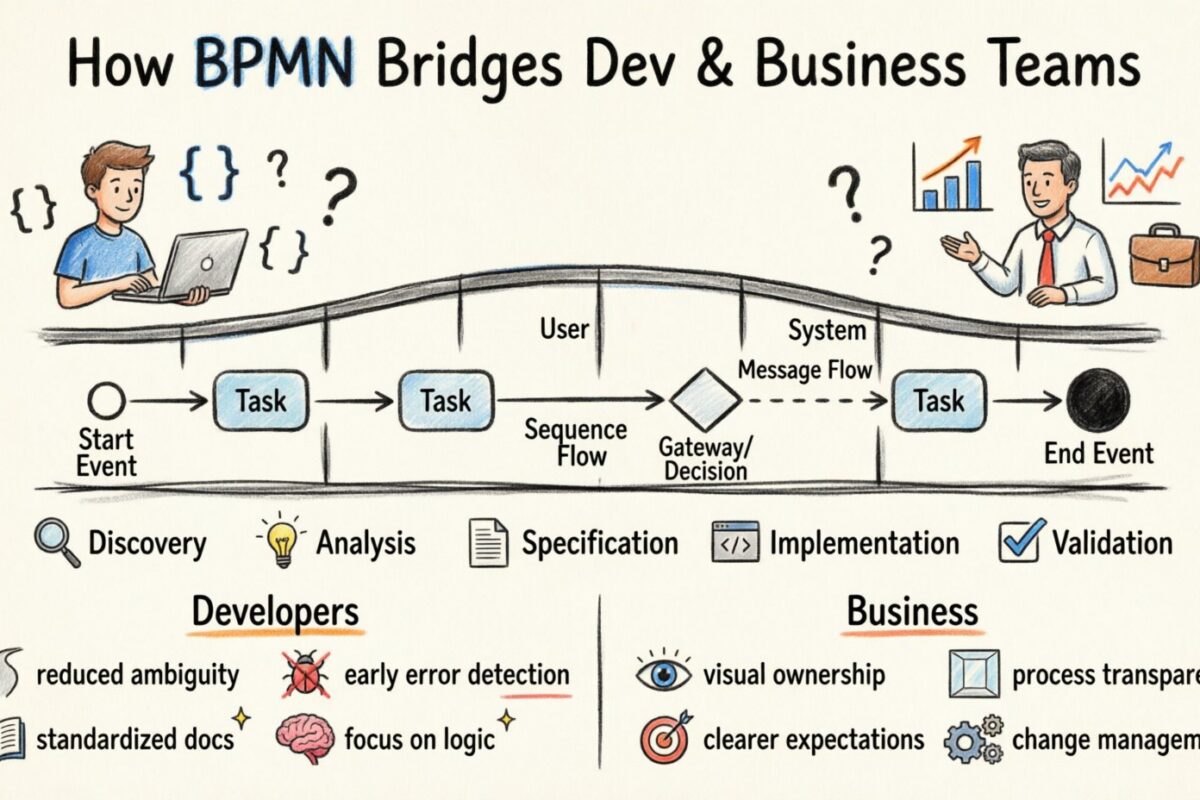
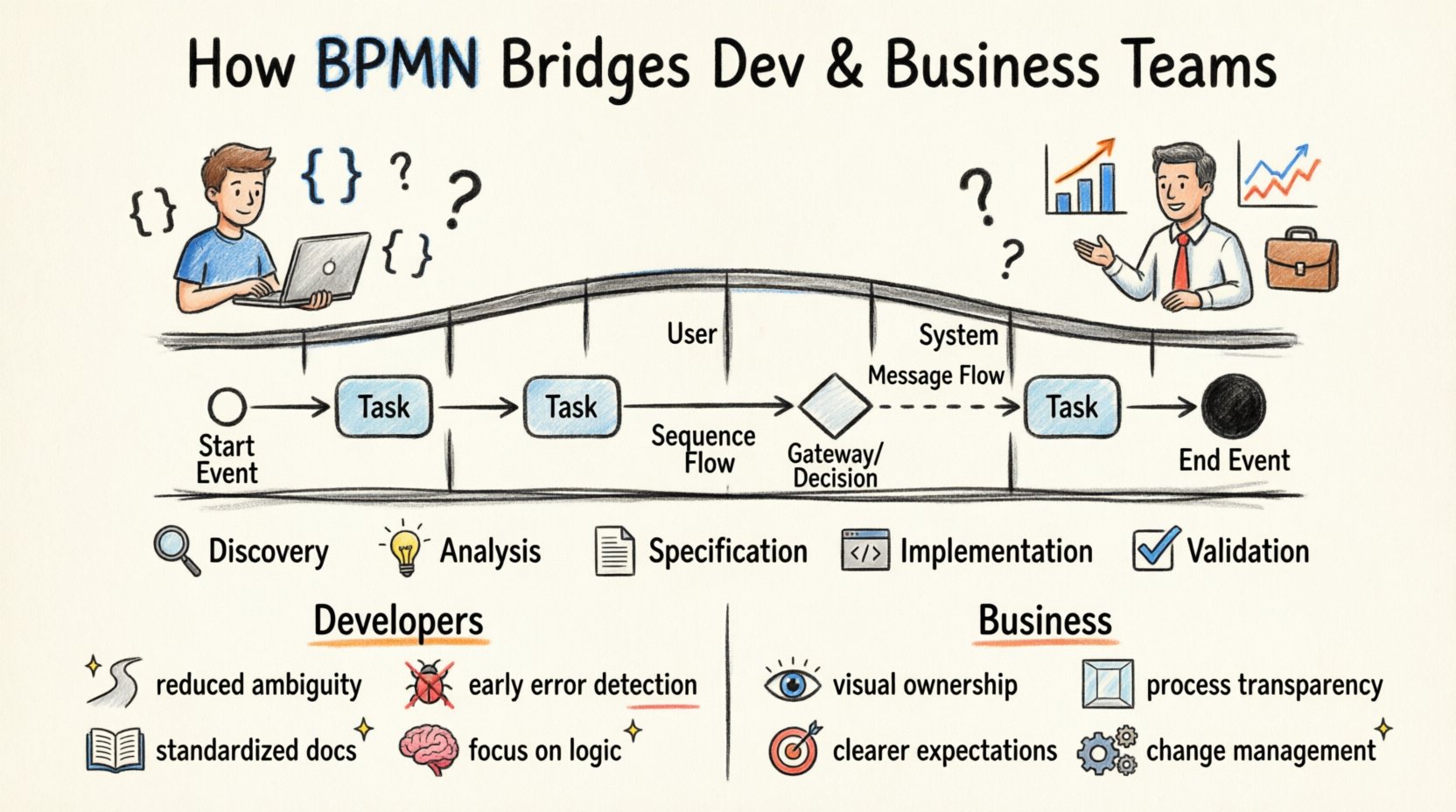
To communicate effectively, both parties must understand the symbols. The following table outlines the core elements used in BPMN and their practical implications for development.
| Symbol Type | Shape | Meaning for Developers | Meaning for Business |
|---|---|---|---|
| Start Event | Circle (Thin) | Entry point of the process logic | How the process begins |
| End Event | Circle (Thick) | Exit point or termination condition | How the process ends |
| Task | Rounded Rectangle | A single unit of work (function call) | A specific action or job |
| Gateway | Diamond | Logic branching (AND, OR, XOR) | A decision that splits the path |
| Sequence Flow | Arrow (Solid) | Order of execution | The next step in the process |
| Message Flow | Arrow (Dashed) | Communication between systems | Exchange of information |
| Sub-Process | Rounded Rect with + | Complex logic hidden for clarity | A mini-process within the main one |
Understanding these symbols is the first step. However, using them correctly requires discipline. A common mistake is mixing Message Flows with Sequence Flows. Sequence Flow represents the flow of control within a single process. Message Flow represents the flow of data between separate participants. Confusing these leads to incorrect architectural designs where systems are expected to interact when they should not.
Implementing BPMN in the Development Lifecycle 🔧
Integrating BPMN into the software development lifecycle (SDLC) requires a shift in timing. Traditionally, requirements are gathered, and then design begins. With BPMN, the design phase becomes the requirements phase. Here is how this integration typically unfolds:
- Discovery Phase: Business stakeholders draw the current state of the process. This is often called “As-Is” modeling. It captures the reality, including inefficiencies and manual workarounds.
- Analysis Phase: Teams identify bottlenecks and opportunities for automation. This is where the “To-Be” model is created. It outlines the ideal state with automation and optimizations.
- Specification Phase: Developers review the “To-Be” model to understand the technical requirements. They identify which tasks require APIs, which require database updates, and which require user interfaces.
- Implementation Phase: Code is written to match the logic defined in the model. The model acts as the source of truth for the logic.
- Validation Phase: The deployed system is compared against the original model. If the system deviates, the model is updated, or the code is corrected.
This approach ensures that the code reflects the business intent. It prevents the scenario where developers optimize for technical efficiency while ignoring business goals.
Benefits for the Development Team 💻
For developers, BPMN offers more than just a diagram. It offers clarity and structure.
- Reduced Ambiguity: When a requirement is vague, a diagram clarifies it. If the diagram shows a loop, the developer knows to implement a loop. If it shows a parallel path, the developer knows to implement concurrency.
- Early Error Detection: Logic errors can be spotted during the modeling phase. A developer can look at a gateway and say, “This OR gateway will never be reached because the previous step always fails.” Catching this before coding saves hours of debugging.
- Standardized Documentation: The model serves as living documentation. When new developers join the team, the BPMN diagram explains the process flow better than a README file.
- Focus on Logic: Developers can focus on the algorithmic complexity of a specific task without worrying about the overall business flow, as the flow is already mapped.
Benefits for Business Stakeholders 🏢
For business leaders and analysts, BPMN provides visibility and control.
- Visual Ownership: Stakeholders can see their processes represented visually. This empowers them to validate that their needs are being met before development starts.
- Process Transparency: It becomes easy to see where the system waits, where it moves fast, and where it stops. This visibility helps in identifying areas for future optimization.
- Clearer Expectations: By agreeing on the model, the business team understands what is technically feasible. They can see where automation is possible and where human intervention is required.
- Change Management: When business rules change, the model is updated first. This allows the business team to see the impact of the change on the entire workflow before the IT team modifies the code.
Common Challenges and How to Navigate Them ⚠️
While BPMN is powerful, it is not without challenges. Teams often struggle with specific aspects of adoption.
- Over-Modeling: Teams sometimes create diagrams that are too detailed. A BPMN diagram should not show every database field. It should show the process flow. Too much detail drowns out the main message.
- Lack of Standardization: If team members use different symbols for the same concept, confusion arises. It is vital to agree on a notation standard (e.g., BPMN 2.0) and stick to it.
- Static Documents: A diagram that is created once and never updated becomes a liability. The model must evolve as the software evolves. If the code changes and the diagram does not, the diagram becomes wrong.
- Tooling Friction: Some tools make it hard to export or integrate models with development environments. Choosing tools that support open standards helps mitigate this.
To navigate these challenges, teams should establish a governance process. This includes regular reviews of the models and strict version control. Just as code is versioned, process models should be versioned. This allows teams to track changes over time and revert if necessary.
Maintaining Process Accuracy Over Time 🔄
The accuracy of a BPMN model degrades if it is not maintained. In the early stages of a project, the model is crucial. In later stages, it is easy to neglect. To maintain accuracy:
- Assign Ownership: Designate a specific person or role responsible for updating the model. This ensures accountability.
- Link to Code: Where possible, link specific model elements to code modules or tickets. This creates a traceability chain.
- Regular Audits: Schedule periodic reviews where the model is compared against the running system. This is especially important after major releases.
- Training: Ensure that both business and technical teams have a basic understanding of the notation. If only the developers understand the symbols, the business team cannot validate them.
Integrating BPMN with Modern Engineering Practices 🛠️
BPMN is not limited to traditional waterfall methodologies. It integrates well with Agile and DevOps practices.
In Agile, BPMN can be used during the sprint planning phase to define the scope of user stories. Instead of writing text-heavy tickets, teams can attach a small diagram showing the specific workflow for that feature. This helps the team understand the context of the story immediately.
In DevOps, BPMN can define the deployment pipeline logic. While CI/CD tools have their own configuration languages, understanding the high-level process flow helps in designing robust pipelines. For example, a BPMN diagram can show the approval gates required before a release to production. This visualizes the compliance requirements that might otherwise be hidden in configuration files.
Additionally, BPMN supports the concept of Event-Driven Architecture. In modern systems, processes are often triggered by events rather than user actions. BPMN supports event-based start and intermediate events. This allows developers to model complex interactions between microservices where one service triggers another without waiting for a direct request.
Conclusion on Process Transparency and Success ✅
The relationship between developers and business teams is the backbone of successful software delivery. When this relationship is strained, projects suffer. When it is supported by a clear, shared language, projects thrive. BPMN provides that language.
It moves the conversation from abstract concepts to concrete visual models. It reduces the risk of building the wrong thing. It provides a clear reference point for testing and maintenance. While it requires an initial investment in learning and discipline, the return on investment is significant in terms of reduced rework and higher quality software.
By embracing this standard, organizations can build a culture of transparency. Developers understand the business goals, and business stakeholders understand the technical constraints. This mutual understanding is the foundation of a high-performing engineering organization. As technology continues to evolve, the need for clear communication will only increase. BPMN remains a stable, reliable tool to meet that need. 🌟