

Quality user stories are the backbone of successful software delivery. When a team writes clear, actionable, and testable stories, the gap between understanding and execution narrows significantly. However, quality does not happen by accident. It requires consistent attention, reflection, and iterative improvement. One of the most powerful mechanisms for achieving this is the retrospective.
A retrospective offers a structured opportunity for a team to inspect itself and identify areas for improvement. While many retrospectives focus on process or velocity, dedicating time specifically to the quality of user stories can yield long-term dividends. This guide explores actionable strategies to enhance story quality through retrospective practices, ensuring your backlog remains a source of clarity rather than confusion.
Why Story Quality Matters 📊
Before diving into methods, it is essential to understand the impact of poor story quality. When stories lack detail or clarity, developers often make assumptions. These assumptions lead to rework, technical debt, and delayed releases. High-quality stories provide a shared understanding of the goal, the scope, and the acceptance criteria.
Key benefits of focusing on story quality include:
- Reduced Ambiguity: Clear definitions minimize the need for constant clarification questions during development.
- Faster Delivery: When the work is well-defined, teams spend less time debating requirements and more time building.
- Higher Confidence: Stakeholders trust the roadmap when they see consistent, well-prepared work items.
- Better Testing: Testable acceptance criteria enable QA teams to validate features accurately.
The INVEST Framework as a Baseline 🛡️
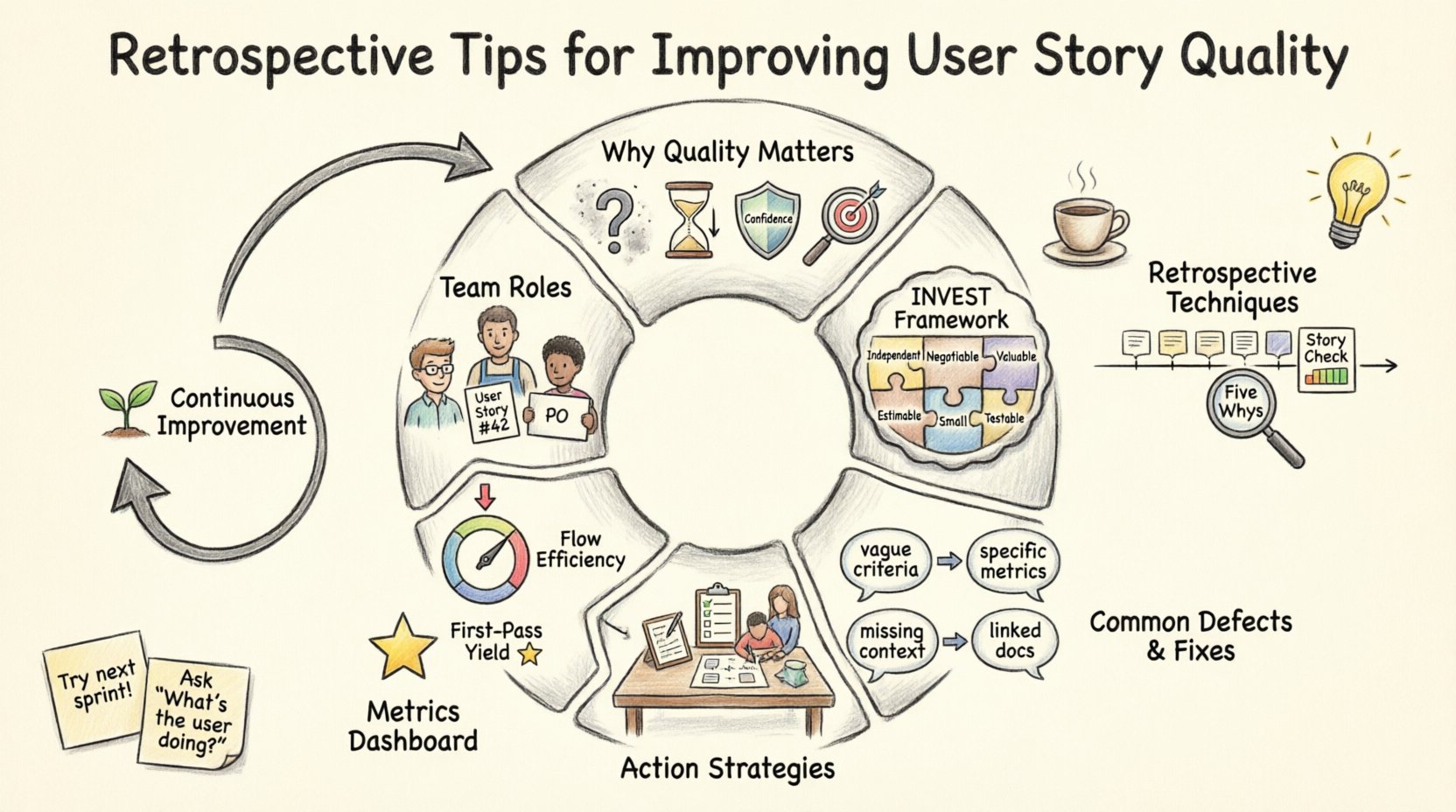
To evaluate story quality effectively, teams often rely on the INVEST criteria. This acronym stands for Independent, Negotiable, Valuable, Estimable, Small, and Testable. A retrospective provides the perfect setting to review stories against these principles.
During a retrospective, ask the team to review recent stories and score them against INVEST. This does not need to be a formal scoring system, but rather a discussion point. If a story was difficult to estimate, it likely lacked granularity. If testing was ambiguous, the acceptance criteria were weak.
Integrating Story Quality into Retrospectives 🔄
Simply mentioning stories is not enough. You need specific techniques to surface quality issues without blaming individuals. The goal is to improve the system, not the people.
1. The Quality Timeline
Create a visual timeline of the last sprint or iteration. Plot where stories were created, refined, and completed. Look for patterns.
- Did stories sit in “Ready” for too long?
- Were there many stories returned for more information?
- Did defects arise from unclear requirements?
2. The “Five Whys” on Story Defects
When a story causes issues, use the Five Whys technique to find the root cause. This prevents treating symptoms rather than the disease.
- Why did the story fail acceptance? (Feature didn’t work as expected)
- Why? (Edge case was not covered)
- Why? (Acceptance criteria did not mention the edge case)
- Why? (Team did not review edge cases during refinement)
- Why? (Refinement checklist was incomplete)
The fix is not to blame the writer, but to update the refinement checklist.
3. Story Health Check
Dedicate a portion of the retrospective to reviewing the “Health” of the backlog. Discuss stories that are currently in progress or ready. Ask:
- Does every story have a clear “Definition of Ready”?
- Are there any stories that are too large or too vague?
- Do we have enough context to start work immediately?
Common Defects in User Stories and Fixes 🛠️
Identifying common patterns of poor quality allows teams to anticipate issues. The following table outlines frequent defects found in user stories and practical solutions.
| Defect Type | Example Scenario | Proposed Fix |
|---|---|---|
| Missing Context | “Fix the login button.” | Require a link to the design mockup or specific error logs. |
| Vague Acceptance Criteria | “System must be fast.” | Define specific metrics (e.g., “Page loads in under 2 seconds”). |
| Overly Large Scope | “Build a complete reporting dashboard.” | Split into smaller, incremental stories (e.g., “Add date filter”). |
| Assumption of Knowledge | “Update the legacy field.” | Link to documentation or add a section explaining the legacy system. |
| Missing Edge Cases | “Allow users to upload a profile picture.” | Explicitly list file size limits, supported formats, and error states. |
Actionable Strategies for Improvement 📝
Once you have identified areas for improvement, you need concrete actions to drive change. These strategies can be implemented immediately in your next cycle.
1. Refinement Workshops
Move beyond the “backlog grooming” session. Hold dedicated workshops where the whole team collaborates on breaking down large epics. This ensures that technical constraints and testing needs are considered early.
- Involve QA: Ensure testers are present during refinement to spot gaps in criteria.
- Involve Ops: Include infrastructure experts to discuss deployment and monitoring needs.
- Timebox It: Keep sessions focused and short to maintain energy.
2. Definition of Ready (DoR) Audit
The Definition of Ready is a checklist that a story must meet before entering a sprint. Regularly audit this list to ensure it is still relevant.
- Is the story small enough?
- Are dependencies identified?
- Is the acceptance criteria clear?
- Is the value proposition understood?
If a story fails the DoR, it should not enter the sprint. This protects the team from starting work without a clear plan.
3. Pair Writing Sessions
Consider pairing a developer and a product owner (or a writer and a reviewer) to write complex stories together. This promotes shared ownership and ensures technical feasibility is baked into the description.
4. Story Mapping
For complex features, use story mapping to visualize the user journey. This helps identify gaps in the flow before individual stories are written. It ensures the user experience is coherent across all features.
Metrics to Track Quality 📏
You cannot improve what you do not measure. While vanity metrics like story count are common, quality metrics tell a different story. Consider tracking the following:
- Flow Efficiency: The percentage of time a story spends in active work vs. waiting. Low quality often leads to rework, increasing wait times.
- Reopen Rate: How often a story is reopened after being marked complete due to bugs or missing requirements.
- Refinement Time: How long it takes to move a story from “Backlog” to “Ready”. If this time is high, the story may lack clarity.
- First Pass Yield: The percentage of stories that pass all acceptance criteria on the first attempt.
Use these metrics to set goals. For example, aim to reduce the reopen rate by 10% over the next quarter. Track progress in the retrospective to see if the changes are working.
Building a Sustainable Culture 🌱
Technical practices fail without the right culture. If team members fear being blamed for poor stories, they will hide problems rather than discuss them. Psychological safety is crucial for honest retrospectives.
1. Normalize Imperfection
Accept that stories will evolve. A story is a promise of knowledge, not a contract of specifications. Encourage the view that refining a story is a sign of diligence, not a failure of the initial draft.
2. Celebrate Improvements
When a story is exceptionally clear or when a refinement session saves the team hours of work, acknowledge it. Positive reinforcement encourages the behavior you want to see.
3. Rotate Facilitators
Have different team members facilitate the retrospective. This ensures diverse perspectives on what constitutes “quality” and prevents groupthink.
Specific Techniques for Different Roles 🎭
Different roles contribute differently to story quality. Tailor your retrospective focus to include specific inputs from each role.
Developers
Focus on technical feasibility and complexity. Ask:
- Did we have enough information to estimate accurately?
- Were there hidden technical dependencies?
- Was the scope clear enough to implement without guessing?
Testers / QA
Focus on testability and edge cases. Ask:
- Could we write a test case based on the acceptance criteria?
- Were there scenarios we had to invent ourselves?
- Was the definition of done clear?
Product Owners / Managers
Focus on value and priority. Ask:
- Was the business value clear to the team?
- Did the story align with the current roadmap goals?
- Was the user persona defined?
Handling Technical Debt in Stories 💻
Sometimes, poor story quality is a symptom of underlying technical debt. If developers constantly have to write workarounds because the system is rigid, the story quality suffers.
Use retrospectives to identify stories that were blocked by technical constraints. Create specific stories to address the debt. Do not let technical debt become a hidden variable in your story estimates. Make it visible and actionable.
Reviewing Past Stories for Patterns 🔍
Periodically, look back at completed stories from previous sprints. This is a retrospective on the retrospective process itself.
- Select a Sample: Pick 10 stories from the last three months.
- Categorize Issues: Note where the biggest friction occurred (estimation, development, testing).
- Identify Root Causes: Was it a lack of design? A lack of API documentation? A missing stakeholder?
- Adjust Process: Update your refinement guidelines based on findings.
Conclusion: Continuous Improvement 🏁
Improving user story quality is not a one-time fix. It is a continuous cycle of learning and adaptation. By embedding quality checks into your retrospectives, you create a feedback loop that constantly sharpens your backlog.
Start small. Pick one technique from this guide and try it in your next retrospective. Track the results. Adjust as needed. Over time, the accumulation of these small improvements will lead to a high-performing team that delivers value consistently and predictably.
Remember, the goal is not perfection. The goal is progress. Every story written is a chance to learn and refine the craft of product development. Keep the conversation going, keep the backlog healthy, and keep moving forward.