

Story refinement, often called backlog grooming, is a critical cadence in agile development. It is the process where the team aligns on upcoming work before it enters active development. However, alignment does not happen by accident. It happens through inquiry. The quality of your software is often a direct reflection of the quality of questions asked during this phase.
When a user story is vague, the cost of ambiguity compounds exponentially. A missing detail discovered during coding costs significantly more than one discovered during refinement. This guide explores how to cultivate a questioning mindset that exposes risks, clarifies requirements, and ensures the team moves forward with confidence.
🧠 The Psychology of Inquiry in Agile Teams
Asking questions is often mistaken for a lack of knowledge. In reality, in a refinement context, it is a demonstration of professional rigor. The goal is not to interrogate the Product Owner or Business Analyst, but to collaborate on understanding the problem space.
- Curiosity over Assumption: Assumptions are the enemy of precision. If you assume a field is optional, build it as optional. If you assume it is required, build it as required. Questions clarify these distinctions before code is written.
- Shared Ownership: When the development team asks questions, they are signaling ownership of the solution. It moves the work from “their request” to “our commitment”.
- Risk Mitigation: Questions surface edge cases, technical debt, and integration points that are invisible in a high-level description.
Refinement is not a status update meeting. It is a discovery session. The questions you ask determine the accuracy of the estimate and the quality of the final feature.
🔍 Core Categories of Refinement Questions
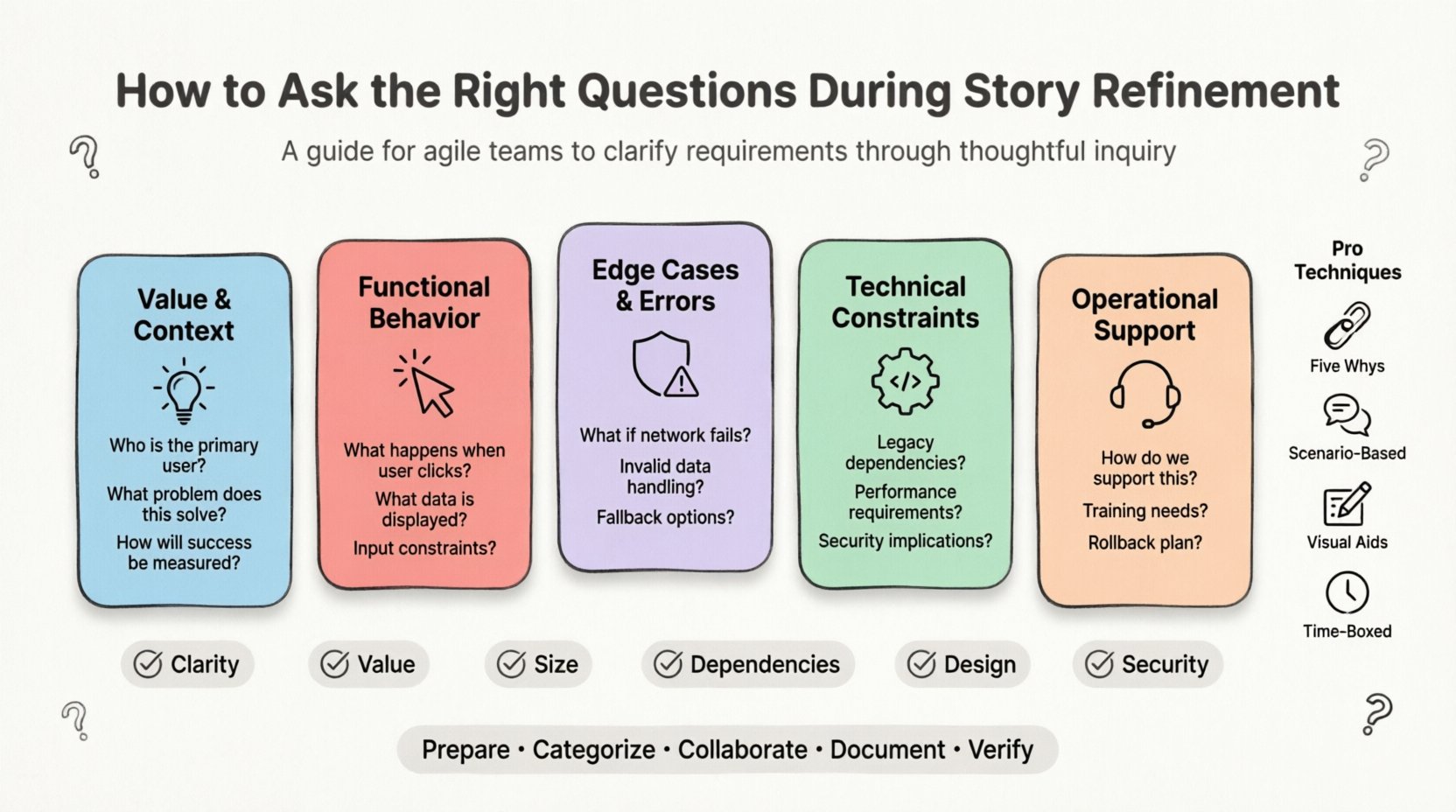
To ensure comprehensive coverage, categorize your inquiries. This prevents questions from being scattered and ensures all dimensions of the feature are examined. Below are the five primary dimensions of inquiry.
1. Value and Context Questions
Understanding why a feature is being built is as important as understanding what it does. This ensures the solution delivers actual business value rather than just technical output.
- Who is the primary user? Is this for an admin, a guest, or a power user?
- What problem does this solve? Can we describe the pain point in one sentence?
- How will success be measured? Are there specific metrics (conversion rates, time saved) associated with this story?
- What is the current workaround? Understanding the status quo helps identify the necessary friction points to remove.
2. Functional Behavior Questions
These questions focus on the interaction between the user and the system. They define the happy path and the immediate variations.
- What happens when the user clicks the button? Does it navigate, submit, or expand?
- What data is displayed on this screen? Are there pagination limits?
- What are the input constraints? Are there character limits, date ranges, or specific formats?
- How does this interact with existing features? Does this update a dashboard? Does it trigger an email?
3. Edge Case and Error Handling Questions
Happy paths rarely exist in isolation. Systems fail, networks drop, and users make mistakes. Robust software anticipates these scenarios.
- What happens if the network connection is lost? Is the data saved locally or is the action cancelled?
- What if the user enters invalid data? Do we validate client-side, server-side, or both?
- What is the system behavior at capacity? What happens if 10,000 users hit this endpoint simultaneously?
- What are the fallback options? If an external service is down, does the feature degrade gracefully?
4. Technical Constraints and Architecture Questions
Developers bring technical context that business stakeholders may not possess. These questions ensure the solution is feasible within the current architecture.
- Are there legacy dependencies? Does this require changes to an older system?
- What are the performance requirements? Does this need to load in under 200ms?
- Are there security implications? Does this data require encryption or specific access controls?
- Does this introduce technical debt? Are we using a temporary solution that needs a permanent fix later?
5. Operational and Support Questions
Once the feature is live, how does the organization support it? This ensures the product remains maintainable.
- How will we support this feature? Is there documentation needed for the help desk?
- Are there training requirements? Does the team need to be taught how to use a new admin panel?
- How do we monitor this? Do we need specific logs or alerts for this functionality?
- What is the rollback plan? If this feature breaks production, how do we revert quickly?
📊 The Definition of Ready Checklist
A common output of effective questioning is a refined story that meets the Definition of Ready (DoR). This checklist ensures a story is sufficiently detailed to be pulled into a sprint. Use the following table as a reference for your team’s DoR standards.
| Category | Question to Answer | Target Audience |
|---|---|---|
| Clarity | Is the acceptance criteria testable? | QA & Development |
| Value | Is the business value clearly stated? | Product Owner |
| Size | Is the story small enough for a sprint? | Team Lead |
| Dependencies | Are external dependencies identified? | Architecture |
| Design | Are UI/UX assets provided? | Design |
| Security | Have security requirements been reviewed? | Security Team |
When a story fails to meet these criteria, it is not ready to be estimated. Pushing forward with incomplete information is a primary cause of sprint failure.
🛠 Techniques for Effective Questioning
How you ask is just as important as what you ask. The delivery of a question can either build trust or create defensiveness. Use these techniques to foster a collaborative environment.
The “Five Whys” Method
Often, the first answer to a question is a symptom, not the root cause. If a stakeholder asks for a specific field, ask why that field is needed. Then ask why that information is needed. This drill-down helps identify if a different, simpler solution might exist.
Scenario-Based Inquiry
Instead of asking abstract questions, propose scenarios. “If the user cancels the payment at step 3, what should happen to the order?” This forces the stakeholder to think through the logic flow concretely.
Visual Aids
Words can be ambiguous. Sketches, flowcharts, and wireframes clarify intent. If a concept is complex, ask: “Can we draw this out together?” Visualizing the question often reveals gaps in understanding immediately.
Time-Boxed Refinement
Refinement meetings can drag on if not managed. Set a time limit (e.g., 60 minutes). This forces the team to prioritize the most critical questions. If a story cannot be clarified within the timebox, it is either too large or too complex and should be split.
🤝 Collaboration Dynamics: Who Asks What?
Different roles bring different perspectives to the refinement table. Encouraging specific types of questions from specific roles improves the overall quality of the output.
Product Owner
- Focus on value and priority.
- Ask: “Is this the right thing to build right now?”
- Clarify the business rules and constraints.
Developers
- Focus on feasibility and architecture.
- Ask: “How do we implement this securely and efficiently?”
- Identify technical dependencies early.
QA / Testers
- Focus on edge cases and verification.
- Ask: “How will we know this is working?”
- Define acceptance criteria clearly.
Designers
- Focus on user experience and accessibility.
- Ask: “Is this intuitive for the target user?”
- Ensure consistency with the design system.
⚠️ Common Pitfalls in Refinement Questions
Even experienced teams fall into traps during refinement. Being aware of these pitfalls helps you steer the conversation back on track.
1. Premature Optimization
Don’t ask how to scale to millions of users if the product currently has one. Focus on the current requirements. Future scaling can be addressed when the data supports it.
2. Solutioning Before Problem Understanding
Avoid asking “How should we build this?” before asking “What problem are we solving?”. Jumping to technical solutions limits creativity and often misses the business need.
3. The Silence of the Room
If no one is asking questions, something is wrong. Silence often means confusion masked as agreement. Facilitators must explicitly invite dissent and inquiry. “What is missing from this description?” is a powerful prompt.
4. Ignoring the Definition of Done
Refinement is not just about development. It must include testing, documentation, and deployment. Questions should cover the entire lifecycle of the feature, not just the coding phase.
📝 Documentation and Traceability
Questions and answers should not vanish after the meeting. They must be captured to ensure knowledge retention and future reference.
- Update the Story: Incorporate answers directly into the user story description. Do not rely on meeting minutes alone.
- Link Decisions: If a technical decision was made (e.g., “We will use API X instead of API Y”), document the rationale.
- Track Open Items: If a question could not be answered, mark it as a blocker. Do not allow the story to be estimated until the blocker is resolved.
🔄 Iterative Refinement
Refinement is not a one-time event. Requirements evolve. A story refined last sprint may need re-evaluation this sprint if the context has changed. Treat refinement as a continuous loop of clarification, not a gatekeeper that opens once and closes.
When context shifts, revisit the core questions. Has the user changed? Has the technology changed? Has the priority shifted? This agility ensures the team remains aligned with the current reality of the product.
🚀 Moving from Refinement to Development
The ultimate goal of asking the right questions is a smooth transition to development. When the Definition of Ready is met, the team should enter the sprint with a clear mental model of the work.
- Confidence in Estimates: Questions reduce uncertainty, leading to more accurate velocity predictions.
- Fewer Blockers: Anticipating edge cases means fewer surprises during coding.
- Better Collaboration: Shared understanding reduces friction between roles.
Remember, the cost of changing a requirement in the design phase is negligible compared to the cost of changing it in production. The questions you ask during refinement are the primary defense against expensive rework.
📋 Summary of Best Practices
To summarize the approach to effective questioning:
- Prepare: Read the story before the meeting to formulate questions.
- Categorize: Cover value, function, edge cases, tech, and operations.
- Collaborate: Encourage input from all disciplines.
- Document: Record answers in the story itself.
- Verify: Ensure the story meets the Definition of Ready before estimating.
By treating refinement as a discovery process driven by thoughtful inquiry, teams can deliver higher quality software with greater predictability. The questions you ask today define the stability of your product tomorrow.