

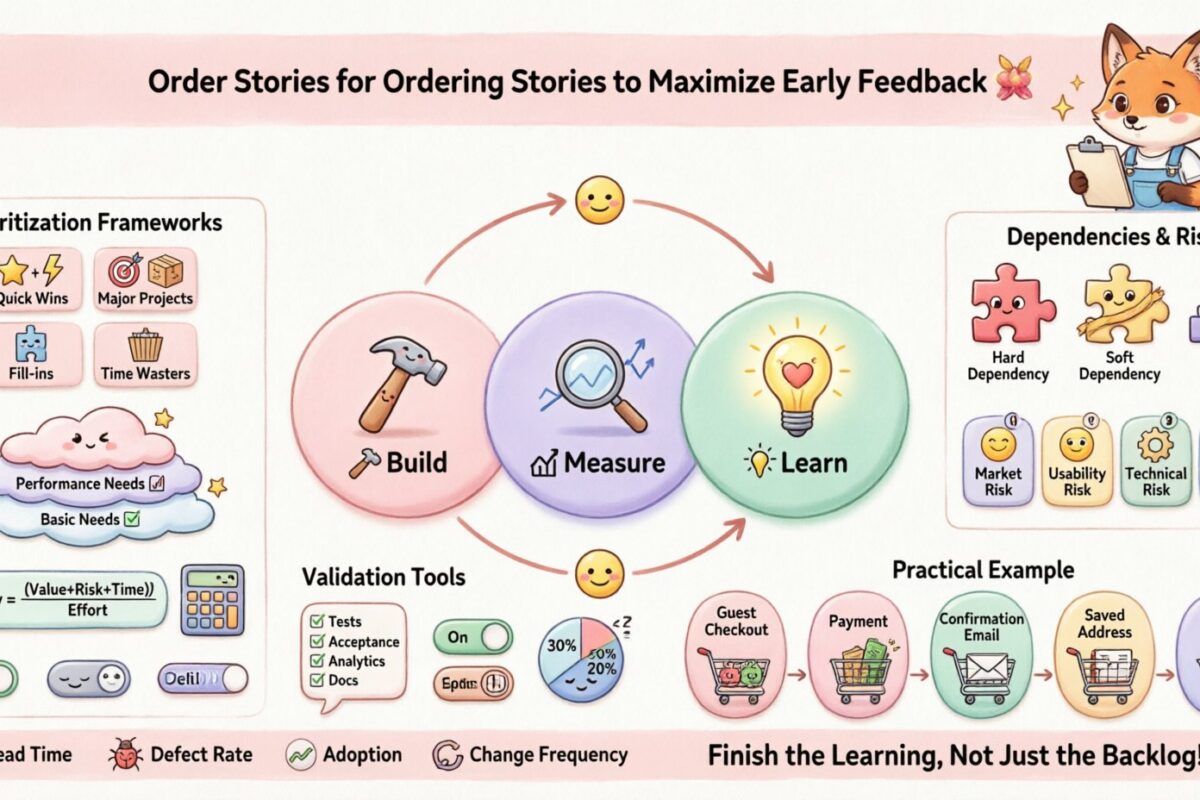
In the fast-paced environment of software development, the speed at which a team learns from its users determines the success of the product. This learning is captured through feedback loops. To shorten these loops, the sequence in which user stories are delivered is critical. Simply finishing tasks is not enough; finishing the right tasks is the goal. This guide explores how to order stories effectively to ensure maximum value and insight are gained as early as possible in the development cycle.
🧠 Understanding the Feedback Loop
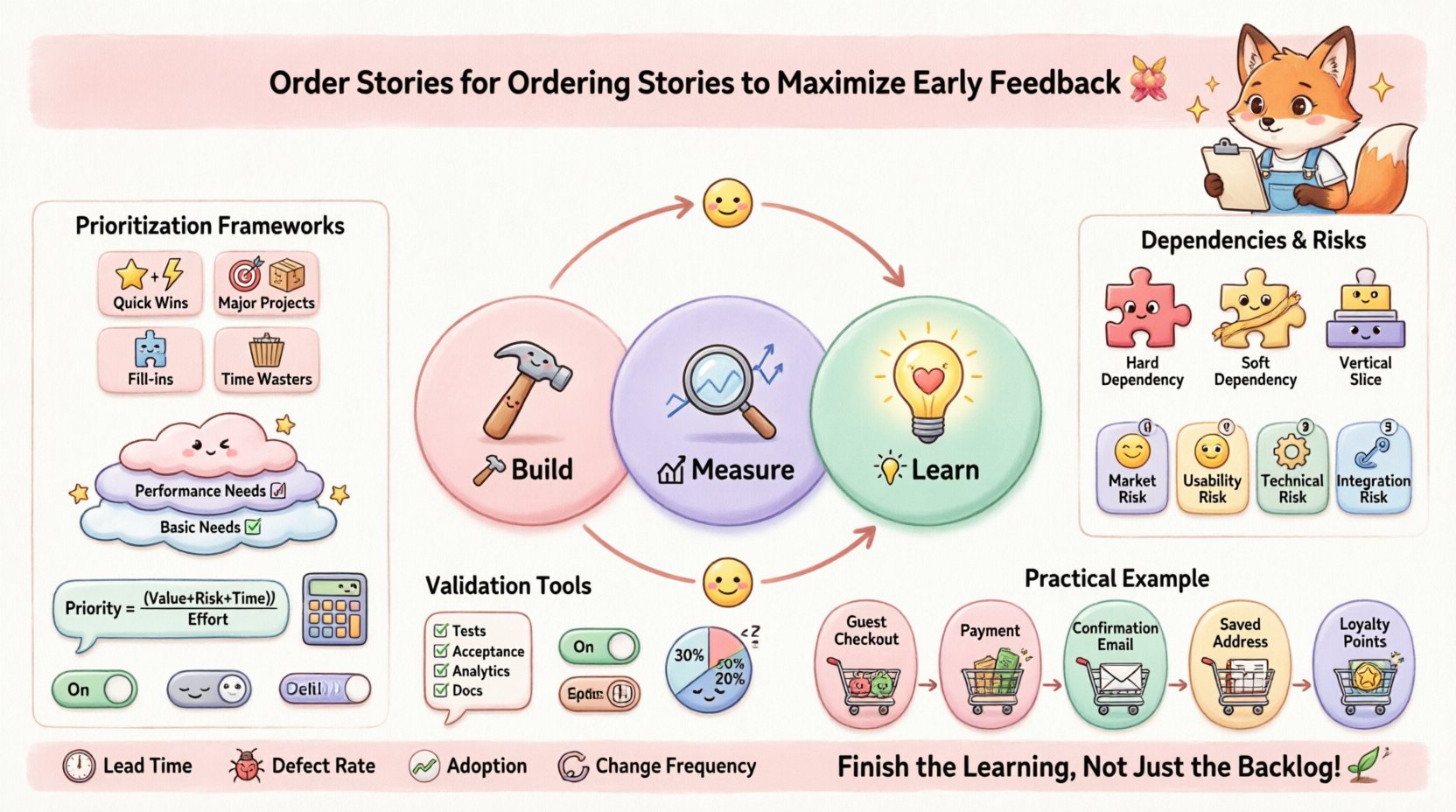
Feedback is the currency of improvement. When you build a feature, you assume it solves a problem. Validation confirms or refutes that assumption. The time between building and validating is the latency of feedback. High latency means you might build the wrong thing for weeks before knowing it. Ordering stories to minimize this latency is a core competency for any agile team.
- Build: The act of writing code to satisfy a story.
- Measure: Observing how users interact with the feature.
- Learn: Analyzing data to decide the next step.
If the first story delivered to production is a complex backend infrastructure change, the feedback loop is long. Users do not see the change immediately. If the first story is a visible UI tweak that solves a pain point, the feedback loop is short. The ordering strategy must prioritize visibility and validation potential.
📋 Core Prioritization Frameworks
There is no single “perfect” order, but there are proven frameworks to help teams decide. These methods help weigh value against effort and risk.
1. The Value vs. Effort Matrix
Plotting stories on a two-axis graph helps visualize priorities. The X-axis represents effort (complexity, time), and the Y-axis represents value (business impact, user satisfaction).
- Quick Wins (High Value, Low Effort): These should be the first stories to order. They deliver immediate feedback and build momentum.
- Major Projects (High Value, High Effort): Break these down. Order the smallest slice of value first.
- Fill-ins (Low Value, Low Effort): Good for filling gaps, but do not prioritize these over high-value items.
- Time Wasters (Low Value, High Effort): Avoid these or deprioritize them significantly.
2. The Kano Model
The Kano Model classifies features based on how they affect customer satisfaction.
- Basic Needs: Features that must be present for the product to work. Order these first to ensure stability.
- Performance Needs: Features where more is better (e.g., speed). Order these to improve the core experience.
- Delighters: Unexpected features that wow users. These are risky for early feedback if they distract from core value.
3. Weighted Shortest Job First (WSJF)
While often used for larger epics, WSJF principles apply to stories. It calculates priority by dividing the job size (effort) into the Cost of Delay (value + risk + time sensitivity).
Formula: Priority = (Value + Risk Reduction + Time Sensitivity) / Job Size
Stories with the highest score should be ordered first. This ensures the team works on the items that save the most money or risk per unit of time.
🔗 Managing Dependencies
Technical dependencies often dictate order more than business value. If Story B cannot be built without Story A, Story A must come first. However, do not let dependencies stall value delivery.
- Hard Dependencies: The system will crash without this. Must be ordered first.
- Soft Dependencies: The feature looks broken without it. Can be deferred slightly.
- Vertical Slicing: Always prefer vertical slices that cut across the stack (UI, API, DB) over horizontal slices (build all APIs, then all UI). Vertical slices deliver value earlier.
Dependency Mapping Table
| Dependency Type | Impact on Ordering | Strategy |
|---|---|---|
| Technical Debt | Blocks future speed | Order early if it risks stability. |
| External API | Blocks integration | Mock early to decouple ordering. |
| UI/UX Design | Blocks implementation | Ensure designs are ready before ordering. |
| Data Migration | Blocks reporting | Order data prep stories before reporting stories. |
🚧 Risk-Based Sequencing
Not all risks are equal. Some risks threaten the business, while others are merely technical annoyances. Ordering stories to address the highest risks early is a powerful strategy.
- Market Risk: Will anyone want this? Test the core value proposition first.
- Usability Risk: Will users understand this? Prioritize usability stories.
- Technical Risk: Can we build this? Prototype complex components first.
- Integration Risk: Does it work with the rest of the system? Test interfaces early.
Consider the Big Design Up Front fallacy. While you shouldn’t design everything before coding, you should design the most risky parts first. By ordering high-risk stories early, you find out if the architecture holds up before you build the entire product on a shaky foundation.
🔍 Validation and Measurement
Ordering stories is only half the battle. You must define what constitutes a valid feedback signal for each story.
Definition of Done (DoD)
A story is not done when it is coded. It is done when it is validated. Include validation criteria in the DoD.
- Automated Tests: Ensure the feature works as expected.
- User Acceptance: Stakeholder sign-off.
- Analytics Events: Tracking setup to measure usage.
- Documentation: Help guides or release notes.
Feature Flags
Use feature flags to decouple deployment from release. This allows you to order a story as “Ready to Deploy” but control when the feedback loop actually starts.
- On by Default: Best for low-risk changes.
- Off by Default: Best for high-risk or experimental changes.
- Percentage Rollout: Start with 5% of users to gather initial feedback safely.
🗣️ Team Alignment and Communication
Ordering stories is a collaborative effort. If the team does not understand why a story is ordered first, they may not execute it with the right mindset.
- Backlog Refinement: Use these sessions to discuss ordering logic, not just task breakdown.
- Context Sharing: Explain the business goal behind the story order. Is it to reduce churn? To gain a new customer?
- Feedback Review: Hold sessions specifically to review feedback from shipped stories before ordering the next batch.
When the team understands the strategy, they become partners in optimization. They might suggest splitting a story differently to enable earlier feedback.
📉 Common Pitfalls to Avoid
Even with a strategy, teams often fall into traps that delay feedback.
1. The “All-or-Nothing” Trap
Waiting until a “complete” feature is ready to ship. This creates a long feedback gap. Instead, ship the smallest viable piece of the feature.
2. Ignoring the “Happy Path”
Ordering complex error handling stories before the basic happy path. Users cannot provide feedback on error handling if they cannot use the feature.
3. Over-Engineering
Building for scale before validating demand. Order stories that prove demand before stories that optimize performance for millions of users.
4. Static Ordering
Setting the order at the start of the sprint and never moving it. Priorities change based on market shifts. Review the order daily or weekly.
🔄 Iterating on the Process
The best ordering strategy is one that evolves. Use retrospectives to discuss the ordering process itself.
- Did we learn? Did the first story give us the data we needed?
- Was it too fast? Did we rush and break things?
- Was it too slow? Did we build too much before checking in?
Adjust the criteria for ordering based on these learnings. Perhaps you need to prioritize riskier stories next time. Perhaps you need to focus more on UI polish.
📊 Measuring the Impact
How do you know if your ordering strategy is working? Track these metrics.
- Lead Time: Time from story start to feedback received.
- Defect Rate: Are early stories causing more bugs than later ones?
- Adoption Rate: Are the features we ordered first actually being used?
- Change Frequency: Are we shipping smaller, more frequent updates?
🛠️ Practical Application Example
Consider a team building a new e-commerce checkout. Here is how they might order stories for maximum feedback.
- Story 1: Guest Checkout. Value: Removes friction. Feedback: See if users buy without accounts.
- Story 2: Basic Payment Integration. Value: Money in. Feedback: Do payments succeed?
- Story 3: Order Confirmation Email. Value: Trust. Feedback: Do users feel secure?
- Story 4: Saved Address. Value: Convenience. Feedback: Do users return?
- Story 5: Loyalty Points. Value: Retention. Feedback: Does this drive repeat business?
Notice how Story 5 is last. It adds complexity. If Story 1 fails, Story 5 is irrelevant. By ordering Story 1 first, the team validates the core assumption (people will buy) before adding value-add features.
🎯 Conclusion
Ordering user stories is not just about task management; it is about learning strategy. By prioritizing high-value, low-risk, and high-visibility stories, teams can shorten the time it takes to learn what their users actually need. This approach reduces waste, increases confidence, and ensures that every line of code serves a validated purpose. The goal is not to finish the backlog, but to finish the learning.
Start reviewing your backlog today. Ask not just “What is next?” but “What will teach us the most?”. This shift in mindset transforms the development process from a factory to a laboratory.