

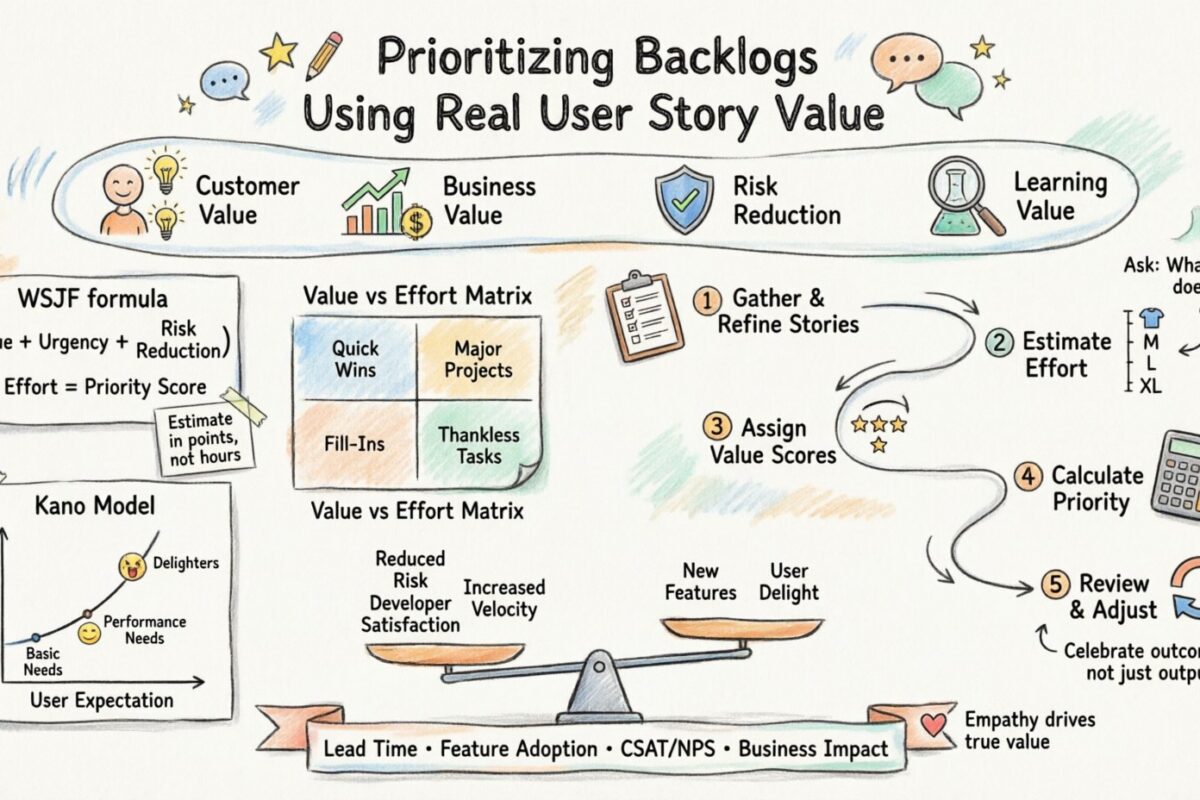
In the complex ecosystem of software development and product management, the backlog often becomes a graveyard of good ideas that never see the light of day. Teams are frequently pulled in multiple directions by stakeholders, market shifts, and internal technical demands. The result is a collection of tasks that lack clear strategic alignment. To navigate this noise, teams must shift their focus from simply completing tasks to delivering genuine user story value. This approach ensures that every hour of development time translates into tangible benefits for the end user and the business.
Prioritization is not a one-time event; it is a continuous discipline. It requires a deep understanding of what constitutes value, how to measure it, and how to weigh competing demands against available resources. By grounding your backlog management in real user value, you create a roadmap that is resilient, adaptable, and focused on outcomes rather than outputs.
Understanding the Core of User Story Value 🧠
Before we can prioritize, we must define what we are prioritizing. In the context of agile methodologies, a user story is a placeholder for a conversation. However, the value behind that conversation is what drives decision-making. Value is not monolithic; it comes in various forms that must be recognized and balanced.
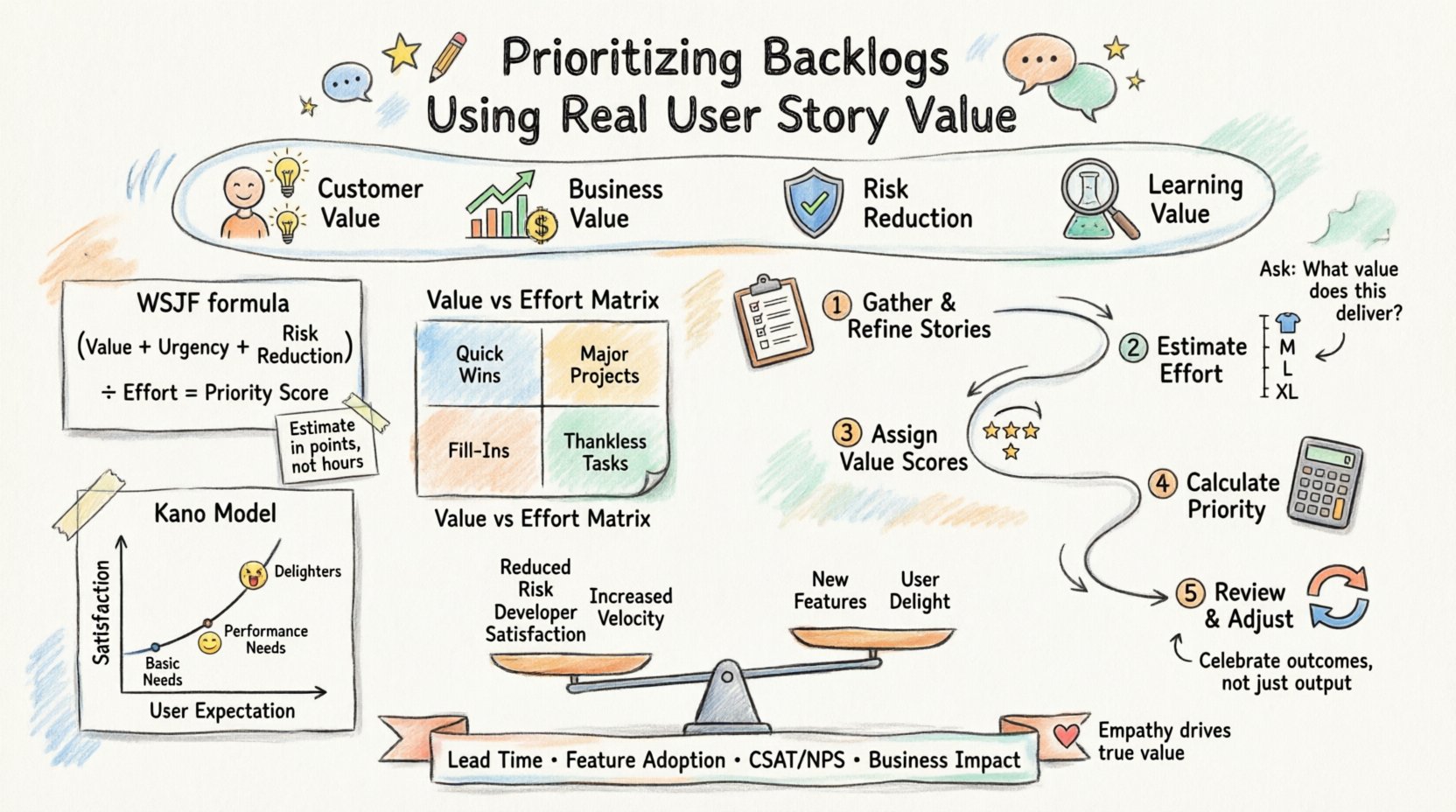
- Customer Value: This is the most obvious metric. How does this feature improve the user experience? Does it solve a pain point? Does it make a process faster or easier?
- Business Value: How does this impact the bottom line? Increased revenue, reduced churn, or market share expansion are key indicators here.
- Risk Reduction: Sometimes, the highest value item is one that removes uncertainty. This could be a spike to investigate a technical feasibility or compliance work to avoid legal penalties.
- Learning Value: In early stages of a product, the value lies in validation. Building something small to test a hypothesis can be more valuable than building a full-scale feature that might not be needed.
When teams fail to distinguish between these types of value, they often prioritize based on the voice of the loudest stakeholder rather than the actual impact. This leads to a fragmented product that tries to please everyone but excels at nothing. Recognizing the specific type of value a story offers allows for more nuanced decision-making.
Frameworks for Valuation and Prioritization 📊
Several established frameworks exist to help teams quantify and compare value. These are not rigid rules but tools to facilitate better conversations. Using these methods ensures that prioritization is transparent and defensible.
1. Weighted Shortest Job First (WSJF)
WSJF is designed to minimize the cost of delay. It calculates a score based on four components:
- Job Size: The effort required to complete the story.
- Time Criticality: How urgent is it to get this done now?
- Business Value: The direct benefit to the organization.
- Risk Reduction/Opportunity Enablement: The value of reducing risk or enabling future opportunities.
The formula divides the sum of value components by the job size. This approach naturally favors high-value, quick-to-implement items, ensuring the team delivers the most impact in the shortest time.
2. The Value vs. Effort Matrix
This visual tool places user stories on a 2×2 grid. The X-axis represents effort (or cost), and the Y-axis represents value. This simple visual helps categorize work into four quadrants:
- Quick Wins (High Value, Low Effort): These should be the first items tackled to build momentum.
- Major Projects (High Value, High Effort): These require significant planning and resources but offer substantial returns.
- Fill-Ins (Low Value, Low Effort): Good for filling gaps in capacity, but should not drive the roadmap.
- Thankless Tasks (Low Value, High Effort): These are the prime candidates for elimination or de-scoping.
3. Kano Model
The Kano Model categorizes features based on customer satisfaction. It distinguishes between:
- Basic Needs: Things users expect to work. If these are missing, satisfaction plummets. If present, satisfaction does not increase significantly.
- Performance Needs: The more of these features, the higher the satisfaction (e.g., speed, battery life).
- Delighters: Unexpected features that cause high satisfaction when present but do not cause dissatisfaction when absent.
Using this model helps teams decide whether to maintain baseline functionality or invest in innovation that differentiates the product.
The Process of Value-Driven Prioritization ⚙️
Implementing a value-driven approach requires a structured process. It moves beyond ad-hoc requests and establishes a rhythm of review and adjustment. The following steps outline a robust workflow.
Step 1: Gather and Refine User Stories
Before prioritization can occur, the backlog must be groomed. Stories that lack clarity cannot be valued accurately. Ensure every story has:
- A clear user role (Who is the story for?).
- A defined need or problem (What is the goal?).
- A specific outcome (Why does this matter?).
If a story is vague, it should be broken down or rejected until it is clear. Ambiguity is the enemy of accurate valuation.
Step 2: Estimate Relative Effort
While exact time estimates are often misleading, relative effort helps. Use techniques like Planning Poker or T-Shirt sizing (S, M, L, XL). The goal is not to predict time but to compare the complexity of one story against another. This allows the team to understand the cost of each value proposition.
Step 3: Assign Value Scores
Stakeholders and Product Owners assign value scores to each story. This should be a collaborative effort. Use a scoring system (e.g., 1 to 10 or Fibonacci numbers) to represent the impact. Encourage stakeholders to justify their scores. This discussion often reveals hidden assumptions or misaligned expectations.
Step 4: Calculate Priority Scores
Apply the chosen framework (WSJF, Value/Effort, etc.) to calculate a priority score for each item. This removes the emotional bias from the decision. The data speaks for itself. If a high-effort item has a low value score, it drops down the list, regardless of who requested it.
Step 5: Review and Adjust Regularly
Market conditions change. New information emerges. A prioritization exercise should happen before every planning cycle. What was valuable last month might not be relevant today. Regular reviews ensure the backlog remains a living document that reflects current reality.
Collaboration and Stakeholder Alignment 🤝
One of the biggest challenges in prioritization is managing expectations. Stakeholders often want everything done immediately. Transparency is the key to managing this pressure. When the prioritization process is open and based on agreed-upon metrics, stakeholders understand why some requests are deferred.
Facilitate workshops where stakeholders can see the trade-offs. Show them the Value vs. Effort matrix. Explain that resources are finite. When stakeholders participate in the valuation process, they take ownership of the decisions. This reduces the likelihood of micromanagement later.
Table 1 below illustrates how different stakeholder requests might look when scored against value and effort.
| Request ID | Description | Business Value (1-10) | Effort (1-10) | Priority Score | Decision |
|---|---|---|---|---|---|
| REQ-001 | Update User Profile Page | 9 | 3 | High | Immediate |
| REQ-002 | Implement Dark Mode | 5 | 8 | Medium | Backlog |
| REQ-003 | Fix Login Bug | 10 | 2 | Critical | Next Sprint |
| REQ-004 | Export Data to PDF | 4 | 5 | Low | Future |
This visual representation helps stakeholders see that not all requests are equal. It shifts the conversation from “Why not this?” to “How do we maximize our impact with these resources?”.
Handling Technical Debt vs. Features ⚖️
A common conflict in backlog management is the balance between new features and technical debt. Features drive visible value, but debt often hides behind the scenes until it becomes a crisis. However, technical debt is not inherently negative; it is often a deliberate trade-off to move faster. The challenge is managing the interest payments on that debt.
Treat technical debt as a user story. It has value, even if that value is negative (i.e., the cost of not doing it). The value of paying off debt includes:
- Reduced Risk: Preventing outages or data loss.
- Increased Velocity: Easier to add new features when the codebase is clean.
- Developer Satisfaction: Engineers work better when they are not fighting legacy code.
To integrate this into prioritization, assign a value score to debt reduction items. If a refactoring task prevents a potential 20% slowdown in future development, that is a quantifiable value. Some teams allocate a fixed percentage of capacity (e.g., 20%) to technical improvements to ensure it never gets completely deprioritized.
Measuring Success and Iterating 📈
Once you have prioritized your backlog, how do you know it was the right decision? You need metrics that track value delivery, not just task completion.
- Lead Time: How long does it take from idea to deployment? Shorter times indicate a more responsive team.
- Feature Adoption: Are users actually using what you built? If a high-value feature has low adoption, the value assumption may have been wrong.
- Customer Satisfaction (CSAT/NPS): Do users report higher satisfaction after releases?
- Business Metrics: Did revenue, retention, or engagement improve as predicted?
Review these metrics regularly. If a specific type of feature consistently underperforms, adjust your valuation criteria. This creates a feedback loop where the prioritization strategy evolves alongside the product.
Common Pitfalls to Avoid ⚠️
Even with a solid framework, teams can stumble. Awareness of common traps helps avoid them.
- Recency Bias: Prioritizing the most recent request rather than the most valuable. This often happens when stakeholders send emails just before a planning session.
- Analyst Bias: Letting the person who wrote the story or the person who requested it dictate the priority. The value must be assessed objectively.
- Ignoring Context: Prioritizing a feature without considering the current state of the platform. A feature might be high value but technically impossible or risky given current constraints.
- Over-Optimization: Spending too much time debating the perfect order. Sometimes, a “good enough” priority list is better than a perfect one that takes weeks to create.
The Role of Empathy in Prioritization ❤️
Data and frameworks are essential, but empathy is the glue. Understanding the user’s struggle is what gives a story its true weight. When a team member explains a story from the perspective of a frustrated user, the value becomes apparent without needing a score.
Encourage the team to read user feedback, watch session recordings, and support tickets. Real-world data often contradicts assumptions made in a planning room. A story that looks low value on paper might be the key to unlocking a major market segment if it addresses a critical user pain point.
Building a Culture of Value 🌱
Ultimately, prioritizing based on user story value is a cultural shift. It requires everyone from developers to executives to think in terms of outcomes. This means celebrating the delivery of value, not just the shipping of code.
- Celebrate Outcomes: When a feature drives a metric, acknowledge the impact, not just the completion.
- Encourage Disagreement: Healthy debate about value leads to better decisions. Create a safe space for team members to challenge assumptions.
- Stay Flexible: Be willing to kill a project if the value proposition evaporates. Killing a project is a success if it saves resources for a better opportunity.
By embedding these practices into the daily workflow, the backlog transforms from a to-do list into a strategic asset. It becomes a map that guides the team through uncertainty, ensuring that every line of code serves a purpose and every sprint moves the needle forward. The goal is not to have a perfect backlog, but to have a backlog that reflects the most important work for the user and the business at that moment.
Start by auditing your current backlog. Ask for each item: “Why are we doing this?” and “What value does it deliver?” If the answer is unclear, mark it for review. Over time, this discipline will sharpen your team’s focus and improve the quality of the product you deliver.
Final Thoughts on Sustainable Growth 🌿
Sustainable growth comes from consistency in value delivery. It is better to release a few high-value features reliably than to release many low-value features sporadically. This consistency builds trust with users and stakeholders alike.
Remember that value is dynamic. What is valuable today might not be tomorrow. The process of prioritization is the mechanism that keeps the product aligned with reality. By committing to this process, teams empower themselves to make difficult choices with confidence. They stop asking for permission to do the right thing and start doing it.
The journey toward value-driven development is ongoing. There is no finish line, only continuous improvement. Stay curious, stay data-informed, and always keep the user at the center of the conversation.