

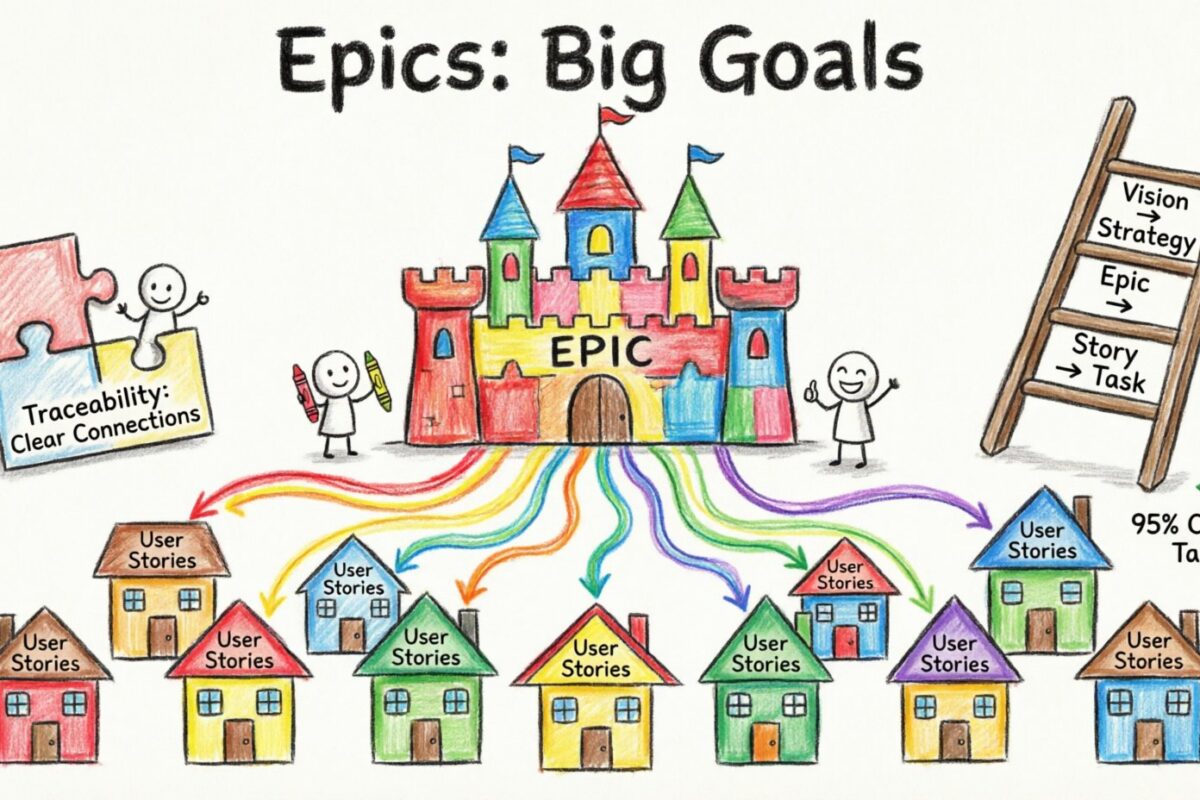
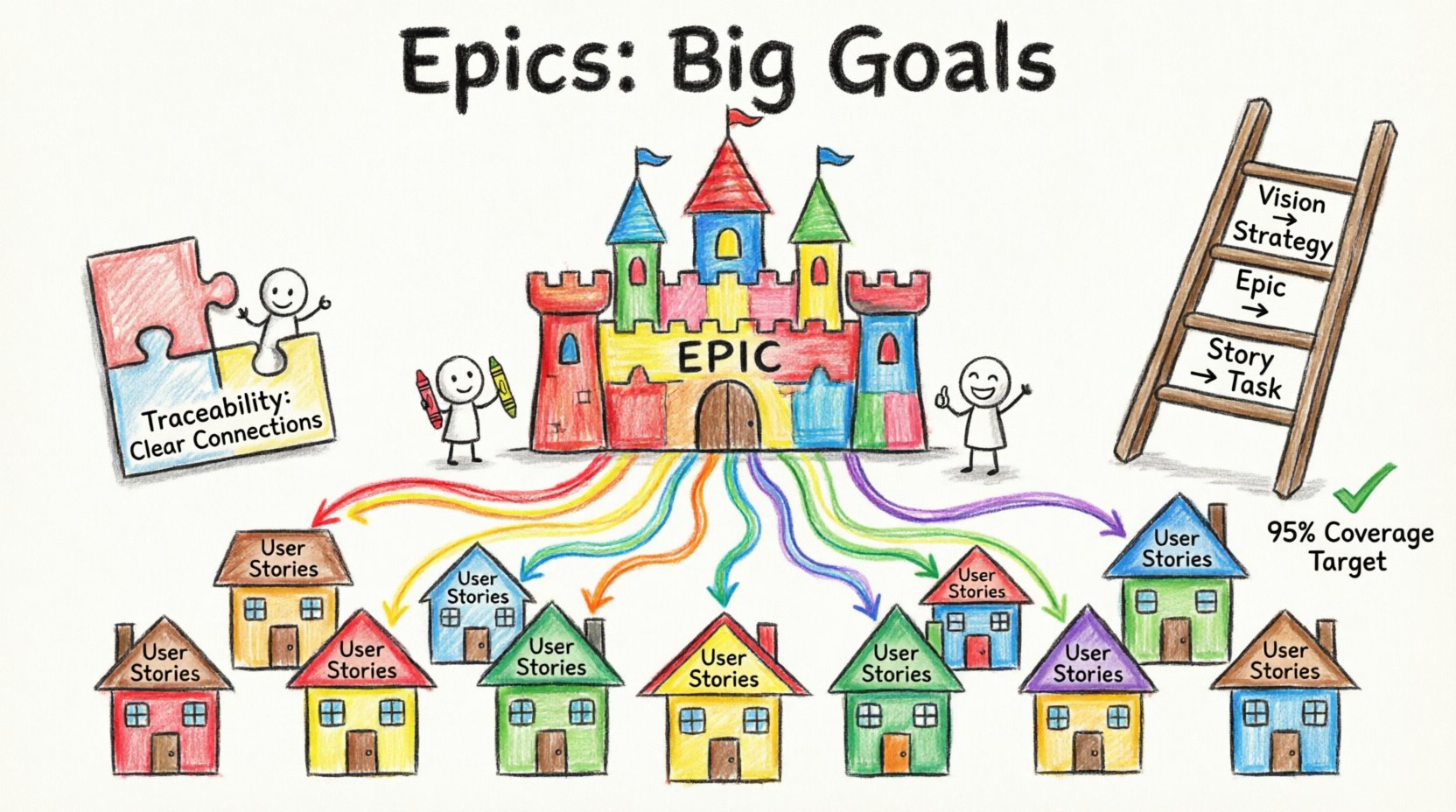
In modern software development and project management, the ability to trace requirements from high-level goals down to specific implementation tasks is critical. This guide explores the mechanics of connecting Epics to User Stories. It ensures that every piece of work contributes directly to the broader vision. Without this link, teams risk building features that do not solve actual problems. Clear traceability provides visibility, accountability, and a structured path for delivery.
This document outlines the principles, processes, and best practices for maintaining a robust hierarchy. We will examine how to structure your backlog, manage relationships, and measure the health of your requirements. The goal is to create a system where change is managed effectively, and value is delivered consistently.
🧱 Understanding the Hierarchy: Epics and Stories
Before establishing connections, it is vital to define the components involved. A clear understanding of what constitutes an Epic versus a User Story prevents confusion during planning and execution.
- Epics: These represent large bodies of work that are too big to be completed in a single iteration or sprint. They often span multiple teams or release cycles. An Epic typically aligns with a strategic initiative or a major feature area.
- User Stories: These are smaller, discrete units of work that deliver value to the end user. They are written from the perspective of the user and are small enough to be completed within a single sprint.
Key Differences at a Glance
| Feature | Epics | User Stories |
|---|---|---|
| Size | Large, multi-release | Small, single sprint |
| Focus | Strategic Outcome | Tactical Value |
| Duration | Weeks to Months | Hours to Days |
| Ownership | Product Owner / Leadership | Development Team / PO |
When you connect these two elements, you create a lineage. This lineage allows stakeholders to understand how a specific line of code relates to a business objective. It bridges the gap between strategy and execution.
🔗 The Importance of Traceability
Traceability is not just about linking tickets. It is about maintaining context. When requirements are siloed, changes in one area can have unintended consequences elsewhere. Connecting Epics to User Stories mitigates these risks.
Why Linking Matters
- Scope Management: It becomes easier to identify when a story is out of scope for its parent Epic. If a story does not contribute to the Epic’s goal, it should be questioned.
- Impact Analysis: If an Epic is modified or cancelled, you can quickly identify all dependent User Stories that need to be addressed. This prevents wasted effort on obsolete features.
- Progress Reporting: Stakeholders can see the completion percentage of an Epic based on the status of its child stories. This provides a realistic view of delivery timelines.
- Value Alignment: It ensures that the team is working on the right things. Every story should answer the question: “Does this help achieve the Epic?”
- Compliance and Audit: In regulated industries, proving that software features meet specific requirements is mandatory. Traceability provides the necessary evidence.
🛠️ Best Practices for Establishing Links
Creating a connection is a deliberate act. It requires discipline and consistency from the product team. The following practices ensure that the hierarchy remains clean and useful over time.
1. Define the Epic Before Breaking Down Stories
Do not wait until stories are being created to define the parent Epic. Start with the goal. Write the Epic first, clearly stating the problem being solved and the expected outcome. Only after the Epic is established should the team begin breaking it down.
- Write the Epic description with clear success criteria.
- Ensure the Epic has a defined owner.
- Set a rough timeline or target release for the Epic.
2. Use Standardized Naming Conventions
Consistency aids searchability and clarity. If Epic names vary wildly, finding related stories becomes difficult. Adopt a naming convention that includes the initiative name or ID.
- Example: Instead of “Login Feature,” use “AUTH-101: Secure Login System.”
- Example: Instead of “Fix button,” use “AUTH-101: Fix Login Button Layout.”
3. Validate Story Completeness
A User Story should not be so large that it cannot be finished in a sprint. If a story feels like an Epic, it needs to be split. However, it must remain linked to the original Epic. Splitting a story creates a child relationship, but the top-level Epic connection remains.
4. Maintain the Link During Refinement
Links are often broken when stories are moved between sprints or projects. Ensure that the relationship is preserved during backlog refinement sessions. If a story is moved to a different Epic, update the parent field immediately.
🚨 Common Pitfalls to Avoid
Even with the best intentions, teams often fall into traps that degrade the quality of traceability. Recognizing these patterns early helps maintain a healthy backlog.
Orphan Stories
These are User Stories that exist without a parent Epic. They often creep in during sprint planning as “quick fixes” or “technical debt” items. While necessary, they dilute the strategic focus.
- Solution: Create a “Technical Debt” Epic to house these items. This keeps them visible but distinct from feature work.
- Rule: Every story should have a parent, even if the parent is a general maintenance category.
Over-Splitting
Breaking work down too finely can destroy the context. If a story is too small, it might lose the narrative of what it is trying to achieve within the Epic.
- Indicator: If a story takes less than 2 hours to complete, it might be too granular.
- Solution: Group small tasks into a cohesive story that delivers a functional piece of the Epic.
Stale Epics
Epics that sit in the backlog for months without progress become irrelevant. They accumulate stories that may no longer be valid.
- Strategy: Review Epics quarterly. Archive or close those that are no longer aligned with business goals.
- Communication: Notify stakeholders before closing an Epic to explain why it is being retired.
One-to-Many Confusion
While a Story usually belongs to one Epic, some systems allow multiple parents. This can create ambiguity about ownership and priority.
- Recommendation: Stick to a single-parent hierarchy for clarity. If a story serves two Epics, consider splitting it into two distinct stories.
📈 Measuring Traceability Health
How do you know if your linking process is working? You need metrics that reflect the integrity of your backlog. Tracking these numbers helps identify bottlenecks or gaps in planning.
Traceability Coverage
This metric calculates the percentage of User Stories that are linked to an Epic.
- Target: Aim for 95% or higher coverage.
- Implication: If coverage is low, it indicates that work is being done without strategic alignment.
Epic Completion Rate
This measures how many Epics are fully closed versus how many are active.
- High Completion: Suggests good planning and execution.
- Low Completion: Suggests scope creep or inability to finish large initiatives.
Velocity Consistency
When stories are well-defined within Epics, velocity should stabilize. Large fluctuations often indicate that stories are not properly linked or scoped.
- Observation: If velocity drops suddenly, check if recent stories were linked to the wrong Epic.
🔄 Managing Changes Over Time
Requirements change. The market shifts. Technology evolves. A static hierarchy is a brittle one. You need a process to handle changes without breaking the traceability chain.
When an Epic Changes
If the goal of an Epic shifts, the stories within it must be re-evaluated. Some stories may become obsolete. Others may need to be rewritten.
- Step 1: Notify the team of the change in Epic scope.
- Step 2: Review all child stories against the new definition.
- Step 3: Update the status or move stories to a different Epic if they no longer fit.
When a Story Changes
Sometimes a story is found to be incorrect or insufficient. This often happens during development.
- Validation: Does the new requirement still fit the Epic? If not, does the Epic need to be updated?
- Documentation: Record the reason for the change in the history of the story.
🤝 Collaboration Across Teams
In large organizations, one Epic might span multiple teams. Traceability becomes even more critical in this scenario to prevent integration issues.
Shared Epics
When multiple teams work on parts of the same Epic, they need a shared understanding of the parent goal.
- Sync Meetings: Hold regular alignment meetings to discuss Epic progress.
- Unified Board: Use a view that aggregates stories from all teams under the Epic title.
- Dependency Mapping: Clearly mark which stories depend on other teams’ work.
Integration Points
Traceability helps identify integration risks early. If Team A’s story is a dependency for Team B’s story, the Epic view makes this visible.
- Identify: Look for stories that block others.
- Resolve: Prioritize dependency stories to ensure the flow of work.
📝 Maintaining Documentation
The system of links is only as good as the information attached to it. Documentation must be kept current to remain useful.
Acceptance Criteria Alignment
The Acceptance Criteria (AC) for a User Story should reflect the requirements defined in the Epic. There should be no contradiction between the two.
- Check: Read the Epic goal, then read the Story AC. Do they tell the same story?
- Update: If the Epic goal changes, the AC must be updated immediately.
History Logs
Keep a record of why links were created or broken. This is vital for audits and for new team members to understand the history of the work.
- Log Entry: “Moved Story X from Epic Y to Epic Z due to scope change on [Date].”
- Log Entry: “Created Epic Y to track the migration of Legacy System Z.”
🌟 Summary of Key Actions
To maintain effective traceability between Epics and User Stories, follow this checklist:
- ✅ Define Epics before breaking down Stories.
- ✅ Ensure every Story has a parent Epic.
- ✅ Review links during sprint planning and refinement.
- ✅ Archive Epics that are no longer active.
- ✅ Update Acceptance Criteria when Epic goals shift.
- ✅ Monitor traceability coverage metrics regularly.
- ✅ Train new team members on the hierarchy structure.
- ✅ Avoid orphan stories by creating a “Miscellaneous” Epic if needed.
By adhering to these practices, you create a transparent environment where work is meaningful. Teams can focus on delivery without losing sight of the business value. The connection between strategy and execution becomes seamless, allowing for agile responses to change while maintaining structural integrity.
Traceability is not a one-time setup. It is a continuous discipline. It requires attention, maintenance, and a commitment to clarity. When done correctly, it transforms a chaotic backlog into a coherent roadmap. It turns a list of tasks into a plan for success.