

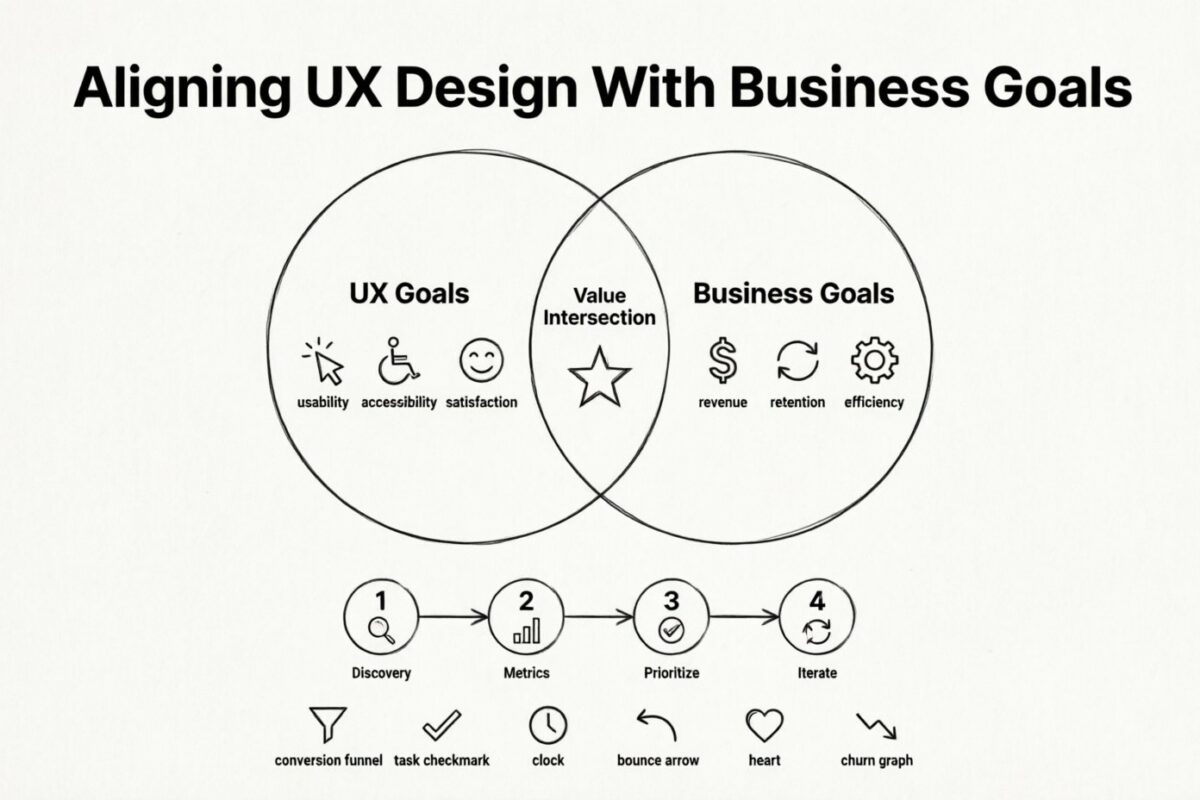
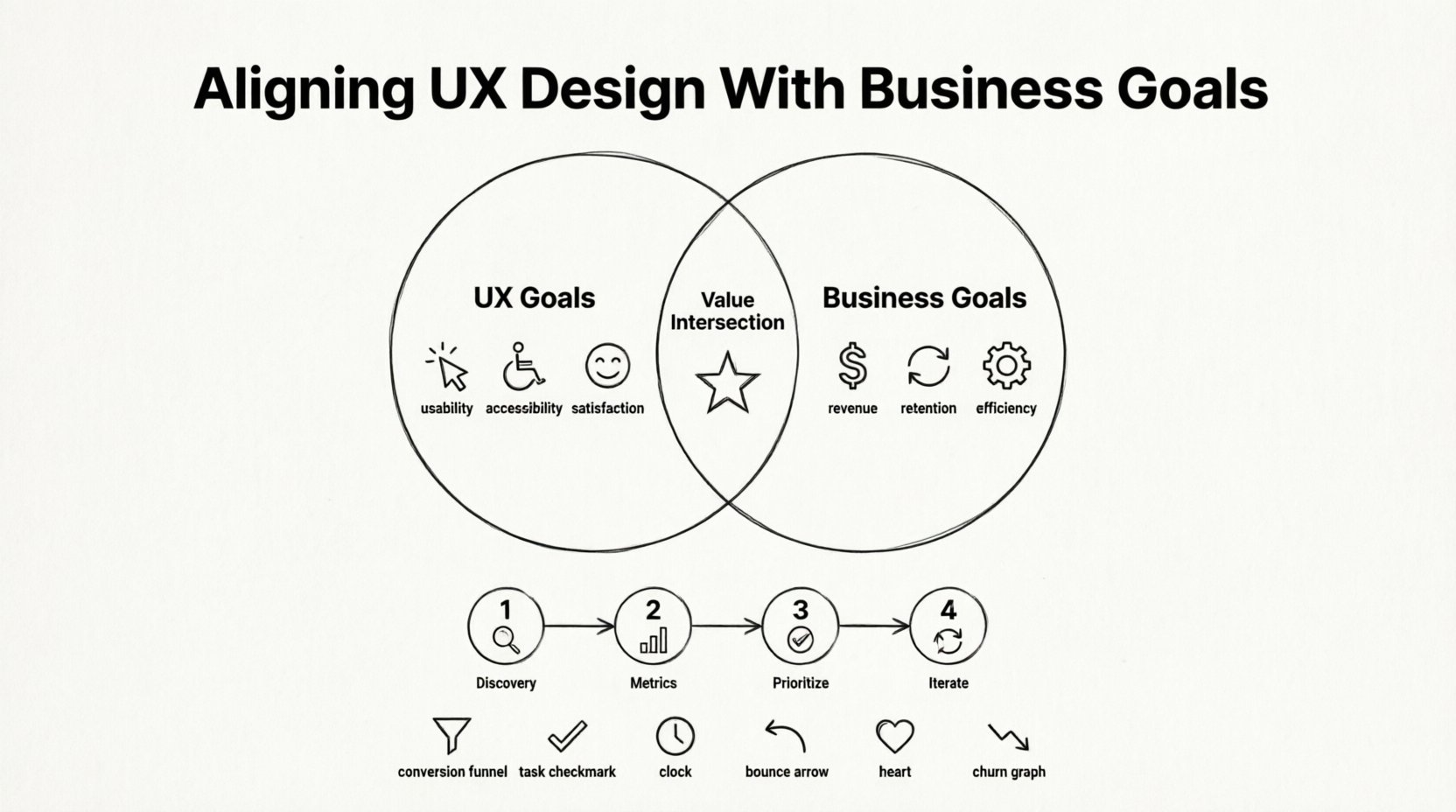
Design and business often speak different languages. Designers focus on user needs, flow, and aesthetics. Business stakeholders focus on revenue, efficiency, and market share. When these two groups do not communicate effectively, projects stall, budgets run dry, and products fail to meet expectations. The solution lies in alignment. This guide provides a clear path to harmonize user experience (UX) design with organizational objectives without sacrificing user satisfaction.
By understanding the core drivers of both sides, you can create digital products that are not only usable but also profitable. This is not about choosing one over the other. It is about finding the intersection where user value meets business value.
Understanding the Core Objectives 🏢
To align design with business, you must first understand what the business is trying to achieve. Business goals are typically measurable outcomes that contribute to the organization’s success. They are often tied to financial performance or operational efficiency.
1. Revenue Generation 💰
For many organizations, the primary goal is to increase income. This can come from direct sales, subscriptions, or advertising revenue. In the context of UX, this translates to conversion optimization. Every button click, form submission, and page view contributes to the revenue funnel.
- E-commerce Sales: Reducing friction in the checkout process.
- SaaS Subscriptions: Simplifying the sign-up flow to increase trial-to-paid conversions.
- Lead Generation: Making contact forms easy to complete to capture potential client information.
2. Customer Retention 🔄
Acquiring a new customer is often more expensive than keeping an existing one. Retention goals focus on keeping users engaged over time. A product that frustrates users will see high churn rates.
- Repeat Usage: Designing features that encourage daily or weekly interactions.
- Loyalty Programs: Integrating rewards that motivate continued engagement.
- Support Reduction: Creating intuitive interfaces that reduce the need for customer service calls.
3. Operational Efficiency ⚙️
Internal tools and enterprise software often have efficiency as the main goal. The business wants employees to complete tasks faster with fewer errors. UX here means reducing cognitive load and streamlining workflows.
- Task Completion Time: How quickly can a user finish a job?
- Error Rates: How often does the user make a mistake?
- Training Costs: How easy is it for a new hire to learn the system?
Defining User Experience Goals 🧩
While business goals look outward at the market, UX goals look inward at the user. A successful product must serve the human interacting with it. If the user struggles, the business loses.
1. Usability 🛠️
Usability is the foundation of good UX. It refers to how easy and efficient it is to use a product. If a user cannot find the button they need, the best design in the world fails.
- Learnability: Can a new user accomplish basic tasks the first time they encounter the design?
- Efficiency: Once the user has learned the design, how quickly can they perform tasks?
- Memorability: If the user has not used the system for a while, can they easily remember how to use it?
2. Accessibility ♿
Accessibility ensures that people with disabilities can use the product. This is not just a legal requirement in many regions; it is a moral obligation that expands your potential market reach.
- Visual Impairments: Using proper contrast ratios and screen reader compatibility.
- Motor Impairments: Ensuring interactive elements are large enough and keyboard navigable.
- Cognitive Load: Using clear language and predictable layouts to aid understanding.
3. User Satisfaction 😊
Even if a task is completed, the user should feel good about the experience. Satisfaction is subjective but measurable through feedback. Happy users become advocates.
- Emotional Response: Does the product feel trustworthy and professional?
- Perceived Value: Does the user feel the time spent was worth the outcome?
- Net Promoter Score (NPS): A metric for measuring the likelihood of users recommending the product.
Bridging the Gap: The Alignment Framework 🌉
Alignment does not happen by accident. It requires a deliberate strategy to translate business requirements into design decisions. The following framework helps map business goals to UX tactics.
Step 1: Discovery and Research 🔍
Before drawing a single line, understand the business context. Ask stakeholders about their KPIs. What does success look like for them? Simultaneously, conduct user research to understand the audience. What are their pain points?
Step 2: Define Success Metrics 📊
Create a shared vocabulary. Instead of saying “make it look better,” say “increase the click-through rate by 10%.” This moves the conversation from subjective preference to objective data.
Step 3: Prioritize Features 🏗️
Not every feature can be built at once. Use a prioritization matrix to decide what to build first. Focus on features that deliver high value to both the user and the business.
Step 4: Iterate Based on Data 🔄
Launch a minimum viable product (MVP) or a prototype. Measure performance against the defined metrics. Use the data to refine the design. This cycle of build-measure-learn ensures continuous improvement.
Key Metrics and KPIs for Alignment 📈
Measuring success is critical. You need to track specific indicators that reflect both business and UX health. The table below outlines common metrics and how they relate to both perspectives.
| Metric | Business Impact | UX Impact |
|---|---|---|
| Conversion Rate | Directly impacts revenue and ROI. | Indicates how well the flow supports the user’s goal. |
| Task Success Rate | Reduces support costs and increases efficiency. | Measures if users can complete their intended actions. |
| Time on Task | Faster completion means higher throughput. | Reflects the efficiency and intuitiveness of the interface. |
| Bounce Rate | High bounce rates mean lost traffic opportunities. | Suggests the landing page did not meet user expectations. |
| Customer Satisfaction (CSAT) | Higher satisfaction leads to repeat business. | Measures the user’s emotional response to the product. |
| Churn Rate | Directly affects long-term profitability. | Indicates long-term usability or value issues. |
Stakeholder Communication Strategies 🗣️
One of the biggest challenges in alignment is communication. Designers must learn to speak the language of business, and business leaders must learn to appreciate design principles. Here is how to bridge that gap.
1. Speak in Data, Not Opinions 📉
Avoid saying “I think this button should be blue.” Instead, say “Testing shows that blue buttons have a 5% higher click rate than red ones in this context.” Data removes emotion and bias from the discussion.
2. Connect Design to Revenue 💵
When proposing a change, explain the financial implication. If you suggest adding a feature, estimate how much it might cost to develop versus how much value it brings. If you suggest removing a step in checkout, estimate the potential increase in sales.
3. Use Visual Prototypes 🖼️
Text can be misinterpreted. A clickable prototype allows stakeholders to experience the flow before it is built. This prevents misunderstandings about functionality and saves development time.
4. Set Realistic Expectations ⏱️
Be honest about timelines and resources. Overpromising leads to disappointment. Explain the trade-offs involved. For example, “We can achieve this high level of animation, but it may impact load times on mobile devices. We need to decide which is more important.”
Common Obstacles and Solutions 🚧
Even with a clear plan, obstacles will arise. Being prepared for these issues helps maintain alignment throughout the project lifecycle.
1. Scope Creep 📏
Stakeholders often want to add features after the project has started. This delays launch and increases costs.
- Solution: Stick to the initial requirements document. If a new feature is requested, evaluate it against the original goals. If it does not align, defer it to a future iteration.
2. Subjective Feedback 😠
Stakeholders often give feedback based on personal taste rather than user data. “I don’t like the color.”
- Solution: Politely redirect the conversation. Ask if there is data supporting this preference or if there are specific user pain points this design is causing. If no data exists, refer back to the project goals.
3. Resource Constraints 💸
Budgets and time are always limited. You cannot do everything perfectly.
- Solution: Prioritize ruthlessly. Identify the “must-haves” versus the “nice-to-haves.” Focus on the core user journey that drives the main business goal. Simplify the scope to fit the budget.
Step-by-Step Implementation Plan 🚀
Ready to start? Follow this practical sequence to align your next project.
Phase 1: Preparation
- Identify Stakeholders: Who makes the decisions? Who provides the budget?
- Define Business Goals: Get a written document outlining targets (e.g., increase sales by 15%).
- Conduct User Research: Interview users, analyze data, and create personas.
Phase 2: Strategy
- Map Goals: Create a document linking business goals to UX tasks.
- Select Metrics: Agree on how success will be measured.
- Define Scope: Outline what is in and out of scope for this phase.
Phase 3: Design and Development
- Wireframing: Create low-fidelity sketches to test layout ideas.
- Prototyping: Build interactive models for testing.
- Usability Testing: Observe real users interacting with the prototype.
- Development: Hand off designs to the engineering team with clear specifications.
Phase 4: Launch and Review
- Soft Launch: Release to a small group to catch errors.
- Monitor Metrics: Track the agreed-upon KPIs.
- Gather Feedback: Collect user and stakeholder feedback.
- Iterate: Plan the next round of improvements based on data.
Maintaining Alignment Over Time 📅
Alignment is not a one-time event. Business goals change as the market shifts. User needs evolve over time. To stay aligned, you must maintain a continuous feedback loop.
Regular Check-ins 🤝
Schedule monthly or quarterly meetings with stakeholders to review performance. Discuss what worked, what did not, and if the original goals have changed.
Continuous Research 🧪
Do not stop testing after launch. Run A/B tests, surveys, and usability studies regularly. New data might reveal that a previous assumption was incorrect.
Documentation 📝
Keep all decisions documented. Why was a specific design chosen? What data supported it? This creates a history that helps new team members understand the context and prevents circular arguments.
Final Thoughts on Design Strategy 🧠
Aligning UX design with business goals is a skill that grows with practice. It requires empathy for the user and respect for the business reality. When these two forces work together, the result is a product that is both useful and viable.
Start small. Pick one project and apply these principles. Measure the results. Share the wins with your team. Over time, the culture of alignment will become the norm rather than the exception. This approach ensures longevity, profitability, and user satisfaction.
Remember, the best designs are those that solve real problems for real people while helping the organization achieve its mission. Keep the conversation open, stay data-driven, and focus on value. That is the path to sustainable success.