

The landscape of user experience design is shifting at a velocity that feels less like a steady march and more like a sprint through a minefield. Every week, a new pattern emerges. Every month, a new interaction model gains traction. Every quarter, a major conference promises to redefine the future of interfaces. For a designer, staying current is not optional; it is a baseline expectation. Yet, the cost of this constant vigilance is often paid in cognitive fatigue and creative exhaustion.
Many professionals find themselves scrolling through endless feeds, bookmarking tutorials they never watch, and feeling a persistent sense of inadequacy when they cannot apply every new concept immediately. This phenomenon is not merely about workload; it is about the psychological burden of perpetual learning. The goal is not to know everything, but to know what matters and to sustain your career without sacrificing your well-being.
This guide offers a framework for maintaining professional relevance while protecting your mental health. We will explore strategies for filtering noise, establishing sustainable learning habits, and recognizing that rest is a critical component of design excellence. By adopting these practices, you can navigate the evolution of the industry with clarity and purpose.
The Psychology of Information Overload 📉
Before implementing any strategy, it is vital to understand the mechanism behind the stress. The design community operates on a cycle of rapid validation. When a new technique is released, it is immediately celebrated, dissected, and often overused. This creates a feedback loop where relevance is tied to recency.
When you feel the urge to consume every piece of content available, you are often reacting to a fear of obsolescence. This fear is valid but often misdirected. The core principles of user experience—usability, accessibility, empathy, and problem-solving—have remained relatively stable for decades. What changes are the tools and the specific visual manifestations of these principles.
Key factors contributing to burnout in this context include:
- Notification Fatigue: Constant pings from social platforms disrupt deep work states.
- Comparison Culture: Viewing curated portfolios of peers and assuming they know more than you.
- Sunk Cost Fallacy: Investing time in learning a trend that may not be applicable to your current role.
- Identity Fusion: Tying self-worth entirely to professional output and trend awareness.
Recognizing these triggers allows you to step back. You are not a machine designed to ingest data; you are a creative professional designed to solve problems. The value you provide comes from your judgment, not your ability to recall the latest animation library.
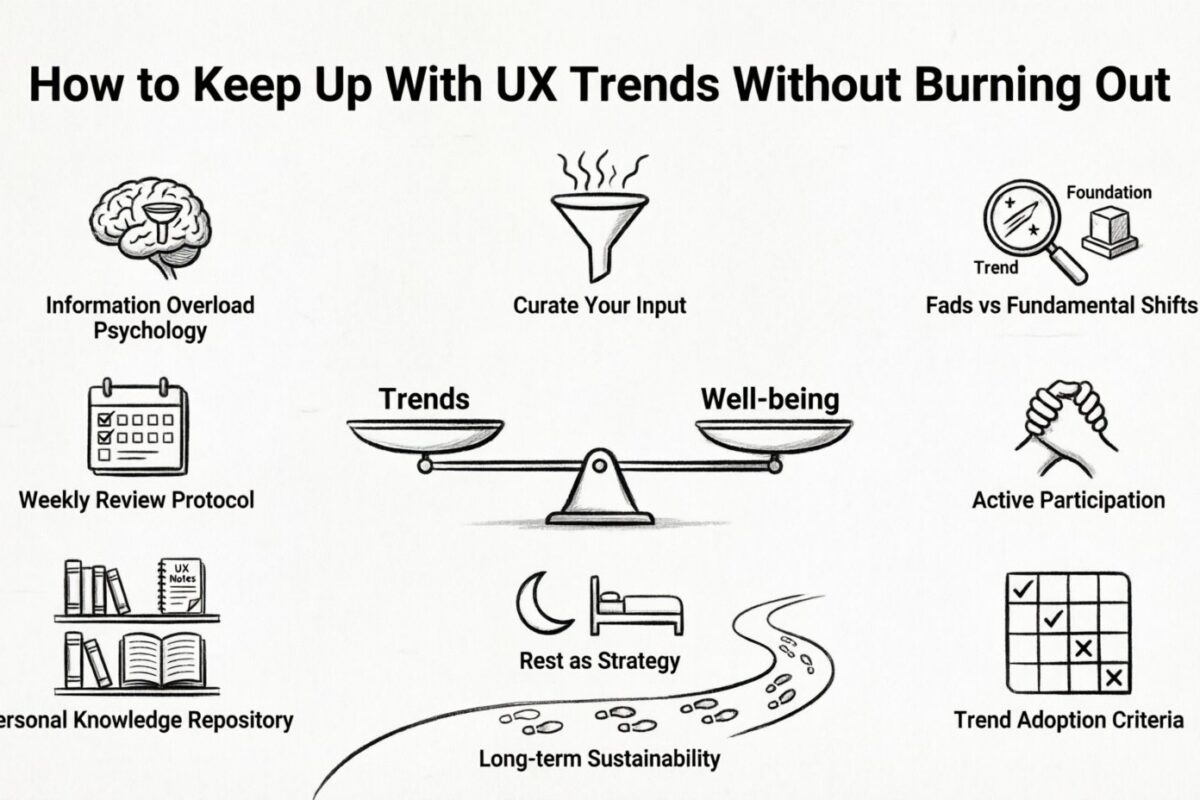
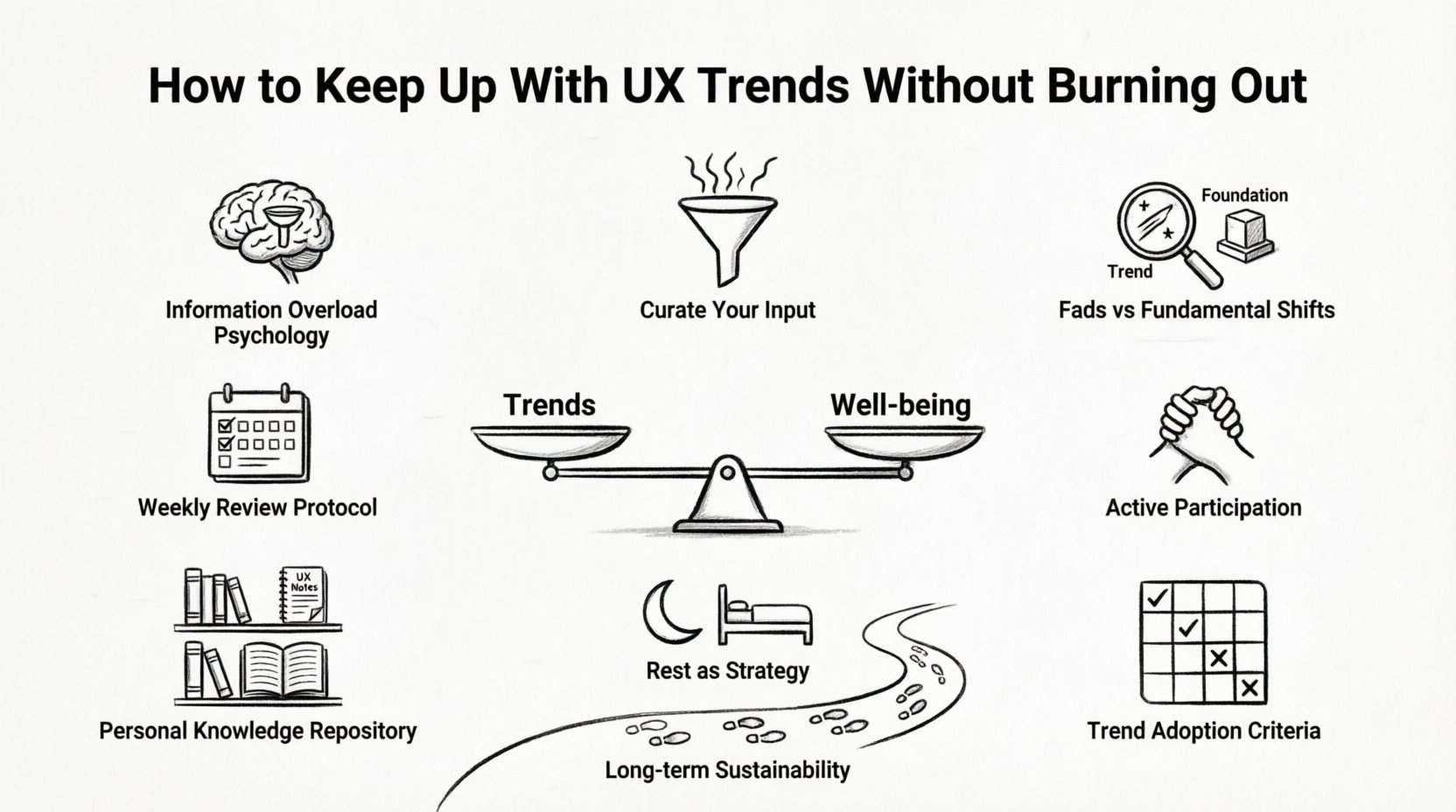
Distinguishing Fads from Fundamental Shifts 📊
Not all changes are created equal. Some shifts represent genuine advancements in how humans interact with digital systems, while others are aesthetic cycles that will pass as quickly as they arrived. Differentiating between the two is the first line of defense against burnout.
Fads are often driven by novelty. They might involve a specific visual style, a gimmicky interaction, or a buzzword that dominates conversation for a season. Examples include specific color palettes that become ubiquitous or micro-interactions that add little functional value. Adopting these requires energy that yields diminishing returns.
Fundamental Shifts are driven by technology, behavior, or accessibility requirements. These are changes that alter the baseline of expectation. For instance, the move toward mobile-first design was not a trend; it was a necessity driven by device adoption. Similarly, the integration of voice interfaces or the emphasis on dark mode accessibility are driven by user needs and hardware capabilities.
To evaluate a new concept, ask these questions:
- Does this solve a user problem that was previously unsolvable?
- Is this driven by a change in user behavior or hardware capability?
- Will this standard likely persist for at least two to three years?
- Does this align with the core values of accessibility and inclusivity?
If the answer is no, you can safely ignore it without guilt. This filter saves hours of research time and preserves mental energy for projects that truly matter.
Curating Your Input Stream 🎧
Most designers consume information reactively. They wait for their feed to deliver content. This passive approach is inefficient and overwhelming. Instead, you must take an active role in constructing your information diet. This process involves auditing your sources and removing those that generate anxiety rather than insight.
Reduce the Noise Limit the number of newsletters you subscribe to. If a newsletter requires you to click through to read the full story, it is likely too long. Aim for curated summaries that highlight key points. If you find yourself opening a link and closing it after ten seconds, unsubscribe immediately.
Select High-Signal Sources Seek out writers and researchers who focus on the underlying mechanics of design rather than just the surface-level output. Look for content that discusses case studies with data, critiques of existing systems, and deep dives into cognitive psychology. These sources provide context that allows you to understand the “why” behind the “what”.
Define Your Boundaries Set specific times for consumption. For example, dedicate the first 30 minutes of your day to reading industry news, but do not check any design content after 7 PM. This separation ensures that your downtime remains truly restorative. It signals to your brain that learning time is over and recovery time has begun.
The Weekly Review Protocol ⏱️
Information retention is difficult when learning is sporadic. A weekly review session allows you to consolidate what you have learned and decide what to discard. This structured approach prevents the accumulation of hundreds of open tabs and unread articles.
During this session, perform the following actions:
- Archive Saved Items: Review bookmarks and saved posts. If you have not opened them in a month, delete them. This action alone frees up significant mental space.
- Identify Patterns: Look at the last seven days of content. Are you seeing the same concept repeated? If so, you have already identified the trend without needing to read every variation.
- Plan Experiments: Select one small concept to test in a personal project or a low-risk work scenario. This moves learning from passive to active.
- Document Insights: Write a brief note on what you learned. Writing forces clarity and helps you remember the core takeaway.
This protocol transforms learning from a chaotic task into a manageable routine. It ensures that you are not just collecting information, but processing it.
Active Participation vs. Passive Consumption 🤝
There is a distinct difference between consuming content and engaging with the community. Passive consumption involves reading articles or watching videos without interaction. Active participation involves discussion, critique, and creation.
While community engagement is valuable, it can be a source of burnout if not managed. Social media interactions can become competitive rather than collaborative. To maintain balance:
- Focus on Quality: Prioritize one or two high-quality communities over many scattered forums.
- Contribute Strategically: Share your own insights only when you have something substantive to add. Avoid the pressure to post daily.
- Seek Mentorship: Find a peer or mentor who can provide guidance. This reduces the need to seek answers from random online sources.
- Limit Screen Time: Engage in discussions offline or via voice when possible. Text-based arguments can be draining.
By shifting from consumption to contribution, you gain a sense of agency. You stop feeling like a spectator in the industry and start seeing yourself as a participant. This shift changes the dynamic from “I need to catch up” to “I have something to offer”.
Building a Personal Knowledge Repository 📚
External platforms are unstable. Links rot, accounts get deleted, and algorithms change. Relying solely on third-party sites for your knowledge base is risky. Building a personal system ensures that your insights are preserved regardless of external changes.
This repository does not need to be complex. It simply needs to be a place where you store your own thoughts, not just other people’s content. Consider the following structure:
- Concepts: Definitions and explanations of core UX principles.
- Patterns: Examples of interface patterns you find effective, with notes on why they work.
- Resources: Links to high-quality tools and documentation that you have vetted.
- Reflections: Notes on your own projects and what you learned from them.
When you build this system, you reduce the need to search for the same information repeatedly. You create a single source of truth for your professional practice. This reduces cognitive load because you are not searching; you are retrieving.
Trend Adoption Decision Matrix
To assist in the decision-making process regarding new trends, use the following matrix to evaluate potential learning investments. This table helps visualize the trade-offs.
| Factor | High Priority (Adopt) | Low Priority (Ignore) |
|---|---|---|
| Relevance | Directly impacts current user needs or business goals. | Only applicable to a niche audience or specific visual style. |
| Maturity | Technology or method is stable and supported. | Experimental, buggy, or in early beta stages. |
| Time Cost | Learning curve is reasonable relative to benefit. | Requires weeks of training for minimal impact. |
| Impact | Improves accessibility, efficiency, or satisfaction. | Primarily aesthetic with no functional gain. |
| Longevity | Expected to remain relevant for 18+ months. | Expected to fade within 6 months. |
Use this matrix to objectively assess new information. If a trend scores low on most factors, you can confidently decide not to invest time in it. This objectivity removes the emotional weight of saying “no” to new opportunities.
Rest as a Strategic Necessity 🛌
Rest is often viewed as the opposite of work. In the context of design, rest is a prerequisite for high-quality output. Cognitive fatigue leads to poor judgment, which leads to designs that fail to meet user needs. Therefore, scheduling rest is not a luxury; it is a professional obligation.
Effective rest strategies include:
- Digital Detox: Spend time away from screens. Engage in activities that do not involve visual processing, such as hiking, cooking, or woodworking.
- Sleep Hygiene: Ensure adequate sleep to consolidate memory and process information. Design problems often solve themselves after a night of rest.
- Hobbies: Maintain interests outside of design. This provides a mental break and often sparks creativity by exposing you to different systems.
- Boundaries: Do not check work communications after hours. Establish clear expectations with your team regarding availability.
When you prioritize rest, you protect your creative capacity. You ensure that when you return to work, you are sharp and focused. This consistency is more valuable than sporadic bursts of intense productivity.
Long-Term Career Sustainability 🌱
The design industry will continue to evolve. New tools will emerge, and old ones will fade. The designers who thrive over the long term are not those who know every tool, but those who understand how to learn. They possess the resilience to adapt without breaking.
Focus on building skills that are transferable. Critical thinking, empathy, research methodology, and communication are skills that apply regardless of the interface. These are the foundations that will support you through any shift in technology.
By managing your learning habits and protecting your well-being, you ensure that your career has longevity. You avoid the trap of being a “trend chaser” and instead become a “design thinker.” This distinction defines your professional identity and secures your place in the industry.
Remember that your value lies in your ability to solve problems, not in your ability to replicate the latest aesthetic. Keep your standards high, but keep your expectations of yourself reasonable. The industry will wait for you. You do not need to run to catch it; you only need to walk steadily forward.