

Design is often treated as a purely logical exercise. We measure conversion rates, analyze heatmaps, and optimize click paths. However, users are not logical machines; they are human beings driven by emotion, memory, and narrative. When we design without a story, we risk creating interfaces that function perfectly but feel cold or disconnected. Storytelling in UX is not about writing fiction; it is about structuring the user experience so that the interaction feels inevitable and meaningful.
This guide explores how to frame problems and solutions using narrative structures. By understanding the psychology of storytelling, designers can create experiences that resonate deeply with users and communicate value clearly to stakeholders. We will move beyond feature lists and into the realm of user transformation.
🧠 Why Design Needs Narrative
The human brain is wired for stories. Neuroscientific research suggests that when we hear a narrative, our brains do not just process language; they simulate the experience. If a story describes an action, the motor cortex lights up. If it describes a smell, the olfactory cortex activates. This is why a well-framed design problem is more memorable than a spreadsheet of metrics.
In the context of User Experience (UX), storytelling serves three critical functions:
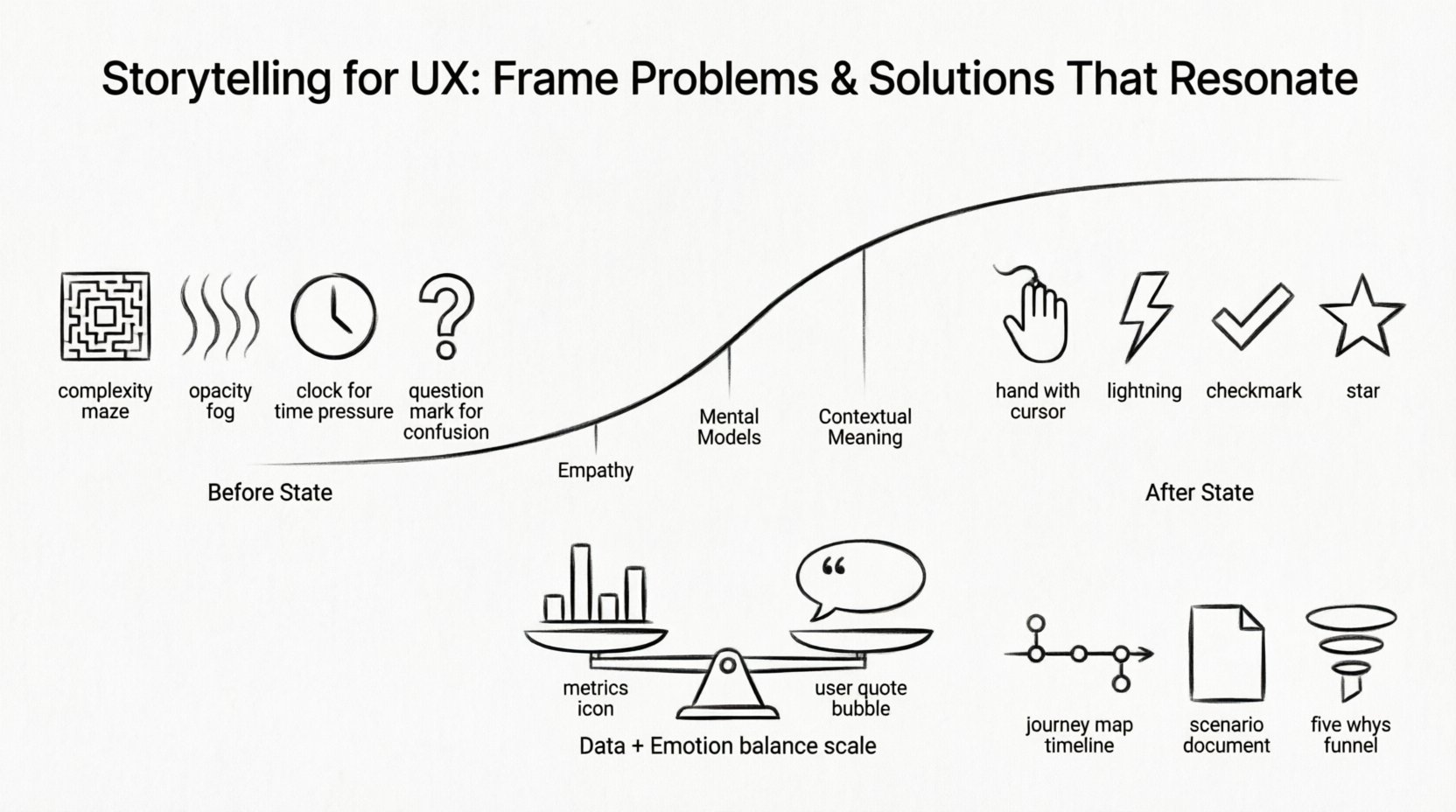
- Empathy Generation: Stories allow stakeholders to step into the user’s shoes. A dry statistic about cart abandonment is less compelling than a narrative about a frustrated user missing a gift for a loved one.
- Mental Models: Users navigate interfaces based on expectations formed by past experiences. A narrative arc aligns the interface flow with these natural mental models, reducing cognitive load.
- Contextual Meaning: Features are functional, but stories provide purpose. A button is not just a rectangle; it is a gateway to a specific outcome within the user’s larger journey.
🛑 Framing the Problem: The Conflict
Every good story requires conflict. In UX, the conflict is the problem the user faces before your solution exists. Framing this problem correctly is the foundation of a successful design narrative. If the problem is vague, the solution will feel arbitrary.
Identifying the Antagonist
In a narrative, the antagonist is the force opposing the hero. In UX, the antagonist is rarely a person. It is usually a barrier, a friction point, or a system limitation. You must identify what stands between the user and their goal.
Consider these common antagonists:
- Complexity: Too many steps to complete a task.
- Opacity: Lack of clarity on where the user is in the process.
- Time: The need to complete a task quickly in a high-stress environment.
- Confusion: Unclear terminology or navigation structures.
The Before State
To frame the problem effectively, you must describe the “Before State.” This is the reality of the user prior to your intervention. It should be detailed and specific.
Instead of saying “Users find navigation difficult,” try this:
“Sarah needs to book a flight for her family vacation. She opens the travel site, but the options are buried under promotional banners. She spends twenty minutes trying to filter by price, but the ‘sort’ button is hidden in a secondary menu. She feels anxious about missing out on a good deal and begins to doubt the platform’s reliability.”
This narrative establishes the stakes. It moves the problem from a generic usability issue to a specific emotional struggle. This clarity guides the design process significantly.
🚀 Framing the Solution: The Transformation
Once the problem is framed, the solution must be presented as the mechanism of resolution. This is not a list of features; it is the “After State.” The goal is to show the transformation the user undergoes.
The Hero’s Journey in UX
The classic Hero’s Journey structure applies well to product design. The user is the hero, the product is the guide, and the problem is the monster. The design provides the tools (features) that allow the hero to succeed.
When presenting a solution, focus on the outcome rather than the input. Do not just say “We added a filter.” Say “The filter gives the user control over the search, allowing them to find the perfect option in seconds rather than minutes.”
Key elements of a solution narrative include:
- Agency: How does the design empower the user?
- Efficiency: How much time or effort is saved?
- Relief: How is the stress or anxiety from the “Before State” resolved?
- Delight: Are there moments of positive surprise?
🗣️ Communicating to Stakeholders
Designers often struggle to get buy-in for their ideas. Stakeholders speak the language of business, while designers speak the language of interaction. Storytelling bridges this gap. It translates user needs into business value through narrative.
When pitching a design change, avoid starting with technical constraints. Start with the story of the user who is currently struggling.
The Data-Story Hybrid
Emotion without data is opinion. Data without emotion is noise. The most persuasive communication combines both.
- Start with the Human Element: Share a quote from user research or a specific scenario.
- Support with Metrics: Show how the problem impacts retention, conversion, or support tickets.
- Connect to Business Goals: Explain how solving this user problem aligns with company revenue or brand reputation.
For example, “We observed three users in a session who abandoned the checkout process at the shipping page. One user mentioned they couldn’t see the total cost upfront. This correlates with a 15% drop-off rate at this step, costing the team approximately $10,000 in monthly revenue.”
⚠️ Common Pitfalls in Design Narratives
While storytelling is powerful, it can be misused. Certain approaches dilute the message or confuse the audience.
- Over-Romanticizing: Do not invent problems that do not exist. Keep the narrative grounded in actual user research and data.
- Focusing on the Product: The story is about the user, not the company. Avoid phrases like “We built this feature.” Instead, use “This feature allows you to…”
- Lack of Structure: A story needs a beginning, middle, and end. A design presentation that jumps between features without context feels chaotic.
- Ignoring the Context: A story that works for a mobile app might not fit a desktop dashboard. Ensure the narrative matches the platform constraints.
🛠️ Practical Techniques for Narrative Structure
To build these narratives consistently, you can use specific methods and frameworks. These tools help organize thoughts before the actual design work begins.
1. User Journey Mapping as a Script
Think of a journey map as a script for a play. Each touchpoint is a scene. Each user action is a line of dialogue. When mapping, annotate the emotional state of the user at every scene. This highlights where the “crisis” points occur.
2. Scenario Writing
Write short paragraphs describing a specific moment in the user’s life. These scenarios should be specific enough that you can visualize the screen. Use the “Who, What, Where, When, Why” framework to flesh out these scenarios.
3. The “Five Whys” of Narrative
When defining a problem, ask why five times. This drills down to the root cause. If a user says “I want a faster button,” asking why reveals “I am afraid I will lose my data.” The solution then becomes a safety feature, not just a speed improvement.
📊 Integrating Data with Emotion
One of the most common challenges in UX is balancing quantitative and qualitative data. Quantitative data tells you what is happening; qualitative data tells you why. A strong narrative weaves these together.
Consider the following table which illustrates how to pair data with narrative elements:
| Data Point | Narrative Element | Example |
|---|---|---|
| High Bounce Rate | The Obstacle | “Users leave immediately because the value proposition is unclear.” |
| User Interview Quote | The Voice | “I was confused about what the next step was.” |
| Session Duration | The Struggle | “It took them an hour to find the settings menu.” |
| Feature Adoption | The Resolution | “Users who found the tool reported higher satisfaction.” |
Using this table as a reference ensures that every number in a presentation has an emotional counterpart. This makes the case for design changes much stronger.
🔄 Iterating the Story
A design narrative is not static. As you gather more feedback and test prototypes, the story evolves. This is not a weakness; it is a sign of a healthy design process.
- Validate the Premise: Does the user actually feel the way you think they do? Conduct interviews to verify the emotional stakes.
- Adjust the Climax: If the solution doesn’t resolve the conflict, the design needs to change. Perhaps the feature is too complex. Refine the resolution.
- Update the Cast: As you discover new user segments, the “hero” of your story might change. Ensure the narrative fits the new persona.
🌟 Building a Culture of Storytelling
For storytelling to work, it cannot be the job of just one designer. It must be embedded in the culture of the team. When developers, product managers, and marketers understand the narrative, they make decisions that support it.
Share the story early. Don’t wait until the final presentation. Include narrative snippets in daily stand-ups, sprint planning, and internal wikis. When everyone understands the “why,” they become advocates for the “how.”
🎨 Visualizing the Narrative
Text is not enough. Visuals play a crucial role in storytelling. A well-designed prototype is a visual story. It shows the flow, the transitions, and the feedback loops.
Use visuals to highlight the emotional arc:
- Color: Use warmer tones for moments of success and cooler tones for moments of friction.
- Typography: Bold headers for key decisions, lighter text for context.
- Motion: Smooth transitions suggest ease and flow; jerky movements suggest friction.
Remember that the visual design must reinforce the narrative you are telling verbally. If the text says “fast and efficient,” the interface should not have long loading screens.
📝 Summary of Key Principles
To summarize, effective UX storytelling requires discipline and empathy. It requires you to step back from the pixels and look at the human experience. Here are the core takeaways:
- Define the Conflict: Clearly state the problem as a user struggle.
- Focus on Transformation: Show how the user changes from the start to the finish.
- Combine Data and Emotion: Use numbers to back up the feelings.
- Align with Business: Show how the story drives value.
- Iterate the Narrative: Be willing to change the story as you learn more.
When you frame your work as a story, you move from being a service provider to a problem solver. You stop selling features and start selling outcomes. This shift changes how stakeholders view your work and how users perceive your product. It creates a connection that lasts longer than a single session.
By mastering the art of narrative, you ensure that your designs do not just work; they matter. They become part of the user’s life, helping them achieve their goals with clarity and confidence. This is the power of storytelling in UX.