

Designing user interfaces is only half the journey. The other half involves translating those visual concepts into functional code. For junior UX designers, bridging the gap between creative vision and technical implementation is one of the most critical skills to develop. This process is not just about handing off files; it is about building a partnership grounded in mutual respect and understanding.
When designers and developers work in isolation, friction arises. Missed deadlines, budget overruns, and compromised user experiences often stem from communication breakdowns. By establishing strong working relationships early in your career, you set a foundation for sustainable growth and higher quality products.
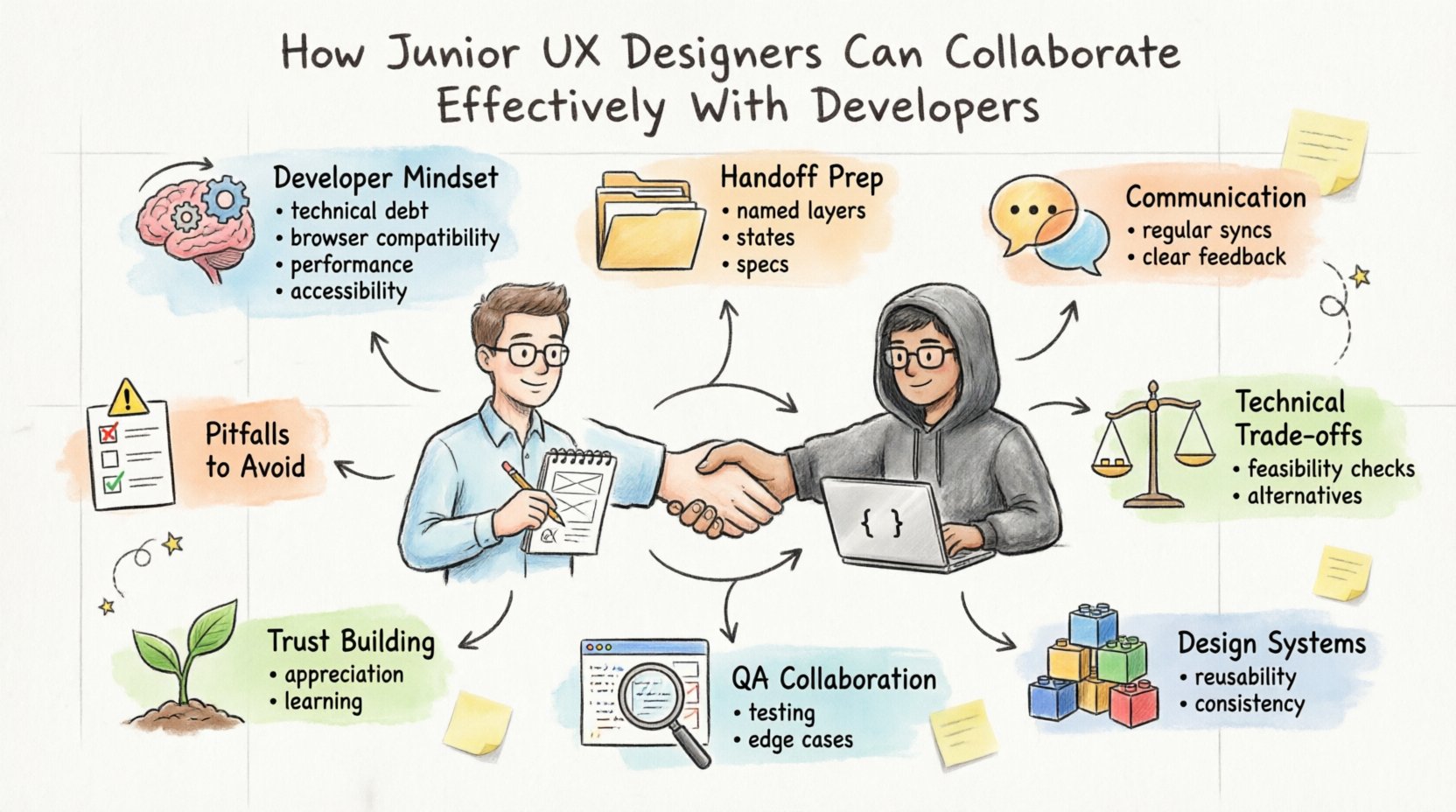
🧠 Understanding the Developer Mindset
To collaborate effectively, you must step into the shoes of the people building your designs. Developers focus on logic, structure, performance, and maintainability. They are concerned with how code scales, how the application handles edge cases, and how long it will take to build a specific feature.
Recognizing these priorities helps you anticipate questions and concerns before they become blockers.
- Technical Debt: Developers worry about writing code that is easy to modify later. Repeatedly requesting changes that require rewriting existing code can slow down progress.
- Browser Compatibility: Your design must work across different devices and screen sizes without breaking functionality.
- Performance: Heavy assets or complex animations can slow down page load times, affecting user retention.
- Accessibility: Code structure must support screen readers and keyboard navigation to meet compliance standards.
When you understand these constraints, you stop seeing developers as obstacles and start viewing them as allies who help you create viable products.
📦 Preparing for Handoff
The handoff phase is the formal transfer of design files and specifications to the development team. A disorganized handoff leads to confusion, increased back-and-forth, and delays. Preparation is key to a smooth transition.
Organizing Your Files
Ensure your design layers are named logically. A developer inspecting a file should not need to guess what a specific layer represents. Use clear naming conventions for components, states, and assets.
- Grouping: Use clear folder structures to separate screens, components, and assets.
- Labels: Name layers based on their function (e.g., “Primary Button”, “User Avatar”) rather than arbitrary names (e.g., “Rectangle 45”).
- States: Clearly define hover, active, disabled, and loading states for interactive elements.
Providing Specifications
Developers need precise measurements, color codes, and font sizes. While modern tools often provide this automatically, manual verification ensures accuracy.
- Spacing: Define margins and padding consistently using a grid system.
- Typography: Specify font families, weights, line heights, and letter spacing.
- Assets: Export images in appropriate formats and resolutions. Ensure icons are scalable vectors where possible.
- Interactions: Document animations, transitions, and micro-interactions with timing and easing details.
🗣️ Communication Protocols
Communication is the backbone of collaboration. It should be consistent, clear, and respectful. Relying solely on comments within design files is rarely enough for complex features.
Regular Syncs
Schedule regular check-ins to discuss progress and roadblocks. These meetings should be brief and focused on alignment rather than status updates alone.
- Pre-Development: Review designs together to catch potential issues before coding begins.
- Mid-Sprint: Check on implementation details to ensure the build matches the design intent.
- Post-Review: Walk through the live build to verify fidelity and functionality.
Asynchronous Updates
Not every discussion requires a meeting. Use project management platforms to track tasks and leave context-rich comments.
- Context: When leaving a comment, explain the “why” behind a request, not just the “what”.
- Clarity: Avoid vague terms like “make it pop” or “center this.” Use specific instructions.
- Attachments: Include reference images or mockups when explaining complex UI behaviors.
⚖️ Navigating Technical Trade-offs
There will be times when your design vision conflicts with technical feasibility. This is a natural part of product development. The goal is to find a solution that preserves the user experience while respecting technical limits.
Early Feasibility Checks
Involve developers in the design phase for complex interactions. They can advise on what is achievable within the current timeline and budget.
- Complex Animations: Ask if a specific motion effect is performant on mobile devices.
- Data Requirements: Ensure the necessary data points exist to support your interface elements.
- Backend Logic: Understand how data retrieval works to avoid designing interfaces that rely on unavailable information.
Proposing Alternatives
When a constraint arises, do not simply accept a reduction in quality. Work with developers to find alternative solutions that meet the same user need.
- Visual vs. Functional: If a visual effect is too heavy, focus on maintaining the functional clarity of the action.
- Simplified States: If a complex interaction is too risky, simplify the flow while keeping the core utility intact.
- Progressive Enhancement: Ensure the core experience works even if advanced features are disabled for certain users.
🧱 Design Systems and Component Libraries
Working within a design system streamlines collaboration. It ensures consistency across the product and reduces the amount of custom code developers need to write.
Benefits for Developers
- Reusability: Components built once can be used everywhere, saving development time.
- Consistency: Standardized styles reduce the cognitive load for users and maintainers.
- Scalability: New features can be assembled from existing parts rather than built from scratch.
Contribution to the System
As a junior designer, you should aim to contribute to the system responsibly. Do not create one-off components that deviate from the established guidelines unless absolutely necessary.
- Document Usage: Write clear guidelines on when and how to use specific components.
- Test Variants: Ensure all variations of a component work correctly in different contexts.
- Update Regularly: Keep your component library up to date with the latest design standards.
🔄 Testing and QA Collaboration
Quality assurance is a shared responsibility. Your involvement during the testing phase ensures that the final product aligns with your original vision.
The QA Process
- Walkthroughs: Review the built interface alongside the developer to spot visual discrepancies.
- Edge Cases: Test how the interface behaves with empty states, error messages, and limited connectivity.
- Responsive Checks: Verify that layouts adjust correctly on various screen sizes.
Feedback Loops
When issues are found, provide feedback that is constructive and actionable. Avoid pointing out problems without suggesting solutions.
- Specificity: Point to the exact element and describe the expected behavior.
- Priority: Distinguish between critical bugs and minor cosmetic adjustments.
- Documentation: Update your design files with the final state to keep the source of truth accurate.
🤝 Building Long-Term Trust
Trust is earned over time through consistent behavior and reliability. When developers trust your designs, they are more willing to invest effort in making them work.
Showing Appreciation
- Recognition: Acknowledge the hard work involved in building complex features.
- Understanding: Be patient when technical challenges arise that delay progress.
- Learning: Show interest in their work by asking about the technologies they use.
Continuous Learning
Understanding the basics of development makes you a better designer. You do not need to be a coder, but knowing how the web works helps you design more realistically.
- HTML/CSS Basics: Learn how layout boxes work and how typography is applied in code.
- JavaScript Logic: Understand how user actions trigger changes in the interface.
- APIs: Know how data is fetched and displayed to avoid designing interfaces that rely on non-existent data.
⚠️ Common Pitfalls to Avoid
Awareness of common mistakes can save you from unnecessary friction. Here are some scenarios where collaboration often goes wrong.
| ❌ What to Avoid | ✅ What to Do Instead |
|---|---|
| Surprising developers with last-minute changes | Communicate changes early and document them clearly |
| Ignoring technical constraints | Discuss feasibility during the design phase |
| Using vague feedback terms | Provide specific measurements and references |
| Designing in a vacuum | Involve developers in brainstorming sessions |
| Overlooking accessibility | Build accessibility into the design from the start |
| Blaming technical limitations for delays | Focus on solving the problem together |
🌟 Final Thoughts on Partnership
The relationship between design and development is symbiotic. Your creativity drives the vision, while their engineering expertise brings it to life. By focusing on clear communication, organized handoffs, and mutual respect, you create an environment where both disciplines thrive.
For junior designers, this partnership is a learning opportunity. Every project offers a chance to understand the technical landscape better. Embrace the challenges, ask questions, and remain open to feedback. Over time, this collaborative mindset will become second nature, leading to smoother workflows and better products for users.
Remember, the goal is not just to deliver a design, but to deliver a solution that works. When you and the development team work as a unified unit, the result is a product that is both beautiful and functional.